
Finding the Best Car Anti Theft Devices

Finding the best car anti-theft devices isn't about one magic gadget. It’s about building layers of security to stay one step ahead of today’s tech-savvy criminals. The smartest approach combines a visible deterrent like a steering wheel lock, an electronic safeguard like an aftermarket immobiliser, and a recovery tool like a GPS tracker. It's this combination that creates a real headache for thieves. At Top Motor Keys, our mobile auto locksmiths provide professional installation of these advanced systems across London, Kent, Essex, and the surrounding areas, ensuring your vehicle is properly protected.
Why Your Car Needs More Than Just a Factory Alarm
That reassuring beep from your factory alarm? It might give you peace of mind, but for a professional thief, it’s often little more than background noise. Criminals have become frighteningly good at bypassing standard systems, especially with keyless entry cars. Relying only on the alarm that came with your vehicle is a bit like using a flimsy shed padlock to guard your prized possessions.
The stats here in the UK tell a stark story. While car theft saw a small 6% dip in the first half of 2025, the bigger picture is still pretty grim. In 2024, a car was stolen every five minutes on average. What’s really worrying is that keyless entry systems are now involved in over half of all thefts (56%), according to recent UK data. You can dig into more car crime statistics on bymiles.co.uk. This isn't just a trend; it's a clear signal that a tougher, layered approach to security is no longer a luxury—it's essential.
Building a Stronger Defence
Think about how you secure your home. You probably don't just rely on the one lock built into the door handle. You might have a deadbolt, perhaps a camera, maybe an alarm. Your car deserves that same multi-layered thinking. A solid strategy uses different types of the best car anti-theft devices that work in tandem to create a formidable barrier.
This guide will walk you through the most effective layers of protection:
Physical Deterrents: These are the classic, in-your-face locks that make a thief look at your car and decide to move on to an easier target.
Electronic Security: This layer is all about the smart stuff—advanced immobilisers and alarms that actively stop the car from being started or driven away.
Recovery Systems: If the worst does happen, GPS trackers are your best bet for helping the police find and get your vehicle back fast.
A layered security approach is all about creating obstacles. The more time and effort a thief has to spend trying to steal your car, the more likely they are to give up and find an easier target.
Using Physical Locks as Your First Line of Defence
Before we get into all the high-tech gadgets, let's talk about the classics. Physical locks are often your first and best line of defence, mostly because they’re a massive visual warning. A thief is usually looking for a quick and easy score. Spotting a solid chunk of metal clamped to the steering wheel or gearstick is often all it takes for them to give up and look for an easier target.
Think of these devices less as just a physical barrier and more as psychological warfare. A brightly coloured steering lock is like a giant neon sign that screams, "This car is a pain to steal, move along!" from fifty feet away. It makes the would-be thief stop and think about the extra time, the noise they'd make, and the special tools they’d need to get past it, which ramps up their risk of getting caught.
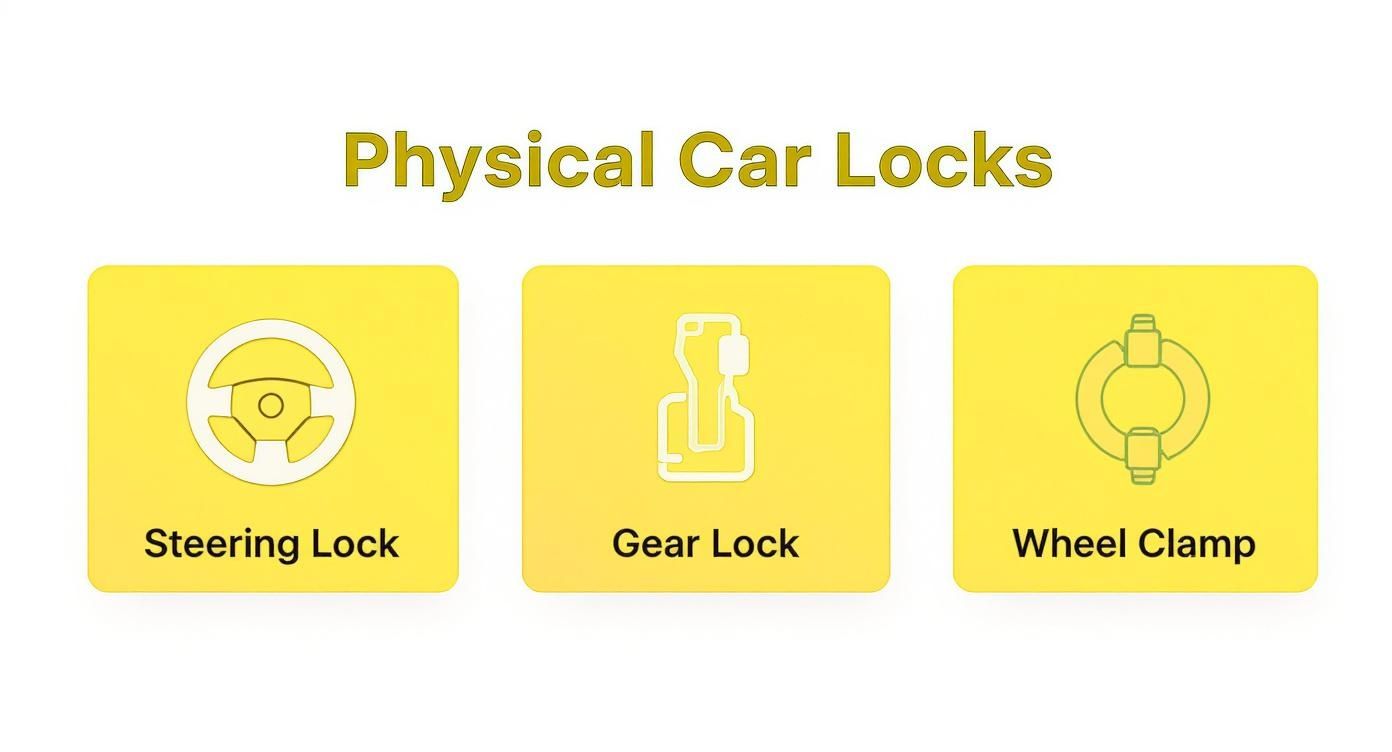
The Power of the Steering Wheel Lock
There's a good reason the steering wheel lock is the most common physical deterrent you'll see – it just works. A decent one, made from hardened steel, makes it physically impossible to turn the wheel. Even if a thief manages to get the engine running, they can't actually drive the car anywhere, which kind of defeats the whole point for them.
When you're picking one out, go for something bright. Yellow and red are popular for a reason; they stand out. The main goal here is to scare thieves off before they even touch your car. Also, make sure it's made from solid, chunky material. A flimsy lock can be snipped through in seconds. A good one should feel heavy and substantial in your hands.
Here’s a real-world story: Sarah, a commuter in Kent, came out to her car one morning and saw the driver's side door lock had been forced. But her car was still there, and nothing was missing. The only thing standing between the thief and her car was the bright yellow steering wheel lock she'd put on the night before. The police reckoned the thief probably popped the door, saw the lock, and decided it was too much hassle.
Exploring Other Physical Barriers
Steering wheel locks are brilliant, but they're not your only option. Depending on your car and where you typically park, a few other physical devices can add some seriously useful extra layers of security.
Gearstick Locks: These clamp your gearstick in place, usually in park or reverse, so a thief can't get the car into drive. They’re especially good for manual cars and create another visible obstacle for anyone peeking inside.
Wheel Clamps: If you want to go for maximum immobilisation, a wheel clamp is tough to beat. You often see them on caravans or cars left in storage, and for good reason. They are a huge visual deterrent, and their sheer bulk makes them a complete nightmare for a thief to deal with.
At the end of the day, any of these physical locks are a massive improvement over having no protection at all. They’re an affordable and effective way to start beefing up your car’s security, making it a much tougher nut for the average thief to crack.
Outsmarting Thieves with Electronic Security
While a big, chunky steering lock is a great way to put a thief off, the real battle against modern car crime is fought with electrons, not steel. Today’s car criminals aren't just opportunists with a crowbar; they’re often tech-savvy crooks using clever gadgets to bypass your car's built-in security. That's where top-tier electronic security devices come in, wrapping your vehicle in an invisible, but incredibly tough, shield.
Let's be blunt: car theft in the UK has skyrocketed. Home Office data shows a staggering 75% jump in stolen vehicles since 2015. This isn't a coincidence. It's largely down to organised gangs mastering keyless entry systems. These "relay attacks" are now behind more than half of all car thefts here, making electronic defences absolutely non-negotiable. If you want to dive deeper, you can read about the latest methods used by UK car thieves on gapinsurance123.co.uk.
Comparing Electronic Security Devices
To help you make sense of the main electronic options, here’s a quick comparison. It breaks down what each device does and what kind of theft it's best at stopping.
Device Type | Primary Function | Best For Preventing | Typical Price Range (GBP £) |
|---|---|---|---|
Faraday Pouch | Blocks key fob signals | Keyless entry/relay attacks | £5 - £20 |
Aftermarket Alarm | Detects intrusion & alerts | Break-ins, towing, wheel theft | £150 - £500 |
GPS Tracker | Locates the vehicle post-theft | Aiding police recovery | £100 - £400 + subscription |
Ghost Immobiliser | Prevents the engine from starting | All forms of theft, including key cloning & relay attacks | £450 - £600 |
This table shows that while simple solutions like a Faraday pouch are fantastic for one specific threat, a layered approach using more advanced systems like a Ghost Immobiliser offers far more comprehensive protection.
How Relay Attacks Actually Work
Think of your key fob as a tiny radio station, constantly broadcasting a weak signal. A relay attack is when thieves use a special amplifier to pick up that signal—even from inside your house—and boost it. They then "relay" this amplified signal to a second device held right next to your car.
Your car is completely fooled. It thinks your key is right there, so it unlocks the doors and lets the engine start. It's a silent, high-tech method that gets around factory-fitted security in just a few seconds. The easiest, cheapest, and genuinely one of the best car anti theft devices to stop this is a simple Faraday pouch. It’s like a signal-blocking sleeping bag for your keys. Pop your fob inside, and its signal is completely cut off. Thieves can’t grab a signal that isn't there.
Advanced Immobilisers: Your Ultimate Digital Deadlock
Nearly every modern car has an immobiliser fitted at the factory, but the pros know exactly how to bypass them. This is where an aftermarket system blows them out of the water. The undisputed king of these is the Ghost Immobiliser, a tiny device that’s completely invisible and wires directly into your car's own electronics.
Instead of a key fob, it demands a unique PIN code that you enter using existing buttons on your steering wheel or dashboard. It’s like a secret handshake between you and your car. Without that sequence, the engine simply will not start. Full stop.
A Ghost Immobiliser creates a digital deadlock. It’s a barrier that even the most sophisticated key-cloning or relay-attack kit can't get past. Since there are no extra wires to cut or tell-tale signals to detect, it’s practically invisible to a thief.
This kind of device is a total game-changer because it stops a theft dead in its tracks, before the car has moved a single inch. You can find out more about how a Ghost Immobiliser provides unbeatable protection on our website.
Ensuring Recovery with GPS Trackers
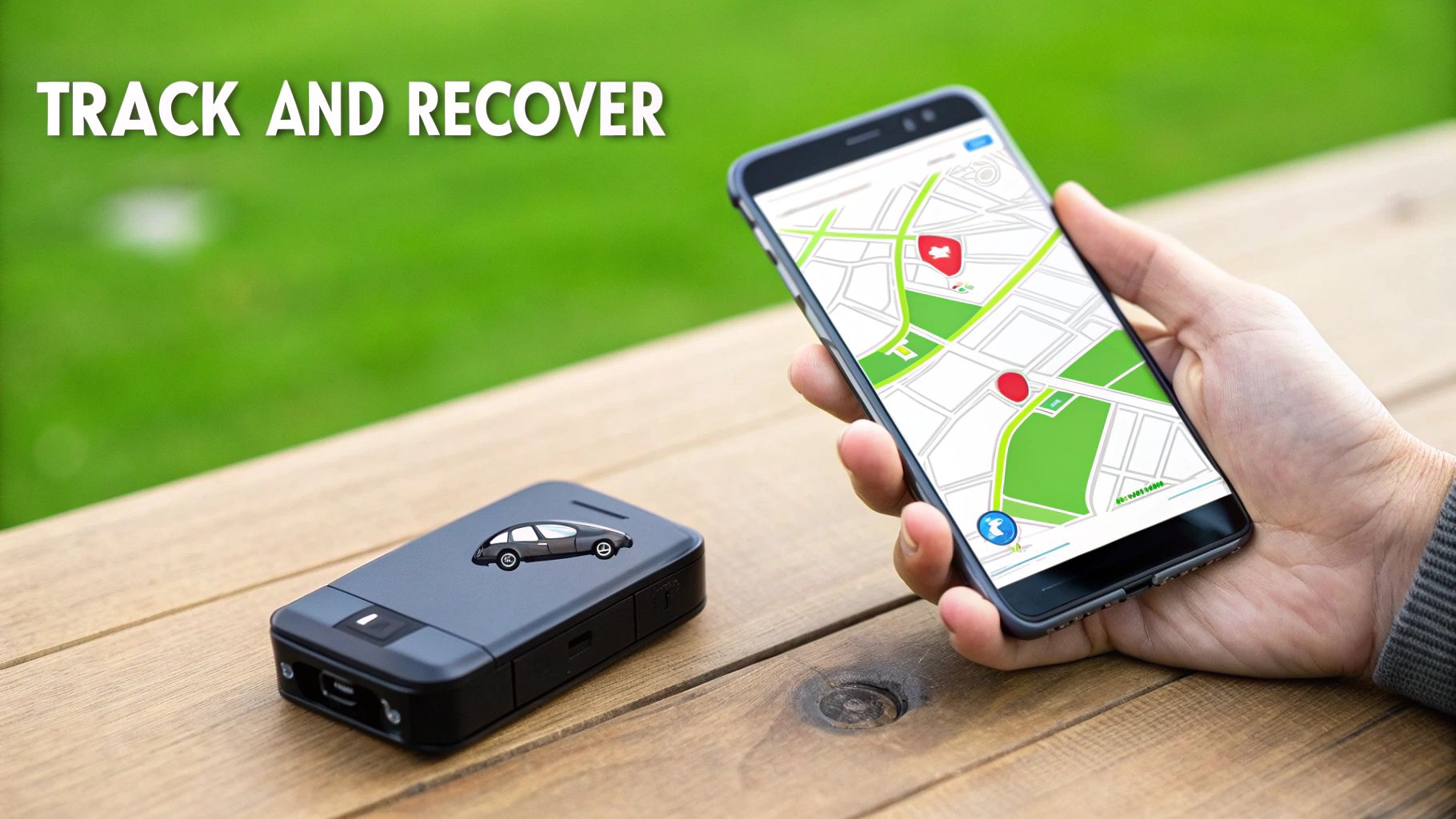
Physical locks and electronic immobilisers are your frontline defence. They're designed to stop a thief in their tracks. But let's be realistic: a truly determined professional might just find a way through. This is where your mindset has to shift from prevention to recovery. Think of a GPS tracker as your ultimate safety net. It’s a silent partner that kicks into action the moment your car disappears, giving you the best possible chance of getting it back.
Unlike a wailing alarm that tries to scare a thief off, a tracker’s job starts after the car is gone. It's the final, crucial piece of your security puzzle, turning what could be a total loss into a recoverable asset.
How GPS Trackers Give You the Upper Hand
At its core, a GPS tracker is a small, discreet box hidden somewhere in your vehicle. It uses the Global Positioning System to work out its exact location and then sends that information straight to your phone or computer. You can literally watch your car moving on a map in real-time.
This tech is a complete game-changer. The national recovery rate for stolen cars is shockingly low—only about 40% of vehicles in the UK ever find their way back to their owners. But a good tracker completely flips those odds. You can dig deeper into how trackers affect vehicle recovery statistics at wentworthprotection.co.uk.
A Quick Story From the Field: We had a client in Burton on Trent whose Range Rover was nicked from their driveway overnight. Their tracker immediately sent an alert to their phone saying the vehicle was on the move. They called the police, fed them the live location data, and the police intercepted the car less than an hour later. They got it back before it could be stripped for parts or stuffed into a shipping container.
Key Features to Look For in a Tracker
Be careful, though – not all trackers are created equal. When you're choosing a tracker, here are the non-negotiables:
Real-Time Monitoring: This is absolutely essential. You need to see where your car is now, not where it was an hour ago. Live updates are critical for a fast police response.
Geofencing Alerts: This is a brilliant feature. You can draw a virtual "fence" around your home or office on a map. If your car leaves that area without you, your phone pings you instantly.
Battery Backup: Pro thieves know to disconnect the car battery first thing. A solid tracker has its own internal battery, so it keeps broadcasting its location long after the main power is cut.
Thatcham Approval: If you want true peace of mind, you need to look for a Thatcham-approved tracker. Thatcham Research is the industry's independent watchdog; their stamp of approval is a guarantee of quality and performance.
A GPS tracker closes the final gap in your security. At Top Motor Keys, we provide expert, discreet installation of top-tier tracking systems across London, Essex, and Kent, making sure your ultimate safety net is in place and ready to act.
Creating Your Personal Security Strategy
Picking the best anti-theft gear isn't about grabbing the priciest gadget off the shelf. It’s about building a smart, layered security plan that actually fits your car, your lifestyle, and your budget.
First, you need to think like a thief for a minute. Is your car the kind that turns heads and attracts organised gangs? Do you park it on a bright, busy street every night, or is it tucked away in a dark, quiet cul-de-sac? Your personal risk profile is ground zero for building a defence that works.
DIY vs. Calling in the Pros
Once you’ve got a handle on what you need, the next question is who’s going to fit it. You can slap on a steering lock or start using a Faraday pouch in seconds. But for advanced kit like immobilisers and trackers, professional installation is crucial. A botched DIY installation can create electrical faults or fail when you need it most. To get a sense of just how complex modern car electronics are, our **practical guide to transponder car keys** is a great place to start.
A professionally installed security device is more than just a product; it's a guarantee. It means every wire is correctly spliced into your car's unique electrical system, making the device reliable, effective, and incredibly difficult for a thief to find and bypass.
Let the Experts at Top Motor Keys Handle It
This is where a professional touch makes all the difference. At Top Motor Keys, we provide an expert mobile installation service for the best systems out there, including Ghost Immobilisers and Thatcham-approved trackers. Our mobile technicians come to you across London, Kent, Essex, and the surrounding regions. We install your new system discreetly and correctly, so you can walk away with complete confidence that your car is properly protected.
FAQ: Your Car Security Questions Answered
Will fitting an aftermarket security system affect my car's warranty?
This is a common concern. A professionally installed system, like those fitted by our team at Top Motor Keys, should not void your vehicle’s warranty. High-quality, Thatcham-approved products are designed to integrate with your car's electronics without causing issues. However, it's always wise to check your specific warranty terms.
Are steering wheel locks still effective today?
Absolutely. While they may seem old-fashioned, a sturdy, brightly coloured steering wheel lock is a powerful visual deterrent. It signals to a potential thief that your car is a difficult target, encouraging them to move on to an easier one. It's an affordable and highly effective first layer of defence.
What is a relay attack and how can I stop it?
A relay attack is a method used to steal cars with keyless entry. Thieves use two devices to capture and "relay" the signal from your key fob to your car, tricking it into unlocking and starting. The simplest and most effective way to prevent this is by storing your keys in a Faraday pouch or box, which blocks the signal completely.
How much should I budget for car security devices?
Costs vary depending on the level of protection you need.
Faraday Pouches: Very affordable, typically under £20.
Steering Wheel Locks: Good quality locks range from £50 - £150.
Aftermarket Immobilisers (e.g., Ghost): Expect to pay £450 - £600 for professional installation.
Thatcham-Approved GPS Trackers: These systems often start around £250 plus an annual subscription fee.
Ready to give your vehicle the protection it deserves? At Top Motor Keys, our mobile experts come directly to you across Tamworth, Lichfield, Sutton Coldfield, Cannock, Burton Upon Trent, Solihull, Coventry to fit the best anti-theft devices in the business. Stop worrying and start protecting your investment. Visit Top Motor Keys to get your free quote today.