
How to Extract a Car Broken Key From a Lock and Remove It Safely

That sinking feeling when you hear a snap and you're left holding only half a key... it's a special kind of frustration. Before you do anything else, take a deep breath. The absolute first rule is: do not try to use the bit of key in your hand to turn the lock. All you'll do is shove the broken fragment deeper inside, making a bad situation much worse.
Instead, your first move is to get a good look at the lock. Is any part of the broken key sticking out? What you do next depends entirely on the answer to that question.
What to Do in the First 5 Minutes
It happens all the time, from the front doors in Coventry to car ignitions in Lichfield. A key you've used a thousand times, weakened by daily wear and tear, finally gives up. How you react in these first few minutes can be the difference between a simple fix and a costly replacement.
This isn't just a freak accident, either. With countless locks in daily use across the country, locksmith services for jobs like this are a big reason the industry is growing by around 4.6% each year. You can get a better sense of the scale of the UK locksmith market on ibisworld.com. The key is to stay calm and figure out what you're dealing with before you make it worse.
Quick Assessment: Your First 5 Minutes
Use this quick guide to understand your situation and decide on the best immediate action.
Key Position | What It Means | Your First Step |
|---|---|---|
Protruding | Good news! You have something to grip. Your chances of a successful DIY extraction are high. | Grab a pair of needle-nose pliers or strong tweezers. |
Flush with the lock face | This is trickier. There’s nothing to grab, so you'll need a specialised tool to hook the key. | Assess if you have the right tools (like an extractor kit). If not, it might be time to call in a pro. |
Recessed (pushed in) | This is the most difficult scenario. The risk of damaging the lock's internal pins is very high. | Stop. Do not insert anything else into the lock. This is almost certainly a job for a locksmith. |
Taking a moment for this simple check saves a lot of headaches. It helps you avoid turning a small problem into a big one.
To DIY or Not to DIY?
So, should you tackle this yourself? It really boils down to one simple thing: can you grab the key?
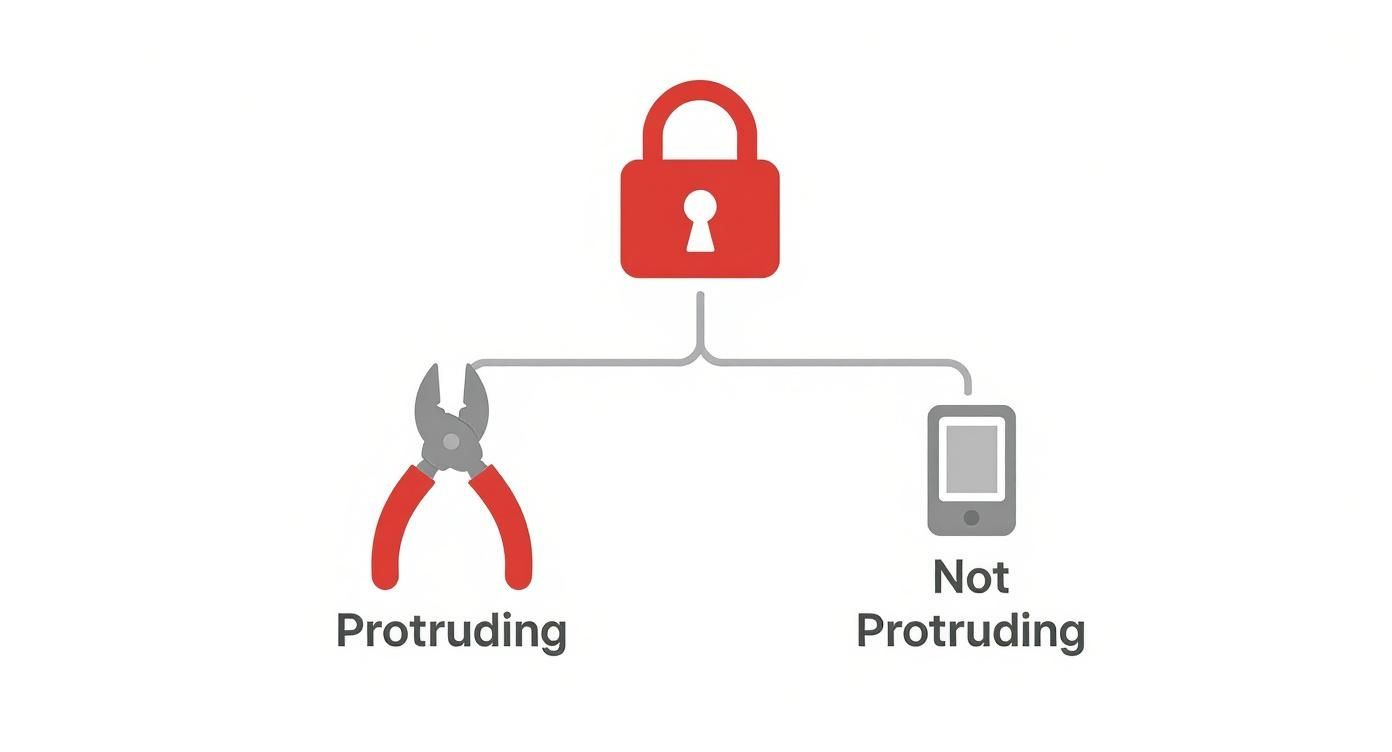
If you've got something to grip, you've got a decent shot. If it's broken off deep inside, your chances of success drop dramatically, while the risk of damaging the lock shoots way up.
Real-life example: I remember a call-out in Sutton Coldfield where a homeowner spent an hour trying to fish out a flush-broken key with a paperclip. By the time I got there, they'd pushed the fragment so far back that it had mangled the cylinder pins. What could have been a simple extraction turned into a full lock replacement.
Once you've had a proper look, you can decide how to proceed.
If a piece of the key is sticking out: Your best bet is to gently grip it with needle-nose pliers or even a strong pair of tweezers. The trick is to wiggle it out slowly and carefully, not just yank it.
If the key is flush or has disappeared inside: This is where things get complicated. You'd need specialised tools like a broken key extractor set. Some people have had luck with a very thin jigsaw blade, but you're working blind and can easily damage the delicate pins inside the lock.
Whether you're in Tamworth, Cannock, or right here in Atherstone, the rules are the same. A calm, methodical approach is your best friend here. Resisting that urge to just jam something else in the lock is the single most important thing you can do to keep a minor hassle from turning into a major expense.
What You'll Need for a DIY Key Extraction
Right, so you're ready to have a go at getting that pesky bit of broken key out of the lock yourself? Good on you. Before you start rummaging around, it's worth knowing that the perfect tool might already be hiding in your garage or even the kitchen junk drawer. Getting this right often just comes down to having the right bit of kit.
Let's see what you should be looking for.
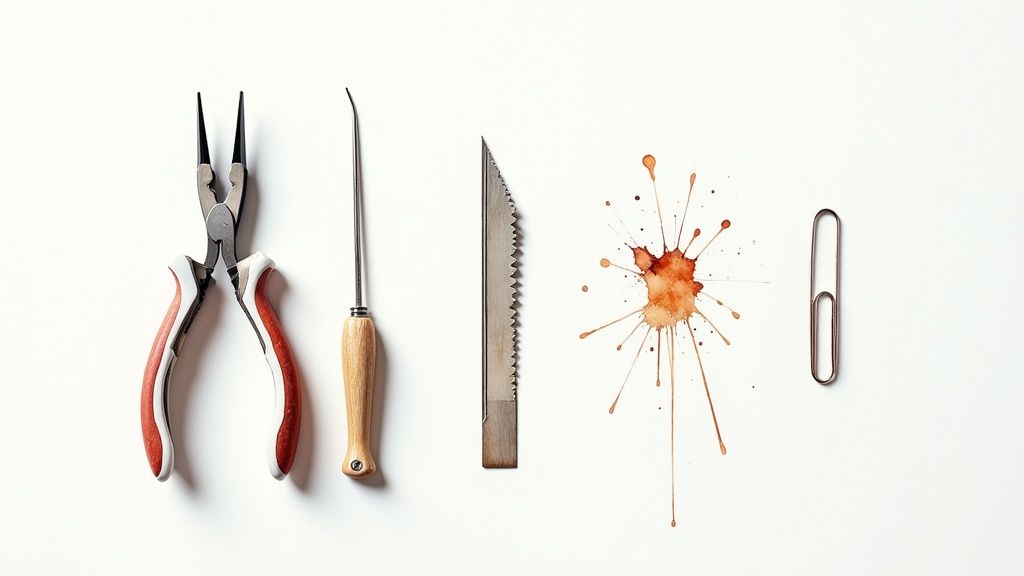
If you're lucky, a little piece of the key will be poking out of the lock. Even a tiny bit makes your life a whole lot easier. This is where a good pair of needle-nose pliers becomes your new best mate. Their fine tip can get a solid grip where your fingers have no chance. A strong pair of tweezers might do the job too, but you need to be sure they can clamp down hard enough without slipping off.
When the Key is Broken Flush
Of course, it's rarely that simple. If the key has snapped off clean and flush with the lock, pliers are completely out of the picture. This is when you need to think a bit more creatively. You're searching for something both thin and strong that can slip into the lock alongside the broken key piece.
Real-life example: I remember a job out in Solihull where a key had snapped in a stiff boot lock. The owner had been wrestling with it for an hour, trying to pry it out. The trick isn't brute force; it's about hooking the fragment and gently coaxing it out.
Here are a few things that actually work:
A Thin Jigsaw Blade: Find one with fine, sharp teeth. The technique is to slide the blade into the lock with the teeth angled outwards, so they catch on the cuts of the broken key. A little wiggle and a gentle pull can be enough to draw it out.
A Sturdy Paperclip or Safety Pin: This is a bit more fiddly, but it can work. Straighten it out and bend a tiny hook on the very end. It takes a steady hand and a fair bit of patience, but it's a classic for a reason.
A Proper Broken Key Extractor Kit: You can pick one of these up online for just a few quid. They come with a selection of specially designed hooks and barbs that are made for exactly this job.
Your Secret Weapon: Lubricant
Whatever tool you end up using, there's one thing you absolutely must have: a quality penetrating lubricant. Seriously, don't even start without it. A quick squirt of something like WD-40 or a silicone-based lock lube can be a complete game-changer.
The spray works by cutting down the friction between the broken key and all the little pins inside the lock. That friction is usually what’s holding the fragment in a death grip.
One of the most common mistakes we see, from Walsall to Wolverhampton, is people trying to yank the key out dry. I'd say lubricating the lock first boosts your chances of success by over 50%. Don't skip it.
Just give a short burst directly into the keyway and let it sit for a minute to penetrate properly. Only then should you try the extraction. This simple prep work stops you from using too much force, which is what usually leads to damaging the lock itself. Having the right tools and a bit of lube is half the battle won.
Getting That Stubborn Key Fragment Out: A Few Tricks of the Trade
Right, let's get our hands dirty. You’ve got your tools and a can of lubricant, so it's time to gently persuade that broken bit of key to come out. We’ll go through the exact methods we use when we're out on jobs, from Burton Upon Trent to Coleshill.
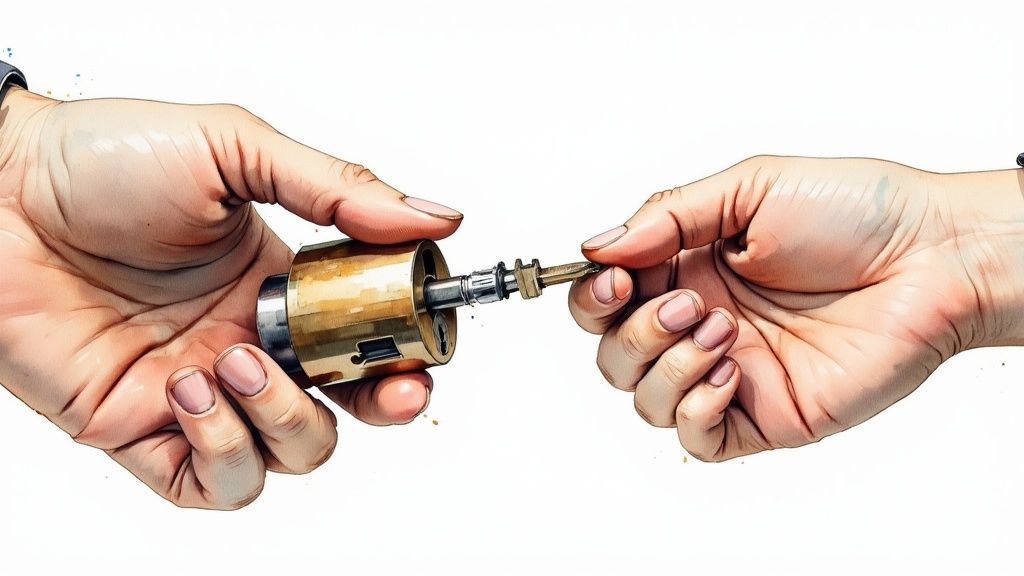
The single most important thing to remember when you extract a broken key from a lock is patience. Seriously. Getting heavy-handed is the fastest way to turn a simple extraction into a costly lock replacement.
Method 1: The Gentle Wiggle (If a Bit of Key Is Sticking Out)
If you can see a piece of the key sticking out of the lock, even just a millimetre, you’re in luck. This is the best-case scenario by a long shot.
First, give the lock a decent spray with your lubricant. Now, grab your needle-nose pliers and get a firm, confident grip on whatever’s exposed. The real trick here isn’t to just yank it out. Instead, apply a bit of gentle, steady pressure outwards while wiggling the fragment up, down, left, and right. These tiny movements are what will help free it from the lock’s internal pins.
Real-life example: We once had a call-out in Nuneaton where the owner had gripped the key so hard with pliers that they just snapped the end off, making it flush with the lock. They went from an easy fix to a much trickier one in a split second. Gentle persistence is the name of the game.
Method 2: The Jigsaw Blade Hook (When It's Broken Flush)
When the key has snapped off deep inside, it's time to get a bit more creative. A thin jigsaw blade with fine teeth is an amazing, if unconventional, tool for this job.
The idea is to carefully slide the blade into the keyway, right beside the broken key. You need the teeth pointing towards you, like tiny hooks. The goal is to get those teeth to catch onto the cuts of the key itself.
Once you feel it's in place, give it a tiny jiggle to make sure the teeth have bitten into the key. Then, just pull the blade slowly and steadily straight back out. If you've got it right, the key fragment will pop out with it. This isn't a sawing motion; think of it more like fishing for a very annoying, metallic fish.
Method 3: The Superglue Trick (Use With Extreme Caution)
Okay, this is the last resort. For the most stubborn fragments, the superglue method can work wonders, but it's a high-risk, high-reward move. If you mess this up, you risk gluing the internal workings of your lock solid, and then you're definitely calling a professional.
If you're willing to take the risk, here’s the process:
Find a thin piece of wire or straighten out a paperclip.
Put a tiny dot of superglue right on the very tip. And I mean tiny.
Carefully guide the wire into the lock until you feel it touch the end of the broken key.
Hold it there, dead still, for at least 60 seconds to give the glue a chance to set properly.
Once you're confident it's bonded, pull the wire straight out.
This trick has saved the day before, but the danger of gluing the lock's pins is very real. If you’re working on a complicated modern car ignition, it might be a risk not worth taking.
Sometimes, a broken key is a symptom of a bigger issue. If you find your ignition barrel not turning, it’s a good idea to understand what's causing it before you start poking around. You could save yourself from making the situation much worse.
When to Call in the Professionals
Knowing how to extract a broken key is one thing, but knowing when to stop trying is just as crucial. It's easy to let frustration take over, but a botched DIY job can turn a simple fix into a full-blown lock replacement. That’s a jump from a minor inconvenience to a major expense.
The golden rule? If you've been fiddling with it for 20 minutes and haven't made any progress, it’s time to step back. Seriously, put the tools down. Continuing to poke around in there risks pushing the broken piece further in or damaging the delicate pins inside the lock cylinder.
The Tell-Tale Signs You Need a Pro
Sometimes, you can tell right away that this isn't a job for your home toolkit. Here are a few situations where your first call should be to a locksmith, not your mate with a pair of pliers:
Complex Locks: Modern car ignitions and high-security locks are a different beast altogether. They’re packed with electronics and anti-tamper bits that are incredibly easy to break.
The Key is Buried Deep: If you can't even see the edge of the key fragment, you simply don't have the right tools to get it out without causing harm.
The Lock Was Already Dodgy: Was the lock stiff or difficult to turn before the key snapped? That’s a big red flag. The broken key is probably just a symptom of a much bigger problem inside the lock itself.
Real-life example: We once got a call-out in Birmingham where a homeowner had spent an hour attacking their lock with pliers and a screwdriver. Not only did they fail to get the key out, but they also completely wrecked the door mechanism. What should have been a straightforward £75 job ended up costing them over £200 for a full replacement.
A professional doesn't just bring a van full of fancy tools; they bring years of hands-on experience. They know exactly how to extract a broken key from a lock without causing collateral damage, saving you a world of stress and, in the long run, cash.
The demand for this skill is on the rise. In the UK, a significant chunk of emergency call-outs—as many as 20%—are for this exact problem. You can dig into more locksmith industry trends on amraandelma.com.
So, if you're stuck in Tamworth, Sutton Coldfield, Cannock, or Ashby de la Zouch, don't risk a bigger bill. Making that call is the smartest move you can make. And for those particularly nasty car lock issues, our guide on finding reliable auto locksmith services near you can be a real lifesaver when you're stuck on the roadside.
Our Professional Key Extraction Process
So, you’ve made the smart call and got a professional locksmith on the way. Good choice. Knowing what happens next can take a lot of the stress out of the situation, whether you’re stuck outside your home in Sutton Coldfield or your car key has snapped in the ignition over in Atherstone. The whole process should be simple and clear from the moment we pick up the phone.
It all kicks off with that first call. The more detail you can give us, the better. Let us know exactly what’s happened – is it your front door lock or the car ignition? This kind of information means we can give you a much more accurate quote over the phone and make sure our mobile unit is kitted out with everything needed for your specific problem. We cover a big patch, including Tamworth, Lichfield, Sutton Coldfield, Cannock, Burton Upon Trent, Solihull, Coventry, Atherstone, Ashby de la Zouch, Coleshill, Nuneaton, Walsall, Wolverhampton, and Birmingham, so an accurate location is a must.
The Right Tools for the Job
When we turn up, you won’t see us fumbling around with bent paperclips or a tube of superglue. A professional locksmith comes equipped with highly specialised gear designed for one thing: to extract a broken key from a lock without damaging the delicate mechanism inside.
You can expect to see us use tools like:
Broken Key Extractor Sets: These are the real workhorses. They’re incredibly thin, flexible metal tools with tiny, sharp hooks or barbs on the tip. We slide them into the keyway alongside the broken fragment to get a solid grip and carefully pull it out.
Fine Wires and Probes: Sometimes, it’s a more delicate operation. We use fine probes to gently manipulate the lock pins, creating just enough wiggle room to latch onto the key piece.
Professional Lubricants and Scopes: We’re not talking about a can of WD-40 here. We use high-quality penetrating oils designed for locks to help loosen a stubborn fragment. On really tricky jobs, we might even use a small endoscopic camera to get a clear look inside the lock.
It’s not just about having the tools; it’s about having the skill and a steady hand to use them. This is where years of experience come in. That expertise is what stops a straightforward extraction from becoming a full-blown lock replacement, which is often what happens when DIY attempts go wrong.
Estimated UK Locksmith Costs and Times
We pride ourselves on being upfront and honest. You’ll never get a surprise bill from us. We'll always confirm the price with you before we even think about touching the lock. The final cost can depend on things like how complex the lock is or the time of day, but we can give you a solid idea of what to expect. This table breaks down typical costs and how long you can expect the job to take.
Service Type | Estimated Cost (GBP £) | Average Time |
|---|---|---|
Standard Cylinder Lock (e.g., front door) | £75 - £95 | 15-30 mins |
High-Security Lock (e.g., anti-snap) | £90 - £120 | 20-45 mins |
Vehicle Door Lock | £85 - £110 | 20-40 mins |
Vehicle Ignition Barrel | £95 - £140+ | 30-60 mins |
Once we’ve got the broken piece out, the first thing we’ll do is test the lock with a spare key to make sure everything is working as it should. If you need a new key, we can often cut one for you on the spot using the two halves of the broken one.
Troubleshooting Guide: When DIY Extraction Fails
Sometimes, even with the right tools and techniques, the broken key piece just won't budge. Here’s a quick guide to what might be going wrong and when it's definitely time to stop.
Problem | Possible Cause | Solution |
|---|---|---|
The extractor tool won't slide in. | The keyway is too narrow, or the key fragment is bent/jammed at an odd angle. | Add more lubricant. Try gently wiggling the lock cylinder with a spare key from the other side (if possible) to create space. If it still won't go in, stop. |
You can feel the tool hook the key, but it won't pull out. | The internal lock pins are jammed against the key's sharp edges, holding it in place. | Apply lubricant again. While pulling gently on the extractor, try to 'rake' the pins by moving the tool slightly up and down to free them. |
The fragment moves slightly but then gets stuck again. | There may be a burr on the key or damage inside the lock cylinder that's catching the fragment. | This is a high-risk situation. Further attempts could cause more damage. It's time to call a professional. |
You used superglue, and now nothing moves. | The glue has likely bonded the key fragment to the internal pins or the lock cylinder itself. | Stop immediately. Do not apply force. This is now a job that requires professional assessment to see if the lock can be saved. |
FAQ: Your Broken Key Questions Answered
We get a lot of calls about broken keys, so I thought I'd tackle some of the most common questions we hear from drivers across Tamworth, Lichfield, and Sutton Coldfield.
Will Trying to Get the Key Out Damage My Lock?
This is the big one, and the honest answer is: it depends on how you do it. If you have the right tools and a gentle touch, you can often get the key fragment out without causing any harm to the lock's inner workings. The real danger comes from getting impatient and using the wrong tools. Shoving a screwdriver or a pair of pliers in there is a surefire way to wreck the delicate pins inside the lock cylinder.
Can I Still Get a New Key Made from the Two Broken Halves?
You absolutely can. We do this all the time for customers from Cannock to Burton Upon Trent. As long as you have both pieces and it's a clean snap, any good locksmith can line them up perfectly in the cutting machine to make a new key. The trick is to make sure the two halves fit together snugly, like a puzzle piece. For a bit more on this, check out our practical guide on needing a spare car key.
How Did My Key Even Break in the First Place?
Most of the time, it's just down to old age. Think about how many times you've used that key over the years. Metal fatigue sets in, creating tiny, invisible cracks that eventually just give way. We see this a lot with older vehicle keys in areas like Solihull and Coventry. But it's not always wear and tear. Other common culprits include accidentally trying the wrong key, forcing a stiff lock, or using a cheap duplicate made from poor-quality metal.
If you're stuck and need a professional to extract a broken key from a lock in Tamworth, Lichfield, Sutton Coldfield, Cannock, Burton Upon Trent, Solihull, Coventry, Atherstone, Ashby de la Zouch, Coleshill, Nuneaton, Walsall, Wolverhampton, or Birmingham, give Top Motor Keys a bell. Our 24/7 mobile service is designed to get you sorted quickly, without any drama. Pop over to https://www.topmotorkeys.co.uk for a free quote.