
Key Fob Programming Ford Guide for West Midlands Drivers

You're standing beside your Ford in a Coventry car park, pressing the key fob and getting nothing back. The doors stay locked, the dashboard won't recognise the spare, and replacing the battery hasn't changed a thing. That's when many drivers discover that key fob programming for Ford vehicles isn't merely a matter of cutting a blade or pressing a button. The remote, transponder and immobiliser must all communicate correctly.
The security concern is real. The Crime Survey for England and Wales reporting found that 58% of car thefts between March 2023 and March 2024 involved criminals illegally accessing vehicles by replicating or manipulating keyfob signals. Proper programming won't replace wider security measures, so it's sensible to review ways to protect your vehicle from theft, particularly if your Ford uses keyless entry.
Understanding Ford Key Fob Security
A recent roadside call in the West Midlands involved a Ford Fiesta whose owner believed the replacement fob was faulty. The locks didn't respond, and the vehicle refused to start. A closer check showed two separate issues, the remote battery was weak and the replacement transponder hadn't been paired with the immobiliser. The blade fitted the ignition, but mechanical fit alone couldn't authorise the engine.
That distinction causes most confusion. A Ford key fob can contain a remote control section for locking and opening, plus an immobiliser transponder that allows the vehicle to start. Some models combine these parts in an integrated keyhead, while newer systems may use a proximity fob without a conventional ignition sequence.
Ford's own replacement process is vehicle-specific. It depends on the VIN, ownership verification and the correct key type, rather than a universal code or routine. The replacement must be checked by locking, granting access, and starting the vehicle, as explained in this practical guide to transponder car keys.
Practical rule: A fob that locks the doors but doesn't start the Ford has a programming or immobiliser problem. A fob that starts the car but won't operate the locks may have a battery, button or remote-synchronisation fault.
Preparing Tools and Checking Compatibility
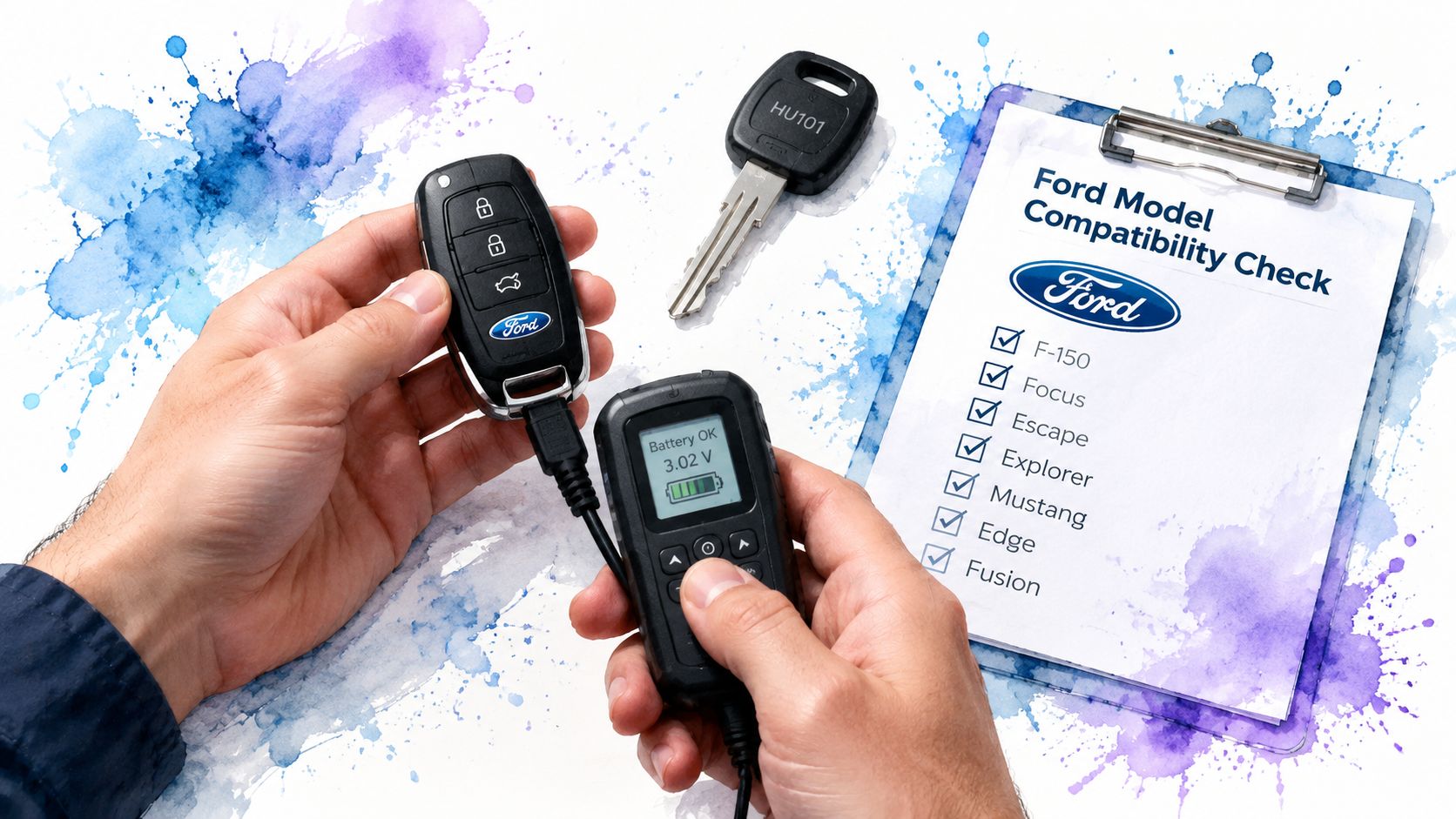
Start with compatibility, not programming. You'll need the Ford model, registration, model year and VIN before buying a replacement fob. The same-looking remote can use a different frequency, transponder type or housing, and an incorrect part may never pair successfully.
Useful equipment includes:
A replacement fob or key blank: Many late-model UK Fords use the HU101 blade profile, but the blade profile doesn't confirm electronic compatibility.
A fresh fob battery: Fit the correct battery securely, checking polarity and contact tension.
A small screwdriver set: You may need it to open the casing without damaging clips or the circuit board.
A diagnostic fob tester: This helps identify a dead transmitter before you blame the vehicle.
Ownership documents: Ford's official process requires vehicle-specific security access and proof of ownership.
A compatible key-code or diagnostic route: Newer vehicles commonly require authorised security access and OBD programming.
Older ignition-based Fords may support an onboard remote routine, but the exact method depends on the vehicle. Ford UK directs owners to model-specific handbook instructions, so generic online advice can be misleading. The familiar “8 turns in 10 seconds” routine only applies to certain older systems, not every Fiesta, Focus or keyless Ford, as Ford's key fob and remote-start guidance makes clear.
Before ordering, compare the replacement fob's part information with the original and check whether all existing keys are available. A useful checklist for choosing a suitable new remote car key should include the model year, key style and whether the car has push-button start.
Onboard Programming Methods for Common Models
Some older Ford systems allow remote-control programming from the ignition without an OBD tool. That doesn't mean every part of the key is self-programmable. Remote buttons may sync through the ignition, while the immobiliser transponder can require separate pairing or an already authorised key.
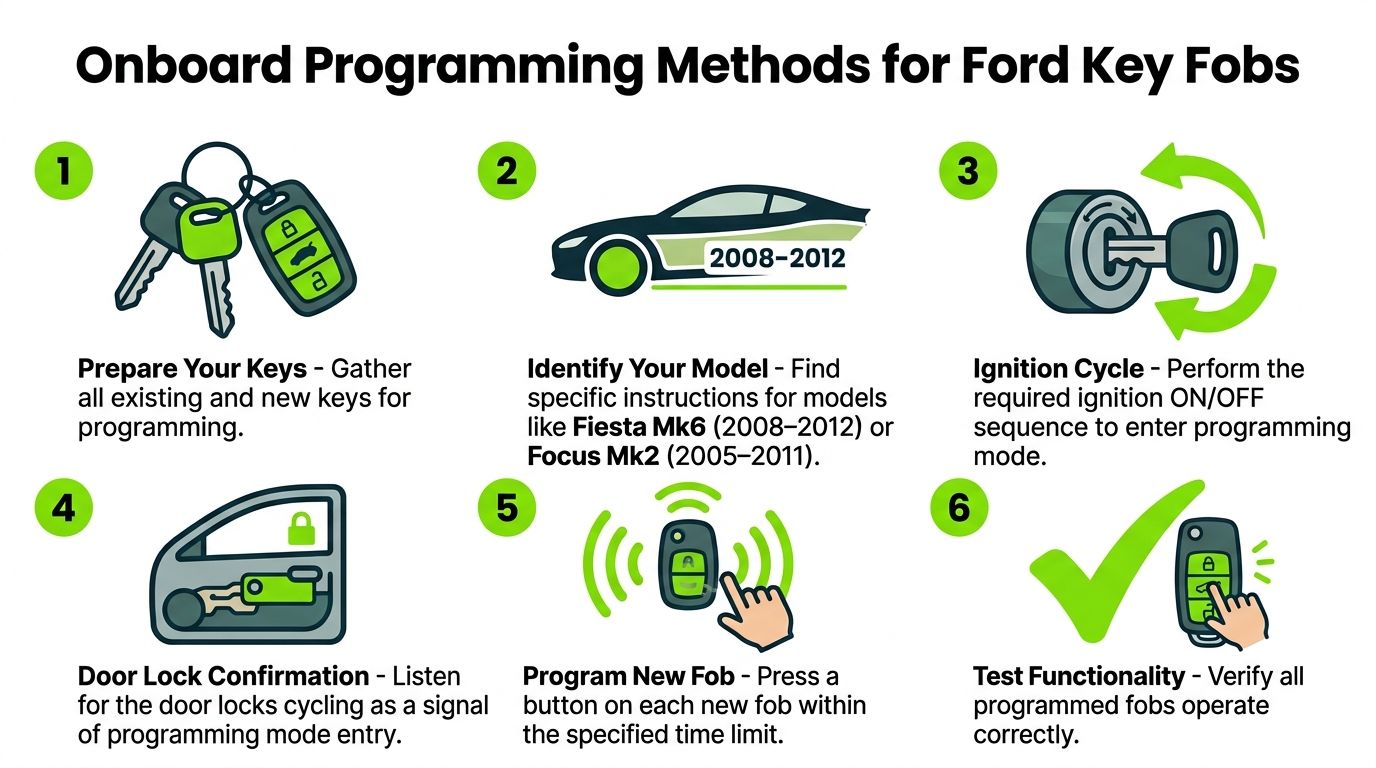
For systems that specifically support the ignition routine, the general sequence is:
Gather every fob: Keep existing and replacement remotes beside you. Some routines can overwrite the current remote memory, so leaving a working fob out may create an avoidable problem.
Confirm the model instructions: Fiesta Mk6 vehicles from 2008 to 2012 and Focus Mk2 vehicles from 2005 to 2011 are examples often associated with older ignition-based procedures, but the exact vehicle specification still matters.
Enter programming mode: Follow the vehicle-specific ignition ON and OFF sequence. On applicable systems, turning the ignition repeatedly within the specified time window causes the locks to cycle.
Wait for confirmation: The door locks cycling indicates that the vehicle has entered remote-programming mode. If nothing happens, stop rather than repeatedly pressing buttons.
Press each remote button: Press a button on each fob within the permitted timing window. The locks should cycle to confirm each accepted remote.
Exit and test: Turn the ignition off, then test lock, door release and any boot or alarm functions fitted to the vehicle.
Timing is where driveway attempts usually fail. One Tamworth driver carried out the correct ignition sequence but opened the door halfway through, cancelling the programming mode. Another pressed the new fob too late, after the locks had stopped cycling. Closing the doors, switching off interior distractions and having all fobs ready makes the process more consistent.
The routine won't solve a newer keyless vehicle that expects diagnostic authorisation. It also won't pair a transponder even if the remote buttons respond. If the car's door mechanisms secure and release but still refuses to start, the immobiliser needs separate attention.
Using Diagnostic Tools for Advanced Programming
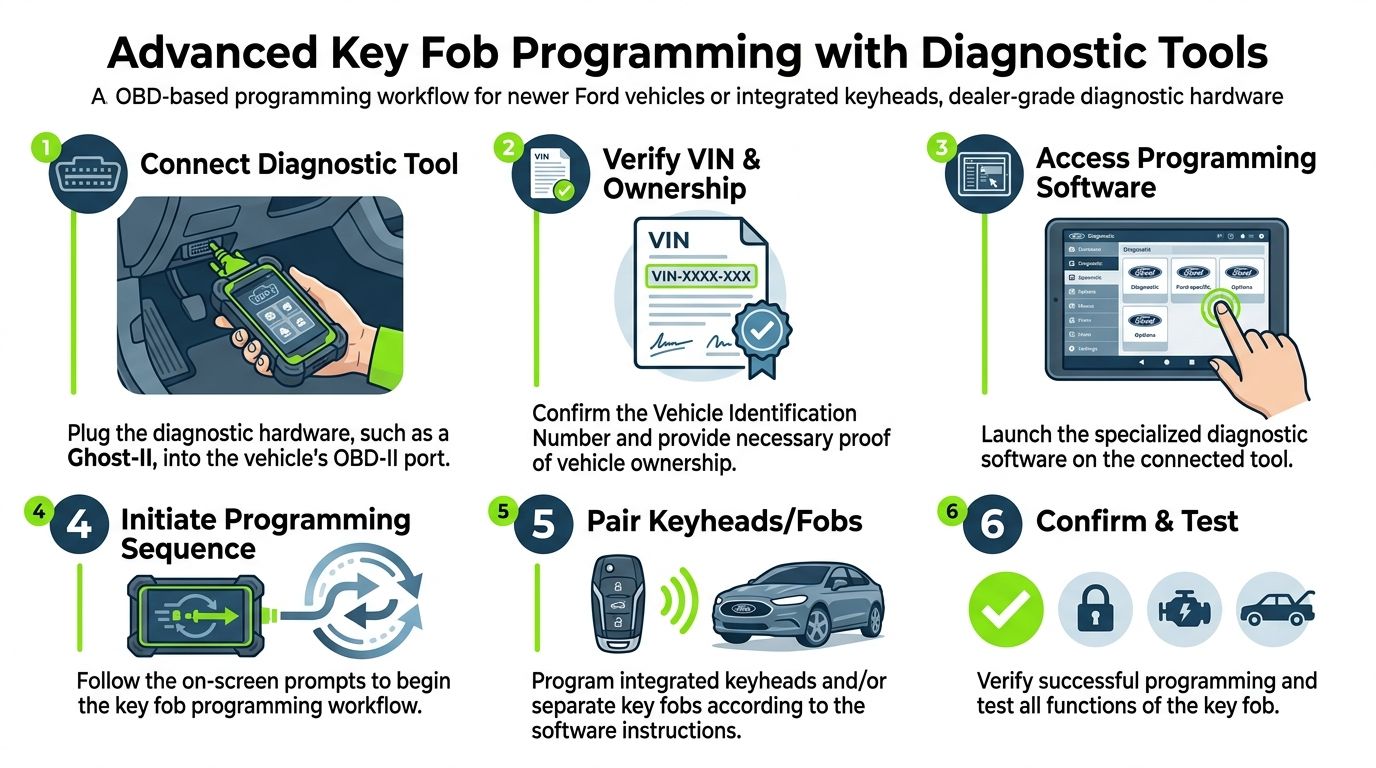
Newer Fords generally need a professional OBD workflow because the immobiliser must recognise the transponder or proximity module. A mobile technician connects dealer-grade or equivalent diagnostic software to the vehicle's OBD port, confirms the VIN and verifies ownership before starting the security procedure.
The practical sequence usually includes:
Vehicle identification: Confirm the VIN, model and key system before selecting software functions.
Ownership verification: Check documents such as the V5C and photo identification.
Key preparation: Cut the HU101 blade where applicable, or confirm the correct proximity module for a keyless vehicle.
Immobiliser pairing: Use the diagnostic platform to add the transponder or key module to the vehicle's authorised-key memory.
Lost-key removal: If a key has disappeared, remove it from memory where the system supports that function.
Functional testing: Check starting, locking, keyless entry, remote range and any relevant warning messages.
A general-purpose key cutter can reproduce the blade shape, but it can't complete the electronic pairing required by many Fords made from 1998 onwards, according to this Ford key replacement guide. The documented kerbside workflow can often be completed in around 30 to 60 minutes and is commonly 30% to 50% cheaper than dealer replacement, although the final price depends on the vehicle, key type and security work involved.
The trade-off is straightforward. Dealer programming gives access to manufacturer systems, but normally involves appointment availability and getting the vehicle to the site. A properly equipped mobile locksmith brings diagnostic hardware to the vehicle, which is particularly useful when there's no working key or the immobiliser prevents driving.
Don't confuse PIN or security access with a universal Ford code. The correct route depends on the vehicle and ownership checks. If the software reports an invalid key type, communication failure or an immobiliser handshake error, forcing another attempt can waste time and risk leaving the system in a restricted state.
When to Call Top Motor Keys and Security Schemes
Professional help makes sense when the fob battery is new but the vehicle still won't recognise the key, when no original key remains, or when the Ford uses a keyless or integrated keyhead system. It's also the safer option if you're unsure whether a replacement fob is compatible. Repeatedly trying an older ignition routine on a newer security architecture won't create a successful pairing.
Top Motor Keys provides mobile Ford key cutting, replacement and programming across the West Midlands and nearby areas, including Tamworth, Lichfield, Sutton Coldfield, Cannock, Burton Upon Trent, Solihull, Coventry, Atherstone, Ashby de la Zouch, Coleshill, Nuneaton, Walsall, Wolverhampton and Birmingham. The service is available 24/7, with technicians using on-site diagnostic equipment for suitable vehicles.
SERMI is scheduled to go live in the UK on 1 April 2026, and the scheme requires independent operators accessing vehicle security information to use a security token and PIN-protected electronic certificate, as stated by Vehicle SERMI. SERMI is not required for every repair task. It applies when the job involves security-related repair and maintenance information, while non-security diagnostic work falls outside that requirement. UK guidance also refers to identity, business and criminal-record checks for applicants, as outlined in this SERMI scheme explanation.
Top Motor Keys is SERMI registered and TASSA registered. TASSA, the Tracking and Aftermarket Security System Association, is relevant when drivers are considering aftermarket immobilisers and vehicle tracking. For local service providers, clear coverage pages and transparent credentials also support practical UK local SEO strategies for small businesses. If you're stranded, the mobile car key programming service can be arranged at the vehicle rather than relying on a tow.
Troubleshooting and Best Practices
Before attempting programming again, separate a remote fault from an immobiliser fault. Press each button and check for the fob's indicator response, then test with a correctly fitted fresh battery. Worn buttons, damaged casings and poor battery contacts can imitate a failed pairing.
Use this order:
Check the fob battery: Confirm polarity and contact pressure.
Inspect button response: A soft or inconsistent button may indicate casing or switch wear.
Close every door: Door-ajar warnings can prevent some programming routines.
Repeat the exact sequence: Start again from the beginning, without changing the timing.
Test every function: Check lock, disengage locks, boot release where fitted and engine start.
Stop after persistent failure: A diagnostic scan is more useful than repeated battery swaps.
Many apparent programming failures turn out to be dead batteries or worn buttons rather than immobiliser pairing problems, according to Ford locksmith troubleshooting guidance. If the remote works but the engine doesn't start, treat it as an immobiliser issue rather than a simple synchronisation fault.
Conclusion and Next Steps
Ford key fob programming depends on the vehicle's security architecture. Some older Fords may accept an onboard ignition routine, while newer keyless systems and integrated keyheads commonly need OBD programming with vehicle-specific security access. The right approach starts with compatibility, ownership verification and a clear distinction between remote operation and immobiliser authorisation.
A spare key is more than a convenience. It gives you a recovery option before a lost or damaged key becomes an emergency, and removing missing keys from memory can reduce the risk associated with a key that's no longer under your control. For fleet managers and small businesses, consistent programming records and a tested spare can also reduce vehicle downtime.
Top Motor Keys offers mobile Ford key cutting, replacement, programming and immobiliser support across Tamworth, Lichfield, Sutton Coldfield, Cannock, Burton Upon Trent, Solihull, Coventry, Atherstone, Ashby de la Zouch, Coleshill, Nuneaton, Walsall, Wolverhampton and Birmingham. The service operates 24/7, provides free quotes and uses SERMI and TASSA registered security practices, with VAT-free pricing available for its mobile service.
If your Ford fob is unresponsive, don't assume the answer is another battery or an online ignition sequence. Identify the model and key type, then use a qualified mobile technician when the vehicle requires diagnostic programming.
Top Motor Keys can test, cut and program Ford key fobs at your vehicle, including spare keys, lost-key replacements and immobiliser support across the West Midlands. Visit Top Motor Keys to request a free quote and arrange mobile assistance today.