
Does my car have an immobiliser? Easy UK check

Ever spotted that little flashing light on your dashboard after you've locked up and walked away? That's not just a random blink; it's often your car's silent guardian at work—the engine immobiliser. It's one of the most common and effective anti-theft devices in modern cars, and there's a good chance your vehicle has one.
What Is a Car Immobiliser and How Does It Work
Think of your immobiliser as a digital bouncer for your engine. Its one and only job is to stop the engine from running unless the correct key is present. This simple but brilliant system is your first line of defence against car thieves, which is a major concern for any driver here in the UK.
So, how does it do it? The magic happens with a tiny transponder chip hidden inside your car key. When you pop the key in the ignition (or for keyless systems, just have the fob nearby), that chip sends a unique security code to a receiver in the car.
If the codes match up, the bouncer gives the nod, and you can start the engine. But if they don't—say, if a thief tries to hotwire the car or use a dodgy copied key—the immobiliser shuts everything down. It will block the fuel system or the ignition, leaving the car going nowhere.
Why This Matters for UK Drivers
Vehicle theft is a problem that just won't go away. Between April 2023 and March 2024, a staggering 129,159 vehicles were stolen across the UK. What's worrying is that plenty of these had standard immobilisers, proving that determined criminals can find ways around factory-fitted security. This makes it vital for motorists everywhere, especially in places like Tamworth, Birmingham, and Coventry, to know what's protecting their car.
While factory-fitted immobilisers are a great starting point, they aren't completely foolproof. Thieves are always finding new tricks to bypass them, which is why more advanced security solutions are becoming so important.
For anyone serious about beefing up their car's defences, looking into something like a Ghost Immobiliser adds a powerful, invisible layer of security that standard systems simply can't offer. Getting to grips with how your basic immobiliser works is the perfect first step towards properly securing your pride and joy.
How to Check If Your Car Has an Immobiliser
So, you're wondering if your car has an immobiliser? Good news – you don't need to be a mechanic to figure this out. There are a few simple checks you can do right on your driveway, and they won't cost you a penny.
Let's run through a few quick and easy ways to get your answer.
The Tell-Tale Dashboard Light
The easiest and most obvious clue is sitting right on your dashboard. When you lock your car and take the key out, have a peek through the window.
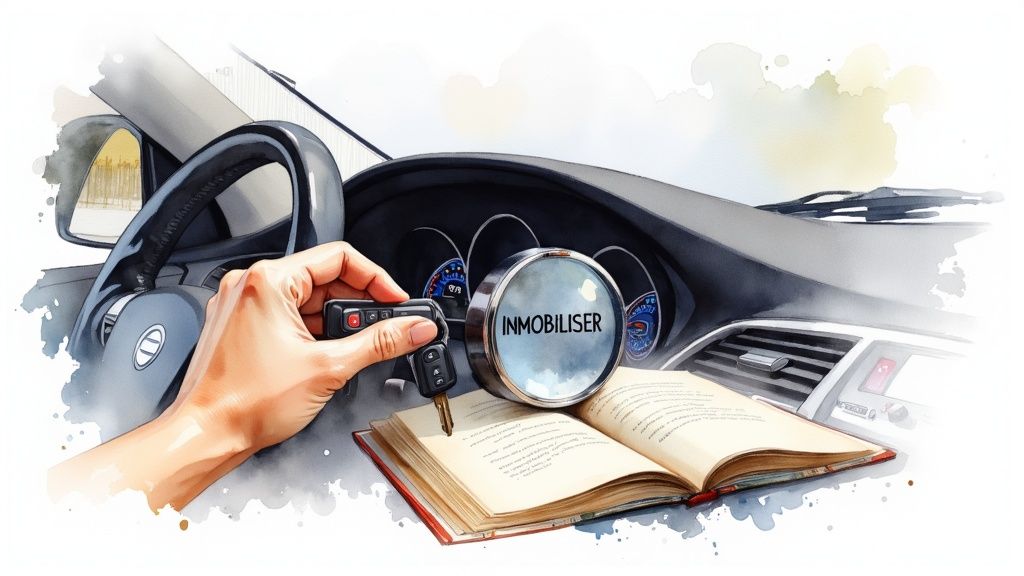
You're looking for a small, flashing light. It’s often an icon of a car with a key inside it, or sometimes a little padlock symbol.
That flashing light is your sign that the security system is armed and ready. When you pop the correct key in the ignition, the light should go out. If it stays lit or flashes rapidly when you try to start the car, that’s often a sign of a fault in the system.
Quick DIY Immobiliser Check Methods
Here's a quick rundown of the simple things you can check yourself without any tools.
Method | What to Look For | Success Indicator |
|---|---|---|
Dashboard Light | A small, flashing icon (key, car, or padlock) after you lock the car. | The light flashes when the car is locked and turns off when the key is in the ignition. |
Owner's Manual | The index or a "Security" section. Search for "immobiliser," "anti-theft," or "transponder." | The manual explicitly mentions the system and explains how it works on your model. |
Car Key Inspection | A thick, plastic head on the key. It feels more substantial than a simple piece of cut metal. | The key's design indicates it houses a transponder chip, which is essential for an immobiliser. |
These simple checks are usually all it takes to confirm whether you have an immobiliser.
Digging a Little Deeper
If you're still not 100% sure after checking the dash, your next stop should be the glovebox. Pull out the car's owner's manual. It might sound a bit obvious, but it’s the most reliable source of truth for your specific make and model.
Don't just flick through it. Head straight for the index at the back. Look up terms like "immobiliser," "security system," "anti-theft," or "transponder." The manual will tell you exactly what system is fitted and how it's supposed to work.
Finally, have a good look at your car key. Keys for cars with immobilisers are usually a bit chunkier than a simple metal key. That’s because the plastic head contains a tiny transponder chip – the brains of the operation.
This little chip is what communicates with your car to give the "all-clear" to start the engine. If you want to dive deeper into how this works, check out our practical guide to transponder car keys.
Troubleshooting Common Immobiliser Problems
An engine immobiliser is a fantastic bit of anti-theft tech, right up until the moment it mistakes you for a car thief and refuses to let you start your own engine. A faulty system can be a proper nightmare, leaving you stranded whether you’re at home in Lichfield or stuck in the work car park in Sutton Coldfield. Let’s walk through how to figure out what's going on.
So, how can you be sure it's an immobiliser fault? The classic sign is when you turn the key, and all the electrics spring to life – the radio, dashboard lights, the lot – but the engine itself absolutely will not crank or fire up. Just dead silence. Another massive clue is that little warning light on your dashboard, often shaped like a car with a key inside it. If that light stays on constantly or starts flashing away when you try to start the car, that’s the system screaming that it can't get a proper security handshake from your key.
Quick Troubleshooting Guide
Before you start thinking about expensive repairs, take a breath. The cause is often surprisingly simple. We've helped countless drivers from Burton Upon Trent to Atherstone who couldn't start their car for one simple reason: a dead battery in the key fob. A weak signal means the transponder chip can't send its vital code.
Here are the most common culprits you can easily check yourself:
Dead Key Fob Battery: This is the number one cause, hands down. The easiest check is to try your spare key. If the car starts right up with the spare, you’ve found your problem.
Damaged Transponder Chip: We all drop our keys. Unfortunately, that can sometimes damage the delicate little chip inside. The key will still turn the locks and the ignition, but the car simply won’t recognise it as a friend.
Car Battery Issues: A low or failing car battery can create all sorts of electronic gremlins, and that can sometimes confuse the immobiliser system into thinking there's a fault. Make sure your main car battery is in good health.
A common mistake is mixing up an immobiliser fault with a dead car battery. If you turn the key and hear a rapid clicking noise, that's almost always a sign of a flat car battery, not the immobiliser.
When It's Time to Call in a Professional Auto Locksmith
Look, while a quick battery swap can sometimes work wonders, there are moments when tinkering with an immobiliser issue yourself can do more harm than good. Knowing when to put the tools down and pick up the phone to an expert can save you a world of time, money, and hassle. If any of the following situations sound familiar, it’s definitely time to get a pro involved.
Real-Life Example
Imagine this: Sarah, a nurse finishing a long shift in Birmingham, gets to her car only to find it won't start. The dash lights come on, but the engine is dead. Her immobiliser light is flashing. She tries her spare key—no luck. This is a classic example of an internal immobiliser fault. Instead of paying for a tow to a dealership, she called a mobile auto locksmith who came to her location, diagnosed a communication error with the ECU, and reprogrammed the system on the spot, getting her home safely.
The big one is losing your only transponder key. If you don't have a spare, you're not starting that car, simple as that. Creating a brand-new key isn't like cutting a house key; it needs specialist diagnostic gear to program it to your vehicle’s computer (the ECU). Another tell-tale sign of a deeper problem is when your car suddenly gives all your keys the cold shoulder, even the spare. This usually points to a fault within the immobiliser system itself or a major communication glitch with the ECU.
Your Local Go-To on Wheels
For anyone in the West Midlands and Staffordshire area, a mobile auto locksmith is a no-brainer. Whether you're stuck in Tamworth, Lichfield, Sutton Coldfield, or Cannock, there’s no need to fork out for an expensive tow truck to a dealership. We come right to your doorstep, whether that’s at home in Coventry, at the office in Walsall, or stranded in a Birmingham car park.
Here’s a bit of inside knowledge: choosing a specialist auto locksmith over a main dealer is almost always faster and a lot kinder on your wallet. Dealers can take an age and charge a premium for the privilege, while a mobile expert can often sort the problem right there and then, getting you moving again in hours, not days.
With car theft still a major concern—England and Wales saw a staggering 375,048 vehicle thefts in the year ending September 2024—making sure your immobiliser is in top-notch condition is non-negotiable. That figure really drives home why getting a professional to check your car's security is a smart move. You can dig into more details about UK vehicle theft statistics on zego.com.
Upgrading Your Vehicle Security Beyond the Basics
Let's be honest, thieves are getting smarter. They're not just smashing windows anymore; they're using sophisticated gadgets like relay attack devices. This means a standard factory immobiliser, while good, sometimes just isn't enough to protect your pride and joy. Modern car crime needs a modern defence, and that means layering your security to stay one step ahead.
This is where next-generation security systems really shine. They're built from the ground up to fight the high-tech methods thieves love to use, giving your vehicle a much tougher defence than what it came with from the factory.
The Power of Invisible Protection
One of the best upgrades you can get is a Ghost Immobiliser. Think of it as a secret shield for your car. There are no key fobs to clone or tell-tale flashing lights to give its location away.
Instead, you set a unique PIN sequence using your car's existing buttons—like on the steering wheel or dashboard. The engine simply won't start until that code is entered.
Even if a thief manages to grab your key, they're not going anywhere without that secret code. This completely stops relay attacks and key cloning in their tracks, which are rampant in areas from Solihull to Wolverhampton.
Car theft is evolving, and so should your car’s security. Layering different types of protection is the single most effective way to make your vehicle an unattractive target for thieves.
It's not just us saying this. With car theft claims rocketing to a record £699 million in 2023, many insurers are now recommending—or even insisting on—advanced security like Ghost Immobilisers for higher-value cars. It’s a clear sign that factory systems alone are no longer cutting it. You can read more about the rising car theft crisis and insurance trends on wecovr.com.
For a full rundown of your options, have a look at our practical UK guide on how to prevent car theft. At the end of the day, it's all about making your vehicle as difficult to steal as possible.
FAQ: Your Car Immobiliser Questions Answered
We get asked about car immobilisers all the time. So, to make things a bit clearer, we've pulled together some straight-talking answers to the questions we hear most from drivers around Ashby de la Zouch, Coleshill, and Nuneaton.
Do All UK Cars Made After 1998 Have an Immobiliser?
Pretty much, yes. It became law that any new car sold in the UK from October 1998 had to have an immobiliser fitted at the factory. So, if your car was built for the UK market after that date, you can be almost certain it's got one. Just bear in mind that the technology in those older systems won't be as tough to crack as modern ones.
Can I Bypass My Car's Immobiliser Myself?
Honestly, trying to bypass an immobiliser yourself is a recipe for disaster. It's not just a simple switch; it’s deeply wired into your car's brain, the Engine Control Unit (ECU). One wrong move and you could easily fry the electronics, landing you with a repair bill that runs into hundreds, or even thousands, of pounds. It's always smarter—and cheaper in the long run—to call in a professional auto locksmith with the proper diagnostic tools.
Key Takeaway: Don't ever try a DIY immobiliser bypass. The risk of causing serious, expensive damage to your car’s computer system is just too high.
How Much Does an Immobiliser Repair Cost?
That's a "how long is a piece of string" question, as the cost really depends on the problem. Something simple, like a dead battery in your key fob or a quick key reprogramming, can be sorted out fairly cheaply, often for under £100. However, if the fault is buried deep in the immobiliser unit or the ECU needs reprogramming, the cost will be higher, potentially ranging from £200 to £500 or more depending on the vehicle. Any decent locksmith will give you a clear, upfront quote before they touch anything, so you won't get any nasty surprises.
If you're stuck with immobiliser problems or just want to get your vehicle's security checked out, Top Motor Keys offers a 24/7 mobile service across the West Midlands and Staffordshire, including Tamworth, Lichfield, Sutton Coldfield, Cannock, Burton Upon Trent, Solihull, Coventry, Atherstone, Ashby de la Zouch, Coleshill, Nuneaton, Walsall, Wolverhampton, and Birmingham. Feel free to get in touch for a free, no-obligation quote today at https://www.topmotorkeys.co.uk.