
How does a car immobiliser work: A UK Driver's Guide

Ever noticed that little flashing light on your dashboard long after you've locked up for the night? That’s your car’s immobiliser, a silent guardian working around the clock to keep your vehicle safe.
Think of it as a digital bouncer for your engine. Your car key holds the secret password, and the engine will only fire up if it hears the correct one. It's this simple yet brilliant security feature that stops your engine from running without the right key in your hand.
Your Car's Invisible Security Guard
In this guide, we're going to pull back the curtain on how this essential bit of kit actually works. We'll break down the tech in simple terms, explore the lightning-fast 'digital handshake' that happens every time you turn the key, and look at the common faults that can leave you stranded.
Most importantly, we'll explain how a specialist auto locksmith can be your roadside hero when things go wrong.
So, what exactly is an immobiliser? It’s an electronic security device wired into your car that stops the engine from starting unless the correct key or key fob is present. When you turn the ignition, your key transmits a unique code to the car’s Engine Control Unit (ECU). If the ECU gives the thumbs-up, the engine roars to life. If not, crucial systems like the fuel pump and starter motor are completely shut down.
The Core Purpose of an Immobiliser
At its heart, an immobiliser’s job is to make old-school theft methods like hot-wiring a thing of the past. By creating this digital link between your key and the engine, it guarantees that only a key programmed to your specific car can get it moving.
This system has been a standard feature in most cars for over 20 years, and it's a huge reason why car crime has shifted from brute force to more high-tech attacks.
Here’s what it’s doing behind the scenes:
Authorisation: It’s constantly checking if the key being used is the one and only key registered for that vehicle.
Engine Disablement: If it detects a dodgy key, it instantly cuts power to vital components like the fuel system or ignition. No code, no go.
Theft Deterrence: That little flashing light isn’t just for show. It’s a clear signal to any would-be thief that your car is protected and won't be an easy target.
Whether you're in Birmingham, Tamworth, or Coventry, understanding how your immobiliser works is the first step towards troubleshooting issues and keeping your car secure. And if you ever do find yourself stuck with an immobiliser fault, a mobile auto locksmith can come directly to you across the Midlands, from Sutton Coldfield to Wolverhampton, saving you the hassle and cost of a tow to a dealership.
The Secret Digital Handshake Explained
Ever wonder what happens in that split second between turning your key and the engine roaring to life? There's a lightning-fast digital 'handshake' going on behind the scenes, a secret conversation that decides if your car starts or stays put. It's this clever process that ensures only your specific key can get the engine going.
It all kicks off the moment you put the key in the ignition.
An antenna ring, a small coil wrapped around the ignition barrel, emits a low-frequency radio signal. This signal acts like a wake-up call for the tiny, battery-free transponder chip hidden inside your key fob.
Energised by the signal, the chip instantly broadcasts its unique security code—a digital fingerprint that belongs only to that key.
The antenna ring then snatches this code out of the air and shoots it over to the brains of the operation: the car's Engine Control Unit (ECU) or a separate immobiliser module.
Your Car's Digital Bouncer
Think of the ECU as a bouncer at an exclusive club, holding a very strict guest list. It takes the code from the key and immediately compares it to the authorised codes it has stored in its memory.
If the codes match? Access granted. The ECU sends the all-clear, releasing the electronic locks on the fuel pump and starter motor. The engine cranks, and you're good to go.
But if the code is wrong, missing, or from a key that hasn't been programmed to the car, it's a hard no. The bouncer turns you away at the door. The engine stays immobilised, refusing to start, no matter how many times you turn the key.
This quick, three-step check is what makes it happen:
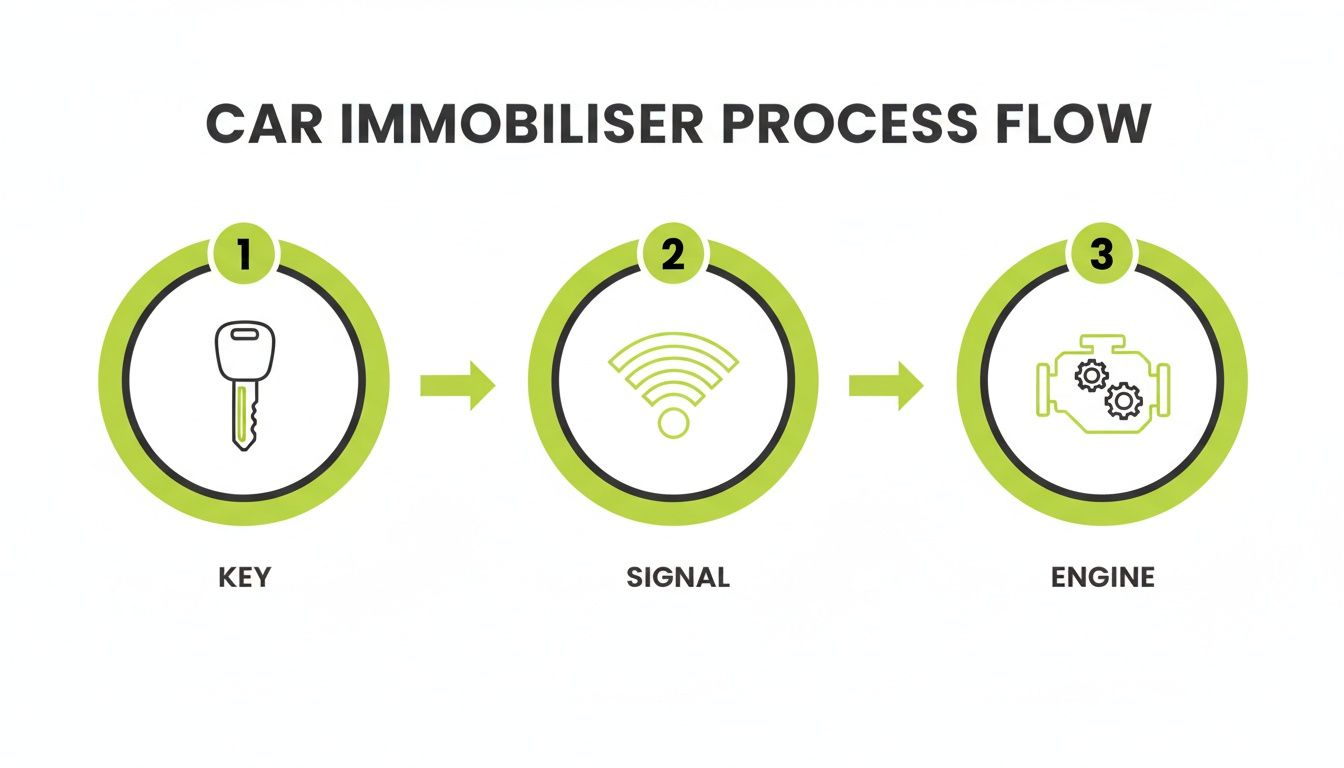
This whole journey—from key to signal to engine—is the fundamental security protocol that stops your car from being hot-wired. The concept is rooted in the same principles of digital security that protect so much of our digital lives.
When manufacturers started fitting immobilisers as standard, the effect on car crime was massive. The UK saw a huge drop in vehicle thefts through the late 1990s and 2000s. Of course, thieves have gotten smarter too, with things like relay attacks, but the immobiliser is still your first line of defence.
If you're keen to learn more about the star of the show, the transponder chip itself, our guide on transponder keys breaks it all down.
Factory Systems vs Aftermarket Upgrades
It's a common misconception that all immobilisers are created equal. The system that came with your car from the factory provides a decent first line of defence, but let's be honest—it's technology that professional thieves have had years to study and crack. As they get smarter, our security needs to get smarter too.

Your standard factory immobiliser is great at stopping old-school hot-wiring. The problem is, criminals aren't using crowbars and twisted wires anymore. The modern car thief uses a relay device to capture the signal from your keyless fob—even if it's safely inside your house—and trick your car into thinking the key is right there. In seconds, they can unlock the doors and drive away without ever laying a finger on your keys.
Why Aftermarket Systems Are a Game Changer
This is exactly where cutting-edge aftermarket systems step in. Products like the Ghost Immobiliser add a completely invisible, yet incredibly tough, layer of security by wiring directly into your car's digital network (its CAN bus). It’s brilliantly simple: before the engine will even think about starting, you have to enter a unique PIN sequence using the existing buttons on your steering wheel or dashboard.
A thief could clone your key, boost its signal, and even sit in the driver's seat. But without knowing your secret button combination, the car is going nowhere. It's a silent, digital deadbolt against even the most sophisticated attacks.
This kind of digital fortress has become essential. With keyless theft now accounting for over 60% of stolen vehicles in the UK since 2020, it’s clear that electronic attacks are the new normal. It's no wonder that many UK insurers now insist on Thatcham-approved aftermarket systems for high-value cars, often rewarding owners with premium discounts of 5-20% for taking that extra step.
Comparing Factory vs Aftermarket Immobiliser Security Features
So, what are the real differences between the security you get off the forecourt and a dedicated aftermarket system? Let's break it down.
Feature | Standard Factory Immobiliser | Aftermarket Ghost-II Immobiliser |
|---|---|---|
Primary Defence | Transponder key authentication. | User-defined PIN code entered via existing car buttons (e.g., steering wheel, window switches). |
Key Vulnerability | Susceptible to relay attacks and key cloning. | No key signal to intercept. Can't be bypassed with key cloning or relay devices. |
Physical Presence | Standardised, known locations for ECU and immobiliser components. | Completely undetectable. No extra fobs, no LEDs, and hidden within the vehicle's wiring loom. |
Bypass Method | Can be bypassed with specialist diagnostic tools or ECU swapping. | Cannot be found or bypassed with diagnostic tools as it communicates via the CAN network. |
Typical Cost | Included with the vehicle. | Professional installation typically costs several hundred pounds. |
Insurance Approval | Standard requirement. | Often required by insurers for high-value vehicles; can lead to premium discounts. |
As you can see, while a factory system is a good start, an aftermarket solution like Ghost closes the modern security gaps that thieves are so skilled at exploiting.
Real-World Protection in the Midlands
Here’s a story we hear all too often: a Range Rover owner in Sutton Coldfield had a Ghost Immobiliser fitted with us. One night, thieves used a relay attack to unlock the doors. They got in, hit the start button, and… nothing. The engine was completely dead. Confused and unable to figure out why, they were forced to abandon the car and flee empty-handed. The Ghost system's PIN request stopped them in their tracks.
For owners of desirable cars in areas from Lichfield to Solihull, an upgrade isn't just an accessory; it's a vital investment. If you want to see exactly how this tech can protect your vehicle, learn more about our Ghost Immobiliser installation. It delivers the kind of peace of mind that factory systems, unfortunately, can no longer guarantee on their own.
A Practical Immobiliser Troubleshooting Guide
Right, so you’ve turned the key, the engine spins over, but it just won’t catch. Or maybe there's a pesky key symbol blinking away on your dashboard, mocking you. Nine times out of ten, that’s your car’s immobiliser having a moment. But before you start picturing expensive garage bills, let’s run through a few simple checks that can often get to the bottom of it.
The tell-tale sign of an immobiliser fault is that all the electrics seem to work just fine – the radio comes on, the lights work, the dash lights up as normal – but the engine itself is a no-go. It’s frustrating, for sure, but it’s a clear clue that the digital "handshake" between your key and your car has failed.
Common Faults and Simple Checks
So, where do you start? Let's walk through the most common culprits we see day in and day out. More often than not, the fix is a lot simpler than you'd think.
Here are the top four issues we constantly deal with across the Midlands, from Cannock to Burton Upon Trent:
Dead Key Fob Battery: This is, without a doubt, the number one cause. That little transponder chip needs a tiny bit of juice to broadcast its code, and a weak battery can stop it dead in its tracks. Before you do anything else, try your spare key. If the car fires up, you’ve found your culprit. Swapping a key fob battery is usually a quick and easy DIY job.
Damaged Transponder Chip: Dropped your keys lately? We all do it. The problem is, the transponder chip inside is delicate. A good knock on the pavement can easily damage it. The key might look perfect on the outside, but if that chip is broken, it can't talk to the car.
Faulty Antenna Ring (Ignition Coil): See that ring around the ignition barrel where you put your key? That's the antenna. Its job is to power up the transponder and "listen" for its code. If it fails, it doesn't matter how good your key is—the signal just isn't getting through. This one usually needs a professional to diagnose properly.
ECU or Key De-synchronisation: Sometimes, the key and the car's brain (the ECU) just forget each other. It sounds odd, but it can happen after the car battery has gone flat, after a jump-start, or even just from a random software glitch. The key essentially needs to be reintroduced to the car's system.
A Real-World Example in Lichfield
Let me paint a picture for you. A customer in Lichfield drops her Ford Fiesta keys on the pavement. She hops in, turns the key, and... nothing. The engine cranks, but the immobiliser light flashes like crazy. She remembers her spare key, gives it a try, and the car starts right up.
This is a textbook case of a damaged transponder chip. The fall was just enough to break the tiny, fragile component inside her main key. The spare key, safe and sound, still had its working chip, which the immobiliser recognised instantly.
In this scenario, the solution isn't a new starter motor or a trip to the main dealer. It's simply a new key. A mobile auto locksmith can drive out to her in Lichfield, cut a fresh key, and program a new transponder chip to match her Fiesta’s ECU right there on the spot. No tow truck needed. If you're curious about what that programming involves, this guide explains how to program car keys and the tech behind it.
When You Need a Mobile Auto Locksmith
So, you've tried the spare key. You've even swapped the fob battery. But the car still just sits there, lifeless. That’s usually the point where the problem is bigger than a simple DIY fix, and it's time to call in the experts.
A mobile auto locksmith is your best friend when it comes to immobiliser trouble. We have the specialist gear and know-how that often surpasses a main dealer, but without the hassle and inflated price tag.
The best part? We come to you. Forget the nightmare of organising a tow truck to the garage, where you’ll probably be waiting for days. Our vans are fully kitted-out workshops on wheels, bringing the solution right to your driveway in Solihull, a supermarket car park in Nuneaton, or the side of the road in Walsall.
Common Scenarios Where We Can Help
Knowing when to pick up the phone can save you a world of time, money, and stress. If you're stuck in any of these situations, it's definitely time to let a professional take the wheel.
Here are a few classic jobs we see all the time:
Lost All Your Keys: It happens to the best of us, but it’s a real security headache. We can come out, wipe the old keys from your car's memory, and then cut and program brand-new ones on the spot.
Damaged Transponder Chip: Dropped your key one too many times? The tiny chip inside can easily get damaged. We can often clone the data onto a fresh key or, if needed, program a completely new one from scratch.
ECU Programming Faults: Every now and then, a car’s brain (the ECU) can get a bit of amnesia and forget the keys it's supposed to recognise. It's called de-synchronisation, and it takes specialist diagnostic tools to get them talking again.
Faulty Ignition or Antenna Ring: Sometimes the key is fine, but the parts in the car that read it have failed. We can diagnose whether it's the antenna ring around the ignition or another component and often fix it right there.
We had a classic callout to a customer in Wolverhampton whose only key had a spin in the washing machine. The remote stopped working, which was annoying, but the real issue was the water-damaged transponder chip. The engine would crank but never fire up. Instead of a pricey tow to the main dealer, we were on-site within the hour, cut a new waterproof key, and programmed it to his car. Job done.
Our Mobile Service Areas
Our whole service is designed to get you moving again as quickly as possible, no matter where you are in the Midlands. We offer a rapid, on-site response across a huge patch.
We cover:
Tamworth
Lichfield
Sutton Coldfield
Cannock
Burton Upon Trent
Solihull
Coventry
Atherstone
Ashby de la Zouch
Coleshill
Nuneaton
Walsall
Wolverhampton
Birmingham
When your car’s immobiliser decides to play up, don't panic. A quick call is all it takes to get an expert to your location, turning a potential crisis into a simple fix.
FAQ: Your Car Immobiliser Questions Answered
We get a lot of questions about how car immobilisers work, their little quirks, and what on earth to do when they decide to play up. To clear the air, we’ve put together some straightforward answers to the queries we hear most often from drivers across the Midlands.
Can I Bypass a Car Immobiliser Myself?
In a word: don't. We strongly advise against even trying this one. While it might seem like a clever shortcut when you're in a pinch, trying to bypass an immobiliser is a seriously complex job that digs deep into your car's electronics. It’s incredibly easy to get wrong.
One misplaced wire or a slip of the hand could fry your car's Engine Control Unit (ECU), and that’s a repair bill you really don’t want to see. Even if you succeed, you’ve just removed a critical layer of security, making your car a sitting duck for thieves and potentially voiding your insurance. It’s just not worth the risk.
How Much Does It Cost to Fix an Immobiliser Problem?
This is a classic "how long is a piece of string?" question. The cost to sort out an immobiliser fault really depends on what’s causing it. The fix can be anything from dead simple to quite involved.
Here’s a rough idea of what you might be looking at:
Key Fob Battery Replacement: This is the best-case scenario. It’s a cheap and easy fix, often costing just a few quid if you pop a new battery in yourself.
New Transponder Key: If your key's internal chip has given up the ghost or you’ve lost the key entirely, you'll need a replacement. For a mobile auto locksmith to come out to you in places like Atherstone or Ashby de la Zouch to cut and program a new key, you're typically looking at £90 to £300+, depending on the make and model.
ECU or Antenna Ring Repairs: If the problem lies deeper within the car's own hardware, the cost will naturally be higher. The good news is that a specialist auto locksmith is almost always a more wallet-friendly option than heading back to the main dealer.
Will Changing My Car Battery Affect the Immobiliser?
For most modern cars, the answer is no. The immobiliser system is designed to remember its programmed keys even when the main battery is completely disconnected. You should be able to swap your battery without any drama.
That said, on some older vehicles or if the battery has been disconnected for a very long time, there's a slim chance the system might lose its sync with the key. If your car refuses to start right after a battery change and the little immobiliser light is flashing away, that’s a tell-tale sign it needs reprogramming.
Is an Aftermarket Immobiliser Worth It?
Absolutely, one hundred percent. This is especially true if you own a desirable car or a model that’s a known target for thieves in areas like Birmingham or Coventry. The immobiliser your car came with is a decent deterrent against opportunists, but organised criminals have found ways around them, like the notorious relay attacks on keyless entry cars.
An aftermarket system like a Ghost Immobiliser adds a powerful, invisible shield. It works by requiring a unique PIN, entered using your car's own buttons (like the window switches or volume controls). This completely neuters key cloning and signal-boosting attacks. It's simply one of the best ways to protect your car from modern theft methods.
Think of it as a worthwhile investment. You’re protecting your pride and joy while staying one step ahead of the thieves, and it often helps with stricter insurance requirements, too.
Whether you're staring at your keys through a locked window, dealing with a faulty immobiliser, or wanting to beef up your car's security, Top Motor Keys is here to help. We provide fast, reliable, and professional mobile auto locksmith services across the Midlands. Don't let a key or immobiliser issue ruin your day—give us a call for a free, no-obligation quote. Find out more at https://www.topmotorkeys.co.uk.