
How to fix key won't turn in car: quick ignition tips

That sinking feeling when your key won’t turn in your car’s ignition is one every driver knows. You’re ready to set off, you pop the key in, and it simply won’t budge. Before you panic, most of these hiccups are down to a couple of simple causes—and you can often sort them yourself in seconds. At Top Motor Keys, we provide mobile auto locksmith services across the West Midlands, including Birmingham, Dudley, Leicester, Coventry, Stafford, and Wolverhampton, so we've seen this issue countless times.
Your First Steps When Your Car Key Is Stuck
It happens in driveways and supermarket car parks all over the UK. Rather than calling for help straight away, try these no-tools checks first. They’ll fix the majority of cases without costing you a penny.
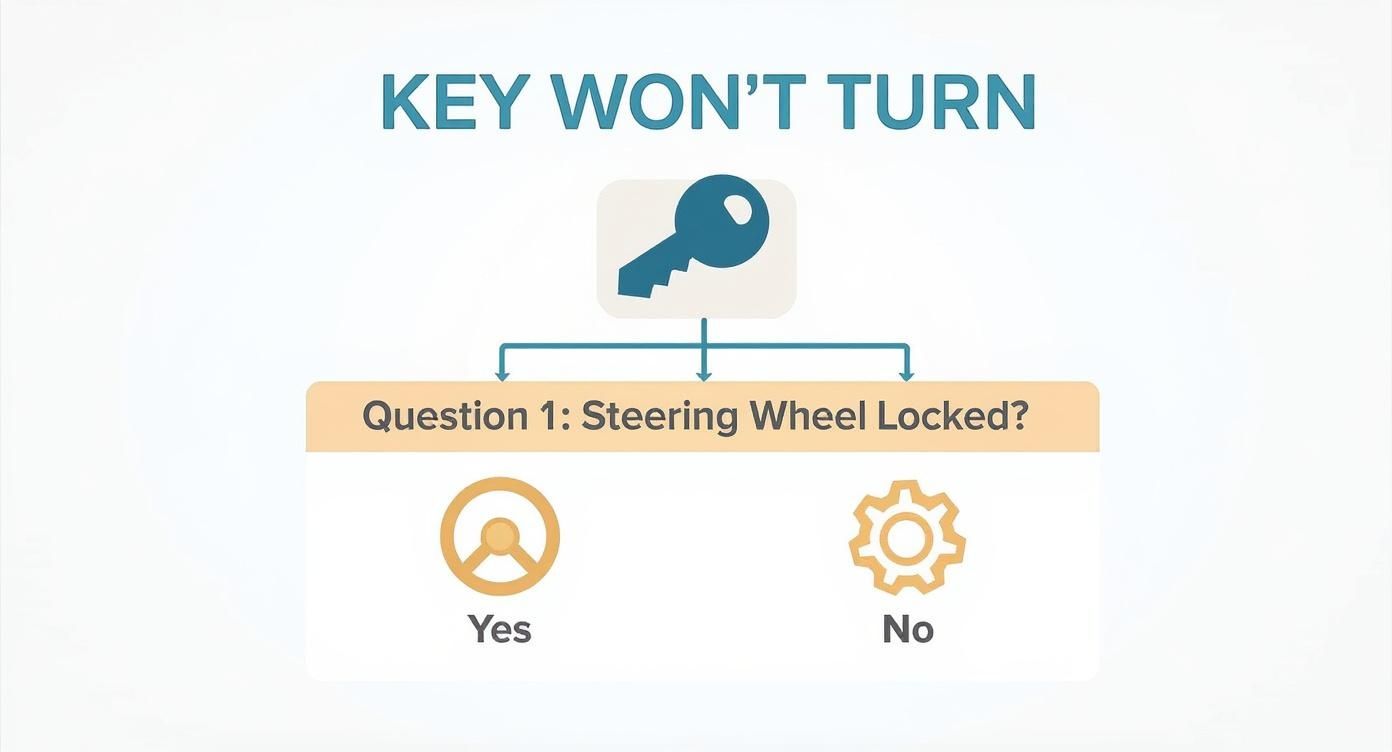
Check The Steering Wheel Lock
This anti-theft feature kicks in when the steering wheel moves after you’ve removed the key.
How It Works: A small bolt slides into the steering column, locking everything solid and putting pressure on the ignition cylinder.
What You’ll Feel: The key feels stuck rock-solid and the wheel won’t turn.
DIY Fix: Rock the wheel gently from side to side and, at the same time, twist the key. You’ll hear a click as the tension releases and the key turns smoothly.
Real-Life Example: We recently helped a driver in Birmingham whose Fiesta refused to start. She was convinced the ignition was shot, but a quick wiggle of the wheel and key unlocked it in under 30 seconds—no call-out needed.
Verify The Gear Selector Position
If you drive an automatic, there’s a safety interlock that stops the engine unless you’re in ‘Park’ (P) or ‘Neutral’ (N).
Sometimes on a slope, the lever looks like it’s in Park but isn’t fully home. Give it a firm push into P, or shift to N and back to P, then try the key again.
Quick Troubleshooting Guide
Use this table to pinpoint the most likely cause and your first DIY move.
Symptom | Likely Cause | First Action To Take |
|---|---|---|
Key feels rock-solid | Steering Wheel Lock Engaged | Wiggle wheel side-to-side while turning key |
Key won’t turn, shifter looks in P | Gear Selector Mis-aligned | Push lever fully into Park (or N then back to P) |
Key twists without resistance | Worn/Bent Key or Debris | Inspect key for wear; spray graphite powder in lock |
Even if these tips don’t do the trick, you’ll at least know what’s wrong before you ring a mobile locksmith. And often, that bit of insight can save you time and money.
Figuring Out What's Really Wrong
So, the quick wiggle of the steering wheel didn't work. Annoying, but not the end of the world. Now we need to put on our detective hats and figure out the real reason your key won't turn in the car. Just diving in without a plan can make things worse, so let's start with the most obvious culprit: the key itself.
Take a good, hard look at your car key. Is it bent, even a tiny bit? Look for any hairline cracks. After thousands of twists and turns, the teeth can wear down, getting just rounded enough that they can no longer line up the tiny pins inside the ignition.
Your Spare Key Is the Ultimate Test
Hopefully, you have a spare key somewhere handy. It’s the most important diagnostic tool you own.
If the spare key works like a charm: Brilliant! The problem isn't your car; it's your old key. It’s either too worn, bent, or damaged. You'll need to get a new key cut, but at least you know the ignition is okay.
If the spare key also gets stuck: This is a big clue. The problem is almost certainly inside the ignition lock cylinder. It could be anything from gunk and debris to a worn-out or jammed internal part.
Real-Life Example: I remember a customer who swore his key was perfect. At a glance, it looked fine. It was only when I laid it flat on a table that we saw the tiniest, almost invisible bend in the blade. That was all it took. His spare key started the car instantly and confirmed our suspicions.
This simple test immediately narrows down the possibilities.
Giving Your Ignition Lock a Gentle Clean
If both your keys are refusing to turn, the next thing to check is a dirty or blocked ignition. Before you reach for that can of WD-40, stop! Oily lubricants are magnets for dust and grime, and over time they create a thick, sticky gunk that will only make the problem worse.
Instead, start with a can of compressed air. Pop the thin straw into the keyhole and give it a few quick, sharp blasts to blow out any lint or debris.
If it still feels sticky, use a proper lock lubricant. You want either a silicone-based spray or a powdered graphite lubricant, as these won't leave a residue. A tiny squirt is all you need. Apply it directly into the keyway, then gently insert your key, wiggling it in and out a few times to work the lubricant into the mechanism.
Exploring Common Mechanical Failures
Sometimes, the reason your key won't turn in the car is a bit more serious than a simple jam. Just like any other part of your car, the mechanical bits of your ignition system can simply wear out over time.
The most frequent offender is the ignition lock cylinder itself. Inside are tiny, spring-loaded pins or wafers that have to line up perfectly with the cuts on your key. After countless turns, these delicate parts can wear down, get sticky, or even break.

Signs of a Failing Ignition Cylinder
A failing ignition cylinder rarely dies without warning. Spotting these hints early can save you the hassle of being stranded.
The Wiggle Dance: You find yourself having to jiggle the key more and more to find that one "sweet spot" where it finally turns.
A Loose Fit: The key feels sloppy in the ignition, not snug like it used to.
Getting Stuck: Your key might turn to the 'accessory' position but then hit a wall when you try to start the engine.
These symptoms all point to a mechanism that's on its last legs. For a deeper dive, have a look at our practical guide to fixing an ignition barrel that won't turn.
Real-Life Example: We had a client in Wolverhampton with this exact problem in his older Vauxhall Astra. For weeks, he’d been doing a complicated little ritual of wiggling and twisting just to get it started. Then, one morning, nothing. The internal wafers had finally worn down so much that no key, not even a freshly cut one, could get them to line up.
When Modern Technology Is the Problem
It's easy to blame a mechanical fault when your key won't turn in the car, but more and more often, the real culprit is hiding in the complex electronics packed inside the key itself.
The most common gremlin is the transponder chip. This tiny, battery-free chip is nestled inside the plastic head of your key. When you put the key in the ignition, your car's immobiliser system asks for a secret password. If the chip replies with the correct code, you're good to go.
Transponder Troubles and Telltale Signs
The problem is, these chips are delicate. Drop your keys one too many times, and the chip can get damaged or its programming can get scrambled. When that happens, your car simply won't recognise the key. You might find the key fits perfectly and even turns part-way, but the immobiliser will stubbornly refuse to let the engine start.
The classic giveaway of a transponder issue is that flashing security light on your dashboard. You know the one—it usually looks like a little key or a padlock. That’s your car’s way of shouting, "I don't know this key!" You can learn more by checking out our practical guide to transponder car keys.
Real-Life Example: We assisted a customer near Stafford with a Ford Focus. The key turned part-way, the radio worked, but the engine wouldn't crank over. A little red light was blinking furiously on the dash. His transponder chip had failed, and we had to program a new one for him on the spot.
The Surprisingly Common Dead Fob Battery
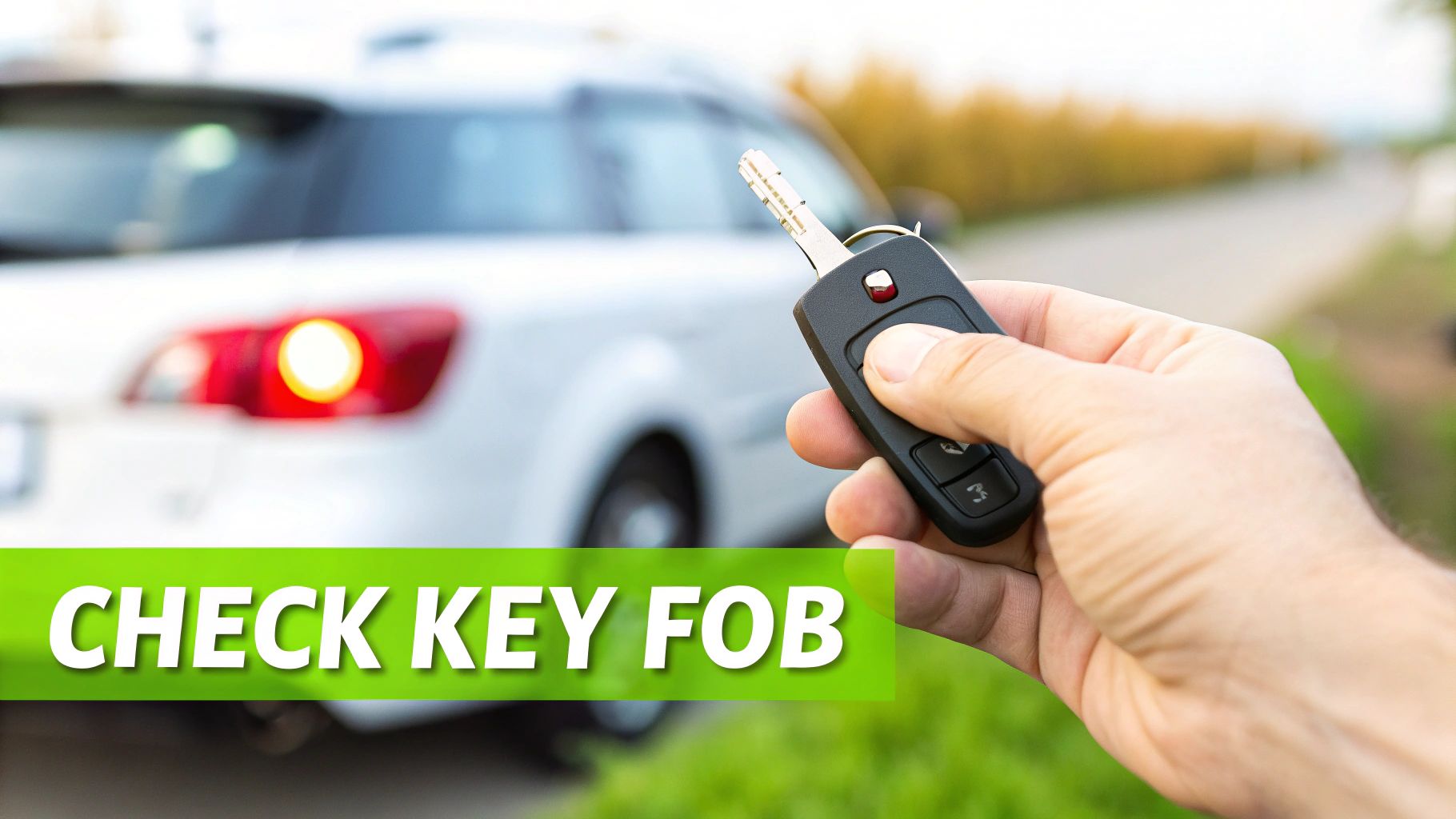
For cars with keyless entry or a push-button start, the problem is often simpler: a dead battery in your key fob. While the transponder chip doesn't need its own power, all the remote locking and keyless start features rely on a small coin battery.
Swapping a fob battery is usually a quick and easy DIY job. Most fobs can be carefully prised open. Inside, you'll typically find a standard coin battery (like a CR2032) that you can pick up from any supermarket.
When It’s Time to Call a Professional
You’ve tried everything, but that key is still stubbornly refusing to turn. At this point, forcing it is a massive gamble. That extra bit of brute force is often what snaps the key blade, leaving half of it wedged deep inside the ignition barrel.
What a Mobile Auto Locksmith Can Do for You
This is where calling in a professional really pays off. A mobile auto locksmith comes directly to you, whether you're on your driveway in Dudley or stuck in a car park in Coventry. No need for a pricey tow truck.
An experienced locksmith has the tools and the know-how for jobs that are well beyond a simple DIY fix:
Extracting a Broken Key: They use specialist tools to pull out a snapped key without wrecking the lock.
Cutting a New Key On-Site: If your key is too worn or bent, they can cut a perfect new one from their van.
Programming Transponder Keys: For electronic faults, they can reprogram a glitchy transponder chip or sync a new key to your car’s immobiliser.
Repairing or Replacing the Ignition Cylinder: If the lock is broken, they can often repair it or replace the entire ignition barrel.
If you’re not sure who to call, our guide on finding reliable auto locksmith services near you for fast roadside help has some great tips.
Estimated Auto Locksmith Service Costs in the UK (GBP £)
Prices vary depending on your car's make, model, and your location. This table gives you a general guide to what you can expect to pay for services across the Midlands.
Service | Estimated Cost Range (£) |
|---|---|
Emergency Call-Out Fee (Daytime) | £70 - £120 |
Standard Key Cutting (Non-Transponder) | £80 - £150 |
Transponder Key Cutting & Programming | £120 - £250 |
Broken Key Extraction from Ignition | £90 - £180 |
Ignition Cylinder Repair / Replacement | £150 - £400+ |
Getting a specialist out is often cheaper than a tow truck and main dealer prices. Always ask for a clear quote upfront.
Frequently Asked Questions
When you're staring at a key that refuses to turn, your mind probably races with questions. Let's tackle some of the most common ones we get from drivers.
Is It Okay to Squirt WD-40 in My Ignition?
It's a common thought, but please never use WD-40 in a car's lock cylinder. It leaves a sticky film that attracts dust and grime, making the problem worse over time. The right tool for the job is a dry graphite or silicone-based lock lubricant.
My steering wheel isn't locked, but the key still won't budge. What's next?
First, ensure your gear stick is firmly in 'Park' or 'Neutral'. If that doesn't work, inspect your key for wear or damage. The crucial test is your spare key. If the spare works, your original key is the problem. If the spare also gets stuck, the fault is almost certainly inside the ignition lock cylinder.
What's the damage? How much to replace an ignition cylinder in the UK?
The cost depends on the car. For a straightforward mechanical lock, an auto locksmith might charge between £150 and £300. For modern cars with complex security systems, the price to replace and program a new cylinder can be anywhere from £400 to over £700.
If you've run through all the checks and you're still stuck, forcing it is only going to cause more expensive damage. For quick, expert help right where you are in the West Midlands, Top Motor Keys provides a 24/7 mobile service. We come to you and fix everything from snapped keys to knackered ignitions on the spot. Ring us for a free, no-pressure quote.