
What Is the Meaning of Immobiliser and How It Secures Your Car

Ever wondered what actually stops a thief from smashing a window and hot-wiring your car like they do in the movies? The answer is a clever bit of kit called an immobiliser. It’s your engine’s own personal bodyguard, and it’s way smarter than a simple lock and key. This guide will walk you through the meaning of an immobiliser, how it works, and what to do when things go wrong.
What an Immobiliser Really Does for Your Car's Security
Think of an immobiliser as a digital bouncer for your engine. It's not a noisy alarm designed to scare thieves away; it’s a silent, invisible guardian that works behind the scenes. Its only job is to ask one simple question every time you try to start the car: "Are you who you say you are?"
The whole thing works like a secret digital handshake. Tucked away inside your car key is a tiny microchip, known as a transponder chip. This chip holds a unique, encrypted code—basically, a secret password.
When you slide the key into the ignition (or just have the fob in the car for keyless systems), a small antenna around the ignition barrel sends out a little signal. This signal wakes up the transponder chip in your key, which then sends its secret password back to the car's brain, the Engine Control Unit (ECU).
If the code from the key is a perfect match for the one stored in the ECU, the handshake is complete. The ECU gives the all-clear, and everything roars to life:
Fuel Supply: The fuel pump gets the green light to send petrol to the engine.
Ignition System: The spark plugs are given permission to fire.
Starter Motor: The engine is allowed to crank and run properly.
But if the codes don't match? Say, if a thief is using a cloned key without the right chip, or trying to bypass the ignition? The ECU slams the door shut. The engine might turn over for a split second, but it will instantly cut out. The car is going nowhere.
Your Car’s Unsung Hero
This simple yet brilliant technology is the main reason why hot-wiring has become a thing of the past for most modern vehicles. In fact, since 1998, it's been a legal requirement for all new cars sold in the UK to have a factory-fitted immobiliser. It’s a standard feature that quietly protects millions of us every day.
Of course, for total peace of mind in high-risk areas, services like a professional vehicle security patrol can add another layer of protection. But it all starts with your car's own defences. If you're not sure what your own car is packing, you can find out in our guide on how to check if your car has an immobiliser.
Know Your System: Comparing Different Types of Immobilisers
Not all immobilisers are created equal. While they all share the same basic goal—stopping your engine from starting without permission—the way they do it can be worlds apart. This difference is what separates a truly secure vehicle from an easy target for thieves.
You’ll generally come across two main types: the standard systems fitted in the factory and more sophisticated aftermarket solutions. Getting to grips with what sets them apart is vital for protecting your car, especially if you're in places like Tamworth, Lichfield, or Sutton Coldfield, where car security is a real concern.
Let’s take a look at what you get with each.
Standard Factory-Fitted Immobilisers
Since 1998, every new car sold in the UK has had an immobiliser fitted as standard. This is the system most of us are familiar with. It works using that "digital handshake" we mentioned earlier, where a little transponder chip inside your car key communicates with your car’s Engine Control Unit (ECU). If the codes match, you're good to go.
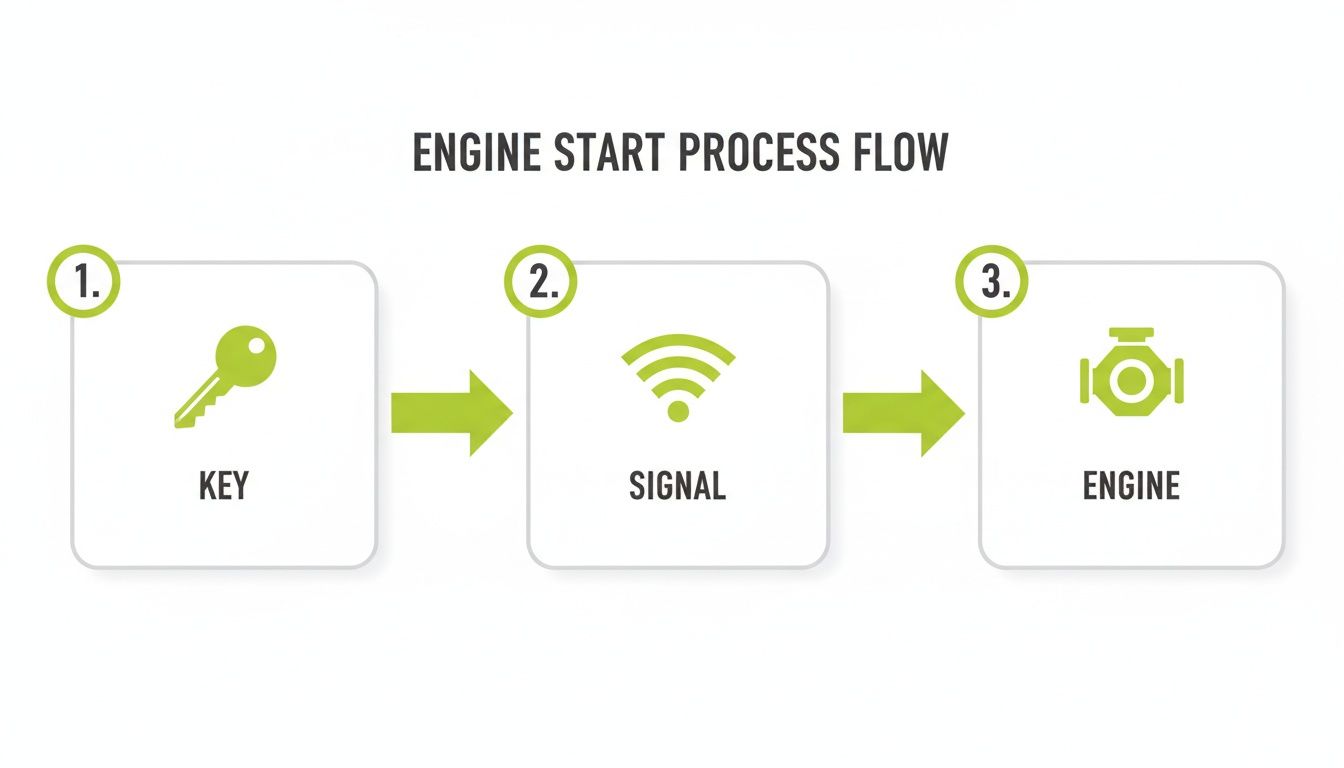
As you can see, it's a simple, three-step process: key sends a signal, the car verifies it, and the engine starts. It was a brilliant defence against old-school hot-wiring. But here's the problem: its strength is also its biggest weakness today. Modern car thieves don't need to physically steal your key anymore.
Advanced Aftermarket Solutions: The Ghost-II Immobiliser
This is where the game changes completely. An advanced system like the Ghost-II immobiliser doesn't rely on a key fob signal that can be easily copied or boosted. Instead, it adds a completely invisible layer of security that only you know.
So, how does it work? Before you can start the engine, you have to enter a unique PIN sequence using the existing buttons in your car—the ones on your steering wheel, dashboard, or doors. There's no extra fob to lose and no tell-tale flashing LED to give away its location. It's completely discreet.
A Ghost immobiliser is like a silent, digital deadlock on your engine. Even if a thief has a perfect clone of your key and is sitting in the driver's seat, the car is going absolutely nowhere until your unique button sequence is entered.
Let’s put that into a real-world context. Picture a thief in a car park in Cannock. They've got a relay attack device, and they've just captured your key's signal from inside a nearby café. With a standard factory immobiliser, they can unlock your car, start it up, and be gone in less than a minute.
But if you have a Ghost-II installed, that relay attack is completely useless. The thief can get in, but the engine is dead to them. They can jab the start button all day long, but without knowing your secret PIN—maybe something like 'volume up, window down, volume up'—they're just wasting their time.
This technology makes modern theft methods pretty much impossible. For anyone with a high-value vehicle in areas from Burton Upon Trent to Solihull, understanding what a Ghost immobiliser installation can do is a crucial step in staying ahead of today’s tech-savvy criminals.
Standard vs. Ghost-II Immobiliser Comparison
To make the differences crystal clear, let's break them down side-by-side. This table shows you exactly what you're getting with a standard factory system versus an advanced aftermarket solution like the Ghost-II.
Feature | Standard Factory Immobiliser | Ghost-II Immobiliser |
|---|---|---|
Operation Method | Transponder chip in the key sends a signal to the car's ECU. | User enters a unique PIN sequence via existing car buttons. |
Vulnerability | Susceptible to modern relay attacks and key cloning. | Not vulnerable to relay attacks as it doesn't rely on key signals. |
Discreetness | Known system, part of the standard car security. | Completely hidden, no extra fobs or LEDs to indicate its presence. |
User Interaction | None required beyond having the correct key. | Requires the driver to input the PIN before starting the car. |
Security Level | Basic protection against traditional theft. | High-level protection against sophisticated modern theft techniques. |
Installation | Comes pre-installed from the factory. | Professional aftermarket installation required. |
Cost | Included in the vehicle's purchase price. | Additional investment for supply and fitting. £499 - £599 |
Ultimately, while factory immobilisers provide a baseline of security that was effective years ago, they simply can't keep up with modern criminals. The Ghost-II offers a robust, modern defence that puts you back in control.
Spotting the Signs of a Faulty Immobiliser
Think of your car's immobiliser as its silent bodyguard. It works away in the background, keeping your vehicle safe. But when it starts acting up, it can quickly turn into a frustrating gatekeeper, leaving you stranded and staring at a car that simply won't start.
The good news? A total failure is rare. Usually, your car will throw out a few warning signs first. Learning to spot these clues can be the difference between a quick, simple fix and an expensive recovery truck from a car park in Tamworth. Let's run through the classic symptoms of an immobiliser problem so you can figure out what your car is trying to tell you.
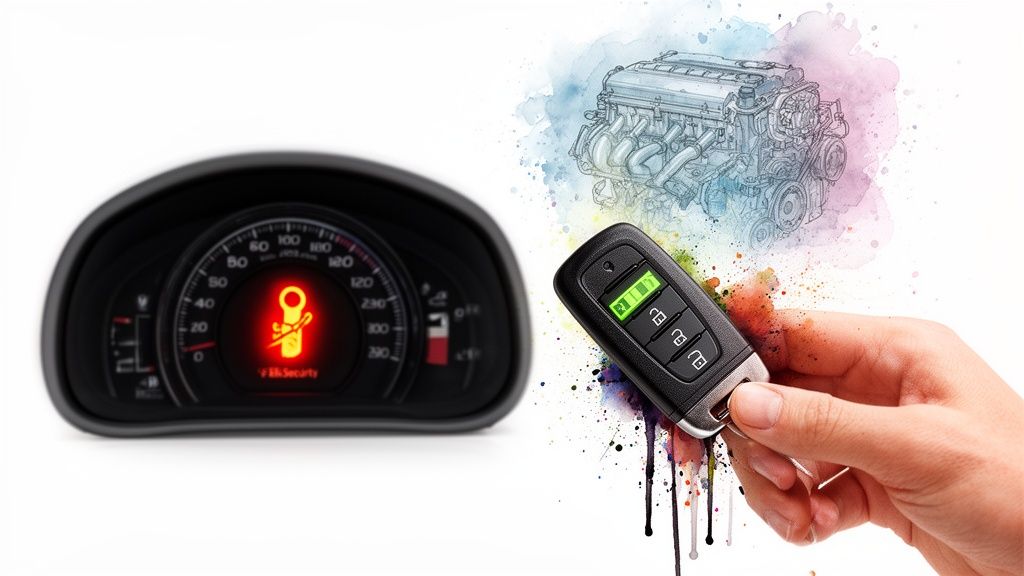
Common Symptoms of an Immobiliser Fault
If your immobiliser is on the blink, you’ll probably notice one or more of these tell-tale signs. They can be subtle at first but tend to get more obvious over time. Keeping an eye out for them can save you a world of hassle.
Here are the most common red flags to watch for:
The Flashing Security Light: You know that little warning light on your dash, the one shaped like a key or a car with a padlock? Normally, it flashes steadily when you lock the car. If it's flashing erratically or stays lit up when you try to start the engine, that's a dead giveaway the immobiliser system has spotted an issue.
Car Starts, Then Immediately Cuts Out: This is the absolute classic. You turn the key, the engine roars to life for a second or two, and then... silence. It just dies. This happens because the immobiliser gives the green light for the initial crank but then cuts off the fuel or spark when it doesn't get the right code from your key.
Remote Locking and Unlocking Fails: Sometimes, the problem isn't the car's immobiliser unit but the key fob itself. If you suddenly can't lock or unlock your doors with the remote, it could just be a dead battery in the fob. A flat battery means the transponder chip inside can't get the power it needs to 'talk' to the car.
The Key Isn't Recognised at All: You pop the key in, turn it, the dashboard lights up, but the engine won't even try to turn over. Nothing. This often points to a complete breakdown in communication between the key's transponder chip and the car's computer.
So, What's Causing the Problem?
Recognising the symptom is the first step, but figuring out the cause helps you decide what to do next. An immobiliser fault doesn't automatically mean you’re facing a massive repair bill.
Here’s a breakdown of what could be going wrong behind the scenes:
Dead Key Fob Battery: This is by far the most common and easiest problem to fix. The transponder chip in your key fob needs a tiny bit of juice to send its code. No battery power means no code, and no code means no starting the car.
Damaged Transponder Chip: We all drop our keys. But one drop too many can damage the delicate chip nestled inside the fob. Even though it's protected, a hard knock can break the internal connections and render the key useless.
Faulty Ignition Barrel Antenna: There’s a small ring-shaped antenna (often called a coil) around your ignition barrel. Its job is to power up and read the chip in your key. If this little component fails, the car has no way of reading your key's code, even if the key is perfectly fine.
ECU De-synchronisation: This one's a bit rarer, but the car's main computer (the ECU) can sometimes forget the keys that are programmed to it. This can happen after the car battery has gone completely flat or if there's been some electrical work done on the vehicle.
If you’re facing any of these issues anywhere from Coventry to Wolverhampton, don’t panic. A quick call to a mobile auto locksmith means we can come out and diagnose the exact problem on the spot, whether it’s a simple key reprogram or a more involved fix.
When to Call a Mobile Auto Locksmith for Help
Let’s be honest, sometimes changing the battery in your key fob just isn't going to fix it. Knowing when to step back and call in a professional can save you a mountain of time, stress, and even money. If you're wrestling with a stubborn immobiliser fault, getting an expert on the case is always the quickest way to get back behind the wheel.
Some situations are just dead giveaways that you need a specialist. Trying to fix complex electronic issues yourself can easily make things worse, potentially frying your car’s sensitive computer systems. If any of the following scenarios sound familiar, it’s time to pick up the phone.
Scenarios Demanding Expert Help
Here are a few of the classic red flags that tell you it's time to call a mobile auto locksmith:
You've Lost All Your Keys: This is a big one. If you have no keys at all, a locksmith is your only real option. We can create a brand new key from scratch and program it to your car’s brain right there on the roadside.
Suspected Transponder Chip Damage: Dropped your keys one too many times? The tiny transponder chip inside could be broken. You need specialist gear to diagnose this properly and sort out a replacement.
Your Car's ECU Has Lost Sync: It happens. After a flat battery or an electrical glitch, the car's main computer can simply 'forget' your key. A locksmith can re-introduce them, a process we call re-synchronisation.
Ignition Barrel or Antenna Fault: What if the key is fine, but the car isn't reading it? A pro can test the components around the ignition that are meant to pick up the key's signal and sort out any faults.
You Need a Security Upgrade: Thinking about stepping up your car's protection with something like a Ghost-II immobiliser? This is absolutely a job for certified installers. A proper installation ensures it works perfectly and doesn’t mess with your car’s warranty.
The Advantage of a Mobile Service
The most frustrating part of an immobiliser problem is that your car is, well, immobilised. That’s where a mobile service like Top Motor Keys really shines. Forget about ringing a tow truck to haul your car to a dealership, only to wait days for them to even look at it. We come directly to you.
Our mobile workshop is fully kitted out to handle pretty much any key or immobiliser issue, wherever you are. That means no towing fees, no long waits, and a much faster fix to get you moving again.
This on-the-spot service is more important than ever. Freedom of Information data showed that over 80,737 vehicles were stolen in England and Wales in just the first nine months of 2025. You can read more about these worrying car theft trends on the Co-op Insurance website.
Our Service Area in the Midlands
We provide fast, reliable help across a wide patch of the Midlands. Whether you're stuck with an immobiliser fault in Birmingham, need a key programmed in Wolverhampton, or want to look at better security options in Coventry, we've got you covered. For more tips, have a look at our guide on finding reliable auto locksmith services near you.
We’re proud to serve all these locations:
Tamworth
Lichfield
Sutton Coldfield
Cannock
Burton Upon Trent
Solihull
Coventry
Atherstone
Ashby de la Zouch
Coleshill
Nuneaton
Walsall
Wolverhampton
Birmingham
Immobiliser Troubleshooting Guide
Before you panic, try these simple steps. Sometimes, the fix is easier than you think.
Check the Key Fob Battery: This is the number one culprit. Replace the battery in your key fob. It's cheap, easy, and often solves the problem instantly.
Try Your Spare Key: If you have a spare key, try using it. If the spare works, you know the problem is with your primary key (likely a dead battery or damaged transponder chip).
Check for Interference: Are you near large radio transmitters or in an underground car park with lots of electronic equipment? Strong radio signals can sometimes interfere with the key's signal. Move the car a few feet if possible and try again.
Reset the System: Lock and unlock the car a few times with the key in the door lock (not the remote). This can sometimes force the system to resynchronise.
Check the Car Battery: A very low or failing car battery can cause all sorts of electrical gremlins, including immobiliser faults. Ensure your main car battery is in good health.
If none of these steps work, it’s time to call in a professional.
FAQ: Your Immobiliser Questions Answered
Can I just bypass my car's immobiliser myself?
Honestly? Please don't. It's one of those things where a quick YouTube search makes it look simple, but the reality is a world of pain. Trying to bypass a modern immobiliser without the right gear can fry your car's Engine Control Unit (ECU). Suddenly, a key problem that we could fix for you on your driveway in Atherstone turns into a nightmare repair bill that could easily run into the thousands. It’s always safer and cheaper to call a professional.
Will changing my car battery mess up the immobiliser?
For most modern cars, no. The unique code is stored in non-volatile memory that doesn't need power. However, on some older or more sensitive vehicles, a complete power loss can cause the key and ECU to lose sync. If your car won't start after a battery change, this is likely the cause, and it will need reprogramming.
What's an immobiliser repair going to cost me?
That really depends on what’s gone wrong. It could be as simple as a new battery for your key fob, which is just a few quid. If you've lost your key and need a new one cut and programmed in places like Nuneaton or Coleshill, you’re likely looking at somewhere between £120 and £300+, depending on the make and model of your car. If the fault is deeper in the car's electronics, the cost will be higher. We always provide a clear quote upfront.
Do I actually need an immobiliser for my car insurance?
Yes, absolutely. To get cover for theft, UK insurers insist on a factory-fitted, Thatcham-approved immobiliser. Thankfully, almost every car made since 1998 has one as standard. If your immobiliser is broken or has been removed, your insurer could refuse to pay out if your car is stolen. With vehicle theft a significant issue, as shown by UK car theft trends on wecovr.com, it's a critical component.
Ready to make sure your vehicle is properly secured? Whether you're stuck in Birmingham, need an upgrade in Coventry, or you're anywhere else in the Midlands, Top Motor Keys is on call 24/7. We offer a fully mobile service for everything from key programming and emergency lockouts to Ghost-II immobiliser installations.
Get in touch today for a free, no-obligation quote and see how easy it is to get dealership-level expertise right on your doorstep. Find out more at https://www.topmotorkeys.co.uk.