Search Results
Search this site
67 results found with an empty search
- Locked Out? Your Practical Guide to Finding an "Auto Locksmith Near Me 24/7"
We’ve all been there. That heart-stopping, stomach-lurching moment when you pat your pockets and… nothing. You’re locked out of your car, the keys have vanished, and a wave of panic starts to wash over you. It's a common, frustrating problem that needs a quick solution. Your first instinct is probably to grab your phone and frantically search for an "auto locksmith near me 24/7". But before you do, just take a breath. A few seconds to think clearly right now can genuinely save you a ton of time, money, and stress. This guide will walk you through exactly what to do, step-by-step. The Moment of Realisation: Your Car Keys Are Gone It’s a horrible feeling. One minute you’re walking out of the Bullring in Birmingham, the next you’re stranded next to your car in a quiet, dark car park. It’s scary, especially when it’s late or you’re somewhere you don’t know. The absolute first thing to do is make sure you're safe. If you feel vulnerable, move somewhere well-lit—like a nearby shop or petrol station—before you start making calls. Once you’re in a safe spot, then you can work out exactly what’s happened. What’s Actually Wrong? A Quick Troubleshooting Guide The kind of help you need really depends on the specifics of your situation. Getting stranded with a key snapped off in the ignition on a back road in Warwickshire is a whole different ball game to accidentally locking your keys in the boot at a supermarket in Coventry. Before you ring anyone, try to pin down the problem. This helps the locksmith know what they’re dealing with and give you an accurate price. Simple Lockout? This is the best-case scenario. If you can see your keys sitting on the passenger seat, it’s usually a quick and cheap fix. Totally Lost Keys? Have they disappeared completely? This is a common call-out. A locksmith will need to create a brand new key from scratch and program it to your car, right there on the spot. Broken Key? Is part of the metal blade stuck in the door lock or the ignition? This requires an extraction, a delicate job, before a new key can even be cut. Faulty Fob? Is your key fob not working? Troubleshooting Step 1: Try the spare key if you have it. If that works, the problem is your main key. It could be a simple dead battery, which you can replace yourself, or a more complex issue with the transponder chip inside. If the spare doesn't work either, the issue might be with the car's receiver. Real-Life Example: We recently helped a customer in Leicester whose key fob suddenly stopped working. They assumed they'd need a costly new key. However, after a quick diagnosis, we found it was just the battery. A five-minute fix saved them a significant amount of money and stress. Giving the locksmith as much detail as possible over the phone leads to faster, more accurate service. How to Find a Real 24/7 Auto Locksmith It’s late, you're locked out of your car, and your first thought is to frantically Google "auto locksmith near me 24/7" and dial the top result. But hold on. Hitting that call button too quickly can land you with a national call centre that just farms out the job to the nearest, often overpriced, subcontractor. The trick is to cut through the noise and find a genuine local expert who actually knows the West and East Midlands. It’s about spotting the signs of a real, local business, not just a faceless middleman. Spotting a Genuine Local Locksmith Imagine you're stuck in a Coventry car park, scrolling through search results on your phone. Here’s a quick mental checklist to run through before you make the call: Look for a Proper Local Address: Do they have a physical address somewhere in the Midlands? A lot of national outfits will just list a vague "service area" to cover their tracks. Check the Phone Number: A mobile number is standard for a mobile service, but a local landline number alongside it—like an 0121 for Birmingham or an 02476 for Coventry—is a brilliant sign they're genuinely based in your area. Analyse the Photos: Are you seeing slick, generic stock photos? Or are you seeing real pictures of their van, their equipment, and the actual people who will be turning up? Authentic photos show a real business. Taking an extra two minutes to check these things can be the difference between a fair price and a massive headache. A true local locksmith cares about their reputation in the community, which usually translates to better service and honest pricing. This is more important than ever, especially with the shocking rise in vehicle crime. Modern keyless entry systems are a prime target for thieves. In fact, over 100,000 vehicles are stolen each year using these high-tech methods, and a staggering 72% of them are never seen again . This crime wave has created a huge demand for skilled technicians who can handle complex modern keys day or night. You can read more about this spike in demand here . Critical Questions to Ask Before They Drive Out That first phone call is your best line of defence against getting stung. A few sharp questions can save you from surprise costs and a whole lot of hassle later on. Real-Life Example: A driver near Wolverhampton got locked out of their Ford Fiesta and was quoted £50 on the phone. When the locksmith showed up, the bill suddenly ballooned to £150. Turns out there was a hidden "emergency call-out fee" and a charge for "specialist tools." This happens all the time. Asking the right questions from the start would have prevented that situation. Our whole process is designed to be simple and transparent, right from that initial call. It’s straightforward: you ring us, we get a local expert on the road, and you’re back in your car. But the magic really happens in that first step – making sure your call is as effective as possible. Getting a Price That Won't Change Never, ever settle for a vague estimate. A professional auto locksmith will be able to give you a firm, final price once they know your car's make and model and what the problem is. Your Essential Auto Locksmith Checklist Question Category What to Ask Why It Matters Pricing "Can you confirm the total, all-in price, including VAT and any call-out fees?" This flushes out hidden charges. The price they give you should be the price you pay, full stop. Timing "What’s your realistic ETA to my location?" A truly local locksmith in the Midlands should be able to get to you within 30-60 minutes . A vague answer suggests they might be miles away. Experience "Have you worked on a [Your Car Make/Model] before?" This is vital for modern cars with complex security systems, like a new Audi or BMW. You need someone who knows what they're doing. Identification "Will you be in a marked van and have ID?" It's a basic safety check. A professional will always be able to identify themselves and their business. Keep these questions handy. They’ll help you quickly figure out if you’re talking to a genuine professional. A reputable locksmith will have no problem answering these questions. If they get shifty about the total cost or can't give you a straight answer on their arrival time, that's a massive red flag. Thank them for their time and move on. What to Expect When Your Locksmith Arrives That feeling of relief when the van finally pulls up is brilliant. But what actually happens next? A professional auto locksmith has a methodical way of working to get you sorted safely and quickly. First, they'll need to check you are who you say you are and that the car is actually yours. Don't be offended when they ask to see your driving licence or V5C logbook. This is a crucial security step and a massive green flag. It shows they're a legitimate professional who won't hand car keys over to just anyone. The Process On-Site Once they've confirmed ownership, they'll get down to diagnosing the real issue. Their van is essentially a mobile workshop, packed with specialist gear. For a Lockout: If you’re locked out of your Ford Focus in the middle of Birmingham, a skilled locksmith will use non-destructive entry tools to get you in without leaving a single mark on your car. For Lost Keys: If you've lost the only key for your Vauxhall Corsa in Leicester, they will program a new transponder chip to talk to your car’s immobiliser by plugging their diagnostic kit directly into the car’s OBD port, right there on the roadside. It's a common misconception that you need a main dealer for modern car keys. The tech inside a good locksmith's van is often the same, if not more advanced. The massive difference is that they come to you, saving you the hassle and cost of a tow truck. Knowing what's involved can give you some peace of mind. You're not just paying for a bit of metal; you're paying for a skilled technician with thousands of pounds worth of equipment to solve a complex problem on the spot. When you're frantically searching for an auto locksmith near me 24/7 , this is the level of on-site, expert service you should be looking for. Where We Cover: 24/7 Service Across the Midlands When you’re stuck on the roadside frantically Googling “auto locksmith near me 24/7”, you need to know that ‘near me’ isn't just a marketing slogan. It has to mean someone can actually get to your car, and fast. That’s why we’re completely upfront about where our mobile workshops operate. We’re a local Midlands business, not some faceless national call centre, and our vans are strategically placed to offer real, rapid support right across the heart of England. Our Core Service Areas We’ve made it our mission to cover a huge patch of the Midlands so you’re never left stranded for long. You’ll find our mobile technicians covering: West Midlands: Including Birmingham , Coventry , Wolverhampton , and Solihull . East Midlands: Including Leicester , Nottingham , and Derby . Surrounding Regions: We also cover a good chunk of the surrounding areas, including most of Warwickshire . This local knowledge is everything. It means we know the back roads and the traffic hotspots, which helps us get to you quicker. It’s a challenging industry, and being able to provide that fast, localised service is what makes all the difference. If you're curious about the industry itself, The Locksmith World offers some great insights into what it takes. Ultimately, we're here for the Midlands community. Whether you’ve locked your keys in the car at a shopping centre in Solihull or lost them completely after a night out in Nottingham, we’re on call. For example, we have technicians providing dedicated support for drivers who need an auto locksmith in Birmingham at all hours. With the locksmith franchise market expanding, reliable local service is more important than ever. You can read more about the growth of the locksmith franchise market to understand the trends. Frequently Asked Questions (FAQ) When you're stranded, you need clear, straight answers. Here are the most common questions we hear from drivers in a jam. How much will this cost me? This is usually the first question, and the honest answer is: it depends. The price is shaped by your car's make and model, the specific problem, and the time of day. Getting into a Ford Fiesta in central Birmingham on a Tuesday afternoon is a different job than programming a new key for a BMW in a remote bit of Warwickshire at 3 AM. Always ask for a fixed, all-inclusive quote when you call. That price should cover everything – the call-out, the labour, and any new parts needed. Will you damage my car getting in? Absolutely not. A professional auto locksmith uses specialised, non-destructive tools designed to open your car without leaving a trace. Your paintwork, window seals, and the lock itself will be completely unharmed. This is the biggest difference between calling a pro and trying to jimmy it open yourself with a coat hanger. I've lost every single key – can you still help? Yes, this is a core part of our 24/7 service. Even with no original key to copy, we can create a brand new one from scratch, right where you are. We cut a new blade and program a new transponder chip to talk to your car’s immobiliser. We also wipe the old, lost keys from the car’s memory so they can no longer be used. Is using an auto locksmith cheaper than the main dealer? In almost every case, yes. Main dealers usually require you to get the car towed to them, which is an immediate extra cost and a massive hassle. Then you could be waiting days for them to order and program a new key. A mobile auto locksmith drives to you, wherever you are. We cut out the towing fees, the dealership labour costs, and the long wait. It's a faster, more straightforward, and more affordable solution. If you're stuck somewhere in the Midlands and need a 24/7 auto locksmith you can count on, give Top Motor Keys a shout. We're fast, professional, and we come to you. Check us out at https://www.topmotorkeys.co.uk or call now for an immediate quote.
- Your Practical Guide to Getting a Spare Car Key
It always starts with that gut-wrenching moment of panic. You’re standing in the car park, patting your pockets, only to see your keys dangling from the ignition inside your locked car. A spare car key isn't just a bit of metal or plastic; it's your get-out-of-jail-free card for moments exactly like this. Think of it as an insurance policy that saves you a mountain of stress, time, and money. Why a Spare Car Key is Essential We’ve all had that sinking feeling. The slow-motion realisation that your only key is gone, snapped in the lock, or staring back at you from the driver's seat. This isn't some rare, unlucky event; key-related mishaps are a daily occurrence for drivers all over the UK. It could be a simple mistake, or it could be a technology glitch, like your key fob battery dying at the worst possible moment. A Real-Life Example Imagine this: Sarah, a nurse finishing a late shift in Birmingham, couldn't find her car keys. After a frantic search, she realised they must have fallen out of her pocket somewhere inside the hospital. With no spare, she was stranded, facing an expensive taxi ride home and the stress of figuring out how to get a new key made the next day, which meant potentially missing her next shift. If Sarah had a spare key with a family member, this crisis would have been a minor inconvenience. Being prepared is genuinely the smartest thing any car owner can do. The numbers are pretty eye-opening. Data shows that a car key problem triggered a breakdown call-out every seven minutes in the UK. Even more shocking, nearly seven million drivers have admitted they don't even have a spare. That’s a huge number of people just one slip-up away from a massive headache. If you want to dive deeper, you can discover more about these car key statistics and see just how easily a backup could save your day. Ultimately, having a spare key ready to go transforms a potential crisis into a minor inconvenience. It’s the difference between being stranded for hours waiting for help and being back on the road in minutes. It's your simple, effective solution for those all-too-human moments of error. Understanding Your Car Key Technology It might sound obvious, but not all car keys are the same. Far from it. Knowing what kind you have is the first step to getting a spare. Your first car probably had a simple mechanical key . Think of it as the Nokia 3310 of the car world—basic, tough, and purely physical. It did one job and did it well: unlocking the door and turning the ignition. No frills, no fuss. The Digital Leap: Transponder Keys Then things got a bit more clever. Transponder keys arrived, adding a small microchip that 'talks' to your car's engine. Without the correct chip, the car simply won't start. This was a game-changer for security, adding a whole new layer of protection. If you want to get into the nitty-gritty, you can check out our practical guide to transponder car keys . The Modern Standard: Smart Keys These days, we have smart keys . With keyless entry and push-button starts, they’re the all-singing, all-dancing smartphones of the car key world. They're packed with technology, incredibly convenient, and, as you'd expect, a lot more complex to replace. A Quick Guide to Car Key Types This table gives you a snapshot of how car key technology has evolved over the years. Key Type How It Works Common Era Replacement Complexity Mechanical Key A unique metal blade physically turns the lock and ignition. Pre-1995 Low – simple key cutting. Transponder Key A microchip in the key sends a unique code to the car's immobiliser. Mid-1990s to late-2000s Medium – needs cutting and electronic programming. Smart Key Uses radio frequencies for keyless entry and push-to-start ignition. Late-2000s to present High – requires advanced programming and syncing. As you can see, the more tech your key has, the more specialised the replacement process becomes. Ultimately, the technology sitting inside your key fob dictates everything. It’s the difference between a simple metal-cutting job and a complex bit of electronic programming. So, What's a Spare Car Key Going to Cost Me? It’s the big question: "How much is a spare key actually going to set me back?" Well, there's no single price tag. The cost hinges entirely on the tech packed inside your key. Think of it like this: a simple, old-school mechanical key is just a piece of metal that needs cutting. That’s straightforward and relatively inexpensive. But a modern smart key? That’s a tiny, sophisticated computer that talks to your car, and it needs specialist programming to get it working, which naturally costs more. What Drives the Price Up? A few things really dictate the final bill. The main culprits are: Your car’s make and model: A spare for a top-of-the-range BMW is going to be a different ball game than one for a trusty Ford Fiesta. The type of key: Is it a transponder key with a chip, or a fully-fledged smart key with keyless entry? The programming involved: The more complex the electronics, the more intricate the programming process becomes. This is a big part of what you’re paying for, which we dive into in our practical guide on how to program car keys . With a huge number of new cars hitting UK roads recently, the demand for these high-tech keys has gone through the roof. Yet, a surprising number of drivers are still chancing it without a spare. That’s a massive gamble when you think about the hassle and expense of losing your one and only key. How to Protect Your Car from Key Theft Having a spare car key on hand is a brilliant bit of peace of mind, but it also comes with a bit of responsibility. If it falls into the wrong hands, that convenience can quickly turn into a massive security risk. These days, thieves are getting incredibly clever. One of their favourite tricks is the "relay attack," where they can capture and boost the signal from your keyless fob—even from inside your house—to unlock and start your car without ever laying a finger on it. So, how do you keep your investment safe? It really boils down to a few smart habits. First off, whatever you do, never hide a spare key inside or on your car. Thieves know every single "secret" spot you can think of. A much safer bet is to leave it securely at home or with a trusted friend or family member. If you've got a modern keyless fob, one of the best and cheapest bits of kit you can buy is a signal-blocking pouch, often called a Faraday bag . It's a simple little wallet that stops thieves from being able to pull off those relay attacks. Don't underestimate the risk. Vehicle theft is a huge problem, and a shocking number of incidents are down to key vulnerabilities. Data shows tens of thousands of vehicle thefts are reported across England and Wales each year. You can dig into the UK car theft statistics on zego.com to see the full picture. And if you do lose a key, the most important thing is to act fast. Our guide on what to do during car lockouts walks you through the essential steps to secure your vehicle. Why a Mobile Locksmith Is Your Best Choice So, you need a spare car key. You've really only got two main routes: the dealership or a mobile locksmith. Heading to the main dealer often feels like a mission. You have to book an appointment, drive all the way over there, and then settle in for a long wait – all while knowing you’re likely paying a premium for the privilege. We think there’s a much better way. Forget the fuss; we offer a solution that's simpler, faster, and much kinder on your wallet. We bring everything you need, right to your doorstep. There’s no need to take time off work or figure out how to get to us – we come to you. Whether you're at home, at the office, or even stuck on the roadside, we can cut and program your new key then and there. It’s a fast, no-drama service that gets you sorted. We cover the entire West Midlands , Staffordshire , and parts of the East Midlands , taking the headache out of getting a new key. Spare Car Key Troubleshooting Guide Sometimes, even a spare key can have issues. Before you call for help, here are a few simple things you can check yourself: Problem Possible Cause What to Do Key won't unlock the doors remotely The key fob battery is dead or weak. Try replacing the battery first. It’s a common and easy fix. Key unlocks doors but won't start the car The transponder chip has lost its programming or is damaged. The key will need to be professionally reprogrammed to sync with your car’s immobiliser. The new spare works, but the old key stopped The old key may have been de-programmed during the process of adding the new one. Both keys might need to be reprogrammed together to ensure they are both recognised by the vehicle. Key is physically damaged (cracked casing) The internal electronics might be exposed or damaged. Get a professional to assess it. Sometimes the internal parts can be moved to a new casing. FAQ: Your Questions Answered Got a few lingering questions? Don't worry, most people do. The world of car keys can seem a bit technical, but we're here to make it simple. Let's tackle some of the most common things we get asked. How long will it take to get my spare key made? This all comes down to the type of key you have. If you've got a basic, old-school mechanical key, we can cut a copy in a matter of minutes. It's that quick. For the more modern transponder and smart keys, there's a bit more to it. We have to cut the physical blade and then program the chip inside to talk to your car's computer. Even then, you’re only looking at around 30 to 60 minutes . The best part? We do it all right there on your driveway, so you're not stuck waiting around in a garage. What if I've lost my only key? Can you still help? Absolutely. This happens more often than you'd think, so please don't panic! Even if you have no key to copy, we have the specialist tools to create a brand new one from scratch. We can safely access your vehicle's immobiliser system to cut and program a fresh key that works perfectly. As an extra security step, we'll also wipe the old, lost key from the car's memory, so it's completely useless if anyone finds it. Will my new spare work exactly like the original? You bet. We make sure your new spare is a perfect match for your old one, with every single function working just as it should. That means remote locking, popping the boot, and starting the engine will all work flawlessly. Before we leave, we'll run through a full test with you to make sure you're 100% happy and confident that you're good to go. Ready to get that peace of mind a spare key brings? The crew at Top Motor Keys is standing by to sort you out with our fast, on-the-spot service. Get a free quote today and cross one more worry off your list.
- A Simple Guide to Car Key Fob Battery Change
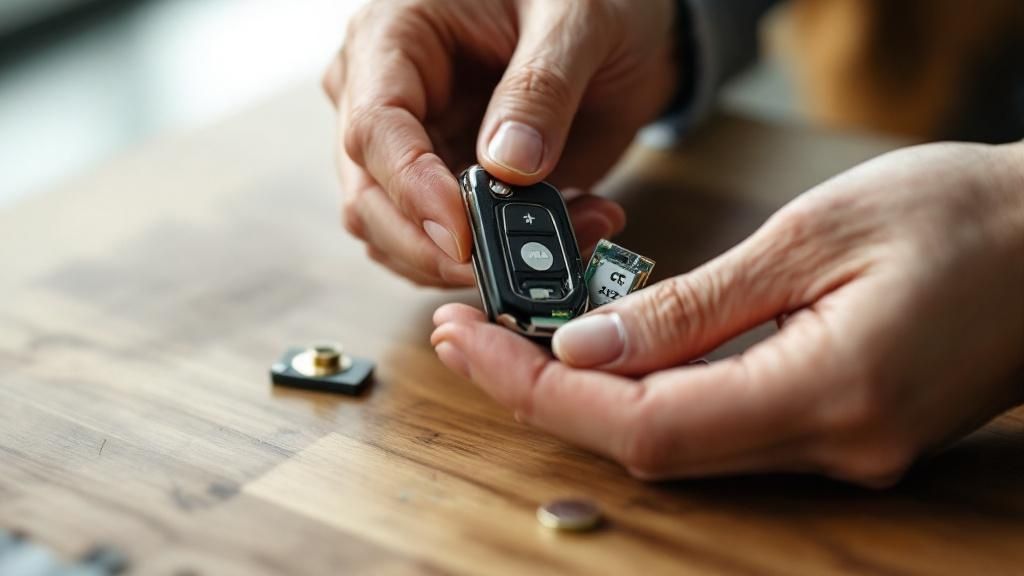
We've all been there. That sinking feeling when you press the button on your car key fob and... nothing happens. It’s beyond frustrating, especially when you're in a hurry. But before you start picturing a massive bill from the dealership, take a breath. More often than not, the culprit is just a dead battery, and it's a fix you can usually handle yourself in about five minutes . This practical, problem-solving guide will show you exactly how to spot the signs of a dying battery, change it yourself, and what to do if things don't go to plan. What to Do When Your Key Fob Dies First things first: don't panic. A dead key fob rarely spells disaster. It's almost always a sign that the tiny battery inside has simply run its course. Learning to recognise the warning signs can save you from getting stranded. Think of it like your phone giving you a low battery warning – your key fob does the same thing, just a bit more subtly. Signs Your Key Fob Battery Is Fading Is it really the battery? A quick check of these common symptoms will usually give you the answer. Symptom What It Really Means Action to Take Reduced Range You have to stand right next to the car for it to work. The battery's power is weakening and can't transmit the signal as far. Inconsistent Response You're pressing the button multiple times to get a reaction. The power output is fluctuating, causing intermittent signal failure. No Indicator Light The tiny red light on your fob no longer flashes when you press a button. The battery is completely drained and can't power even the smallest LED. Spotting any of these signs is a clear signal to pop a new battery in. Tackling the battery replacement yourself is not just satisfying; it's also incredibly cost-effective. A new battery will typically set you back less than £10 , a tiny price to pay to get back on the road. Getting the Right Battery and Tools Together Alright, before you dive in and start taking your key fob apart, let's make sure you've got everything you need. The good news is, you won't need a massive toolbox for this job. Most of the time, all it takes is a small, flat-head screwdriver to gently pry the fob open. In a pinch, a sturdy coin can even do the trick. The real mission-critical part here is getting your hands on the right replacement battery. Finding Out Which Battery You Need The easiest way to figure this out is to pop open the fob and have a look at the old battery. You’ll see a code printed right on top of it – something like CR2032 or CR2025 is pretty standard for most cars these days. These little lithium coin batteries are surprisingly long-lasting, usually giving you a good two to five years of service. You can easily pick up a quality replacement from places like Halfords or just grab one online. Don't be tempted to just chuck any old battery in there. Using the correct one is absolutely vital to stop any potential damage to your fob's electronics and make sure it actually works when you're done. If you want to dig a bit deeper, there's some great info on the importance of choosing the right battery at tradenrg.co.uk . How to Change Your Key Fob Battery: A Step-by-Step Guide Right, let's get down to the actual job: swapping out that dead battery. Most fobs are pretty simple inside. You'll find they're either held together by a tiny screw or they just snap together along a seam. If you've got a Ford or a VW key, for instance, there's usually a little slot designed for prying it open. A flat-head screwdriver works a treat, but honestly, a coin often does the trick just as well. Just gently insert it and give it a little twist. The key is to go slowly – you don't want to hear that dreaded crack of the plastic casing giving way. Once you’re in, take a pause. Before you do anything else, look at how the old battery is sitting. This is the single most important part! More often than not, the positive (+) side with all the text on it will be facing up towards you. But don't just assume; take a mental picture or even a quick snap with your phone. Gently pop the old battery out. A small screwdriver or even a fingernail can help here. Then, slide the new one in, making absolutely sure it's facing the exact same way as the one you just removed. This quick visual guide sums up the whole process nicely. As you can see, it really just boils down to carefully opening it up, doing a quick swap, and then putting it all back together. All that's left is to snap the casing back together. Make sure you hear a satisfying click so you know it's secure. Now, give the buttons a press. Your car should lock and unlock straight away. Job done. Troubleshooting: What to Do If It Still Doesn't Work Right, so you’ve swapped out the old battery for a new one, snapped the case shut, but... nothing. Your car is stubbornly ignoring you. It’s a frustrating moment, but don't chuck the fob across the drive just yet! This happens more often than you’d think, and it’s usually down to something really simple. Before you start thinking you’ve broken it, let's run through a few of the most common issues. A Quick Troubleshooting Checklist Nine times out of ten, when a fob doesn't work after a battery change, it's one of these simple things. Let’s get it sorted. Is the battery in the right way up? It sounds obvious, I know, but it’s the number one culprit. Pop the case back open and double-check that the positive (+) side is facing the correct direction, matching how the old one came out. Did you remove the protective film? Some new coin batteries come with a tiny, clear plastic sticker on one side. If this is still on, it will block the connection. Check both sides of the new battery carefully. Are the contacts making a good connection? Over time, the little metal tabs inside the fob that touch the battery can get a bit grimy or slightly bent. Give them a gentle wipe with a dry cloth or cotton bud and make sure they’re pressing firmly against the new battery. Is the case fully clicked together? If the two halves of the fob casing aren't snapped together securely all the way around, the internal components might not be aligned properly. Give it a firm squeeze until you hear it click shut. Does it need to be reprogrammed? While most cars don't require this, some do lose their sync. Check your car's manual or our guide on programming car keys to see if this applies to your model. When to Call a Professional Auto Locksmith Look, a fresh battery fixes the problem nine times out of ten. But sometimes, you run into an issue that's a bit more stubborn than a simple power swap. Knowing when to put the tools down and call for backup can save you a world of headache. Real-Life Example: Just last week, we helped a customer in Coventry who had a similar problem. They'd changed their Ford Focus key fob battery, but it still wouldn't work. After trying everything, they gave us a call. It turned out that when prying the case open, the transponder chip inside had been slightly dislodged. It’s a tiny component and easy to miss. We were able to reseat it properly and get them back on the road in minutes. If you've cracked the casing, accidentally broken a piece off the circuit board, or the fob just won't talk to your car after you've tried all the troubleshooting steps, it's time to get an expert on the line. These issues often point to deeper electronic faults that only professional diagnostic tools can figure out. If you're curious about the tech inside your key, our practical guide to transponder car keys is a great read. Frequently Asked Questions (FAQ) Right, so you've swapped the battery and everything seems to be working. Brilliant! But it’s normal to still have a couple of questions nagging at you. Let's run through a few of the most common ones we hear. How Long Should a New Car Key Fob Battery Last? Generally speaking, you can expect a quality key fob battery to last for about two to five years . Of course, that’s just an average. How often you use the fob and the quality of the battery itself make a big difference. The battery that comes with the car from the factory usually gives you a solid two to three years. If you’ve popped in a cheap, unbranded one, you might find yourself doing this all over again in about a year. For a deeper dive, there's a great discussion on battery life expectancy over on team-bhp.com . Will I Need to Reprogramme My Key Fob After Changing the Battery? For the vast majority of cars, the answer is a simple no . The key fob is designed to remember its code even without power for a short time. Just swap the battery, and you're good to go. There are, however, a few exceptions. Some older models or specific makes might lose their sync with the car if the battery is out for too long. If your fob isn’t working after a successful battery change and troubleshooting, reprogramming might be the next step. Can I Use Any Battery That Fits? No, you must use the exact same type of battery that you removed. While another battery might physically fit, differences in voltage or composition can damage the delicate electronics inside your key fob or cause it to malfunction. Always match the code (e.g., CR2032) printed on the old battery. And if you've tried everything and are still stuck, that's where we come in. Top Motor Keys offers expert mobile auto locksmith services. If you are in Coventry, Tamworth, Leicester, Northampton, Birmingham , or the surrounding Midlands areas, our team is ready to help. Just give us a shout.
- Finding Reliable Auto Locksmith Services Near Me for Fast Roadside Help
That awful, sinking feeling hits you. You’ve patted down your pockets for the third time, peered through the driver's side window, and there they are: your keys, sitting innocently on the seat. Or worse, they’re just… gone. When you find yourself frantically searching for "auto locksmith services near me," you need a practical solution, fast. Not another headache. That's where a local, mobile auto locksmith comes in. We turn a day-ruining disaster into a minor blip on your radar. Why a Local Auto Locksmith Beats a Dealership Every Time Let's be honest, your first thought might be to ring up the main dealership. But that's almost always the slowest, most wallet-busting route you can take. Think about it. Dealerships usually insist you bring the car to them. That means calling a tow truck, paying for it, and then waiting your turn in their service queue. You could be without your car for days, not hours. A local auto locksmith, on the other hand, works completely differently. Our entire service is built around a simple, problem-solving idea: getting to you, right where you are. The Mobile Advantage: A Real-Life Example The Problem: Sarah finished her late shift at a Birmingham hospital, only to find her car key had snapped off in the door lock. The dealership told her she'd need to have the car towed to them and wait until morning, potentially costing her hundreds in towing and labour fees. The Solution: She searched for "auto locksmith services near me" and called us. In under an hour, our mobile van was on-site. Our technician carefully extracted the broken key fragment without damaging the lock, then cut and programmed a brand-new key right there in the car park. Sarah was back on the road in less time than it would have taken for a tow truck to arrive. This isn’t some far-fetched scenario; it’s what we do every single day. We cut out the middleman, the towing, and the agonising wait times. The real magic of a mobile auto locksmith is simple: we bring the complete workshop to you, wherever you are. This on-the-spot service is a game-changer, saving you time, money, and a world of hassle. Key Benefits of Choosing a Local Expert When you call a local professional, you’re getting more than just a quick fix. You’re getting a service that’s designed from the ground up for emergencies like yours. Rapid Response Times: We're already in your area, so we can get to you fast. No waiting for a slot to open up at a garage; we're often there within the hour. On-the-Spot Solutions: Our vans are packed with the same high-tech key-cutting and programming gear you’d find at a dealership. We can sort everything out right on the roadside. Transparent and Fair Pricing: We don't have the massive overheads of a main dealer, so our prices are much more competitive. You’re not paying for a tow, and you’re not paying inflated dealership labour rates. Ultimately, choosing a local auto locksmith means turning that moment of sheer panic into a problem that gets solved quickly, efficiently, and with real expertise. What Does a Modern Auto Locksmith Actually Do? Thinking an auto locksmith just turns up to pop open a locked door is a bit like assuming a modern smartphone is only for making calls. The reality is a whole lot more technical. Today’s auto locksmiths are really technicians who specialise in your car's entire security system, dealing with complex electronics that go way beyond a simple lock and key. Our skillset has had to evolve right alongside vehicle technology. Of course, getting you back into your car when you're locked out is still a core service, but a huge part of the job now involves diagnostics, programming, and precision engineering. It’s More Than Just Unlocking Doors A modern car key isn’t just a piece of metal anymore; it's a tiny computer that has a conversation with your car. This is where a professional’s real expertise comes into play. Transponder Key Programming: Think of this as teaching your car to recognise a new, unique key. We program the key's microchip to send the correct security code to your car's immobiliser system, which is what gives the green light for the engine to start. Laser Key Cutting: The days of grinding keys on an old machine are long gone for most vehicles. Newer car keys have intricate patterns and grooves that demand high-tech laser cutting machines for a perfect, factory-quality finish. Ignition Switch Repair and Replacement: It happens. A key snaps off in the ignition, or the barrel just jams up completely. We can often repair these issues right there on the spot. If it’s past saving, we can replace the whole unit for you—often much faster and cheaper than a trip to the main dealer. The real heart of a modern auto locksmith's job is making sure the electronic "handshake" between your key and your car works perfectly. Without the right programming, even a beautifully cut key is just a useless piece of metal. Specialists for All Keys, Old and New You might think that with keyless entry and push-to-start systems becoming standard, older-style keys are a thing of the past. Not quite. People in the UK are holding onto their cars for longer than ever before. With the average age of a car on British roads now over eight years , we have to be experts in a huge range of key technologies. It means we're just as comfortable programming a key for a ten-year-old hatchback as we are for a brand-new SUV. This versatility is what sets a specialist apart. Whether you’ve got a traditional metal key, a remote fob, or a modern proximity key, a mobile auto locksmith has the specific tools and know-how to sort it out. That's a level of dedicated service you simply won’t get at a standard garage. If you happen to be stuck outside your car right now, you might find our guide on how to unlock your car without keys helpful while you wait. Real-World Car Key Nightmares Solved It’s one thing to list what we do, but it’s another to show you how it all plays out in the real world. These aren’t just made-up stories; they're the kind of headaches we sort out for people across the West Midlands every single day. Let's walk through a few common scenarios. Each one kicks off with that gut-wrenching moment of panic but ends with a quick, professional fix that puts your day right back on course. The Supermarket Car Park Lockout Picture this: you've just wrestled the weekly shop into the boot, arms full of bags. You slam it shut with a satisfying thud, only to realise the car keys were in that one bag you shoved right to the back. The doors are locked, your shopping's held hostage, and the ice cream is starting to melt. It’s a classic. Here’s how we get you out of that pickle: You Call Us: You give us a ring, explain you're locked out at the local supermarket, and tell us your car's make and model. We’ll give you a straight-up quote and an ETA on the spot, usually under an hour. We Arrive: Our technician pulls up in a van that’s basically a workshop on wheels. First things first, they'll confirm your identity for security. We Get In (Without Damage): Using specialist tools—not a coat hanger—the locksmith gets into your car without a single scratch on the lock or door frame. This whole part usually takes just a few minutes. Problem Solved: The boot is popped, the keys are rescued, and you're on your way. A full-blown disaster averted in less time than it took to do the shopping in the first place. The Snapped Key in the Ignition You're ready to head home after a long day. You stick the key in the ignition, give it a turn, but it feels... wrong. Stiff. You apply a tiny bit more pressure, and then you hear that horrible snap . The metal blade is now stuck fast in the ignition barrel, leaving you holding a useless plastic fob. This is a textbook "don't panic" moment. Your first instinct might be to grab some pliers, but that's a surefire way to cause hundreds of pounds of damage to the ignition system. The only smart move is to call a professional. This job is all about precision. Our technician uses highly specialised tools to carefully extract the broken fragment without harming the delicate ignition barrel. Once it's out, they can cut a brand-new key blade right there and then, pairing it with your existing remote. You're back on the road without needing a tow truck or a wallet-emptying ignition replacement. Lost Keys on a Day Out A family day out at the beach turns sour when someone realises the car keys are gone. You’ve retraced your steps, checked the café, sifted through sand... nothing. They've vanished. With no spare key, you’re well and truly stranded miles from home. This is exactly when searching for "auto locksmith services near me" becomes a game-changer. We can create a new key from scratch, even when the original is lost for good. Our technician will come to you, get into the car, and then 'decode' the lock to figure out the exact cuts needed for a new key. Next, they'll program a new transponder chip so it talks to your car's immobiliser. And, just as importantly, they’ll wipe the lost key from the car’s memory. That way, if someone finds it, they can't just drive off with your car. Peace of mind restored. A Quick Troubleshooting Guide for Key Issues Before you call, sometimes a simple check can identify the problem. Here’s a quick guide to common car key faults. Problem: The remote unlocks the doors, but the car won't start. Likely Cause: This is a classic sign of a transponder chip failure. The remote's battery is fine for unlocking, but the chip that talks to the immobiliser isn't working. What to Do: A professional auto locksmith can test the chip and program a new key for you on the spot. Problem: The key won't turn in the ignition. Likely Cause: It could be a worn-out key blade, a damaged ignition barrel, or even the steering lock being engaged. What to Do: First, try gently wiggling the steering wheel while turning the key to disengage the steering lock. If that doesn't work, avoid forcing it. You likely need an expert to inspect the key and ignition for wear and tear. Problem: My keyless entry car says "Key Not Detected". Likely Cause: The most common culprit is a dead battery in your key fob. What to Do: Check your car's manual for how to use the physical emergency key blade (usually hidden inside the fob) and where the backup start location is (often you need to hold the fob against the start button or steering column). If a new battery doesn't fix it, the fob may need reprogramming. How to Choose a Trustworthy Auto Locksmith When you’re stuck, it’s easy to search for "auto locksmith services near me" and call the first number that pops up. But a few minutes of diligence can save you from a major headache and an inflated bill. A reputable professional will be transparent from the start. Checking for Legitimacy and Skill Look for Reviews: Check Google for recent, positive feedback from other local customers. A solid track record is a great sign. Ask About Insurance: A legitimate auto locksmith will have public liability insurance. This protects your vehicle in the rare case of accidental damage. Clear Pricing: When you call, they should provide a clear quote. Be wary of anyone who is vague about costs or says they "have to see it first" without giving a ballpark figure. A trustworthy auto locksmith is just like any other skilled tradesperson. They take pride in their work, are transparent about their costs, and are dedicated to providing a secure, professional service. Understanding the Costs The price for auto locksmith services depends on the job's complexity. A simple lockout is very different from creating a new keyless entry fob from scratch. Here's a general guide to pricing in the UK. Remember that costs vary based on your car's make, model, age, and your location. Service Type Average Price Range (Daytime) Factors Affecting Cost Emergency Lockout £75 - £150 Vehicle make/model, time of day (out-of-hours costs more), location. Standard Key Cutting £60 - £120 Key blank cost, if it's a laser-cut key, complexity. Transponder Key Programming £120 - £350+ Vehicle security system, key fob complexity, dealer codes needed. Ignition Repair/Replacement £150 - £400+ Extent of damage, parts required, vehicle model. Always ask for a detailed quote to ensure you know what you’re paying for. If you're dealing with a lockout, you can read more about our professional car lockout services . Protecting Your Car from Keyless Theft Keyless entry is brilliant, but it has created a new opportunity for thieves using a method called a relay attack . They use a device to capture your key fob's signal from outside your house, then relay it to an accomplice next to your car, tricking it into unlocking and starting. The whole process is silent and can take less than a minute. This growing threat is why our job has evolved. As auto locksmiths, we're now on the front line of vehicle security, helping you keep thieves out in the first place. You can read more about the high demand for advanced auto locksmith services to see just how widespread this problem has become. How We Reinforce Your Car's Security Erasing Lost or Stolen Keys: If a key is lost or stolen, we can digitally erase it from your car's memory, making the missing fob useless. Security Diagnostics: We can run a full health check on your car's security systems to spot vulnerabilities before a criminal does. Simple Steps for Immediate Protection The single best thing you can do to prevent a relay attack is to block your key fob's signal when you're not using it. A Faraday pouch or box is a cheap and highly effective way to do this. These signal-blocking cases act like a shield, making it impossible for thieves to pick up your key’s signal. It’s a tiny investment for a massive amount of peace of mind. Where Do We Cover? When you’re stuck and searching for an "auto locksmith near me," proximity is everything. That’s why we are a genuinely local service for drivers across the West Midlands and its neighbouring counties. Our mobile workshop is always on the move, meaning an expert is never far away. Our Main Service Areas You'll find us helping drivers all over these areas: The West Midlands: We have the entire region covered, including Birmingham , Coventry , Wolverhampton , Dudley , and Solihull . Staffordshire: Our services extend across Staffordshire, from Stoke-on-Trent and Stafford to Lichfield and Tamworth . Warwickshire: We frequently assist drivers in towns like Warwick , Leamington Spa , and Nuneaton . East Midlands: We also cover parts of the East Midlands, helping people in and around Derby and Burton upon Trent . Being local isn't just about a postcode. It's about knowing the shortcuts, understanding the traffic, and getting to you when we say we will. Not sure if we can get to you? Give us a call. We’ll confirm if you're in our service area and provide a free quote for our auto locksmith services. Frequently Asked Questions (FAQ) Here are some straight answers to the questions we hear most often. Are you cheaper than a main dealer? Yes, almost always. Dealerships often require you to tow the car to them, adding extra cost and delay. We come to you, cutting out the middleman and providing a more affordable service on the spot. How long does it take to get a new car key? A simple, non-chip key can be cut in minutes. For a modern key with a transponder, the cutting and programming process typically takes between 30 and 60 minutes. We do it all from our mobile van while you wait. What if I've lost my only car key? Don't panic! It's a routine job for us. We can gain entry to your vehicle without damage, decode the lock to cut a new key, and program it to your car's immobiliser. Crucially, we will also erase the lost key from the car's memory for your security. Will you damage my car? Absolutely not. We use specialised, non-destructive tools and techniques designed to work on vehicle locks and security systems safely. We guarantee no damage to your locks, doors, paint, or electronics. Whether you’re locked out, need a spare key, or want to bolster your vehicle's security, Top Motor Keys is here to help. We offer fast, expert auto locksmith services across the West Midlands and surrounding areas. For a free, no-fuss quote, get in touch with our friendly team today .
- How to Unlock Your Car Without Keys: A Practical Guide
We’ve all been there. That sickening click of the lock, followed a split second later by the awful realisation that your keys are sitting right there on the driver's seat. It's a universal moment of frustration. Of course, the first thing to do is check every other door. You'd be surprised how often a back door is left unlocked. The next best thing is a spare key, but that's not always handy. If those simple solutions aren't an option, your car manufacturer’s smartphone app is often the safest and quickest way back in for modern vehicles. That Awful Sinking Feeling When You’re Locked Out It’s a moment that can derail your entire day. Maybe you were rushing, distracted by the kids, or just had your hands full with shopping. Whatever the reason, your plans grind to a halt and your mind starts scrambling for a way out of this mess. Trust me, you're not alone. This is one of the most common call-outs we get as auto locksmiths. The good news is, there's no need to panic. This guide is here to cut through the stress and give you practical, problem-solving advice to get you back on the road. What This Guide Covers I’m going to give you a clear, no-nonsense roadmap for sorting this problem out quickly and safely. Forget those old movie tricks with bent coat hangers—they're more likely to scratch your paint than open your door. We'll focus on what actually works for different types of cars. Here's what you'll learn: Safe DIY Tricks: I'll walk you through a few methods that can work on older cars and carry a low risk of causing damage. The Problem with Modern Cars: I’ll explain why newer vehicles with their fancy security systems need a completely different, more technical approach. When to Call in the Pros: Sometimes, making that call is the smartest, cheapest, and fastest thing you can do. I'll help you know when it's time. Locking your keys in the car feels like a massive inconvenience, but depending on where you are or the time of day, it can quickly become a genuine emergency. Having a clear plan is your best defence. My goal here is to give you actionable steps, not just theories. We provide services across the West Midlands, Staffordshire, and parts of the East Midlands , so believe me when I say we’ve seen every lockout scenario imaginable. We know what works, what doesn't, and what can turn a small headache into a massive repair bill. By the time you're done reading, you’ll know exactly how to handle being locked out without damaging your car or your bank balance. Your First Moves Before Trying Anything Alright, so the door's slammed shut and the keys are glinting at you from the driver's seat. That sinking feeling is all too familiar. Before you do anything else, just take a deep breath. Panicking now will only make things worse. First things first: safety. Have a quick look around. Are you in a busy, well-lit street, or is it a dodgy, unlit car park after hours? Where you are should heavily influence what you do next. Once you’ve got your bearings, do a full lap of the car. I know, it sounds almost insultingly simple, but you'd be surprised how many times I've seen someone frantically trying to break into their own car, only to discover the back door or the boot was never even locked. Tug every single handle. It takes five seconds and could save you a world of hassle. It’s a surprisingly common oversight. Police data from the year ending September 2024 revealed that nearly half ( 46% ) of all attempted vehicle thefts in England and Wales happened through an unlocked door. It’s a sobering thought that highlights how easily a simple mistake can be exploited. You can dive deeper into the UK car theft statistics to see just how prevalent this is. Before you go any further, it's a good idea to run through a quick mental checklist to make sure you've covered the basics. Quick Vehicle and Safety Checklist This table sums up the immediate checks to perform. Taking a moment here can prevent unnecessary stress or damage later on. Check What to Look For Why It Matters Safety First Your surroundings: Are you in a safe, well-lit area? Your personal safety is the top priority. It dictates whether you should try a DIY method or immediately call for professional help. All Doors & Boot Systematically try every single door handle and the boot latch. It's the most common and easiest solution. An unlocked door is often overlooked in the initial panic. Lock Type ID Look inside: Can you see physical pull-up knobs or slide locks? Or is it all electronic with no visible mechanism? This is crucial. Using the wrong tool or technique for your lock type can cause expensive damage to wiring, airbags, and seals. Window Check Is any window, including the sunroof, slightly ajar? Even a small gap can provide an opening for a tool, making a DIY solution much more feasible and less risky. Completing these checks gives you a clear picture of your situation and helps you decide on the safest and most effective next step. Identify Your Car's Lock Type Now, get up close and personal with your car’s locking mechanism. This is probably the most critical step before you even think about trying to get in. Get it wrong, and you could be looking at hundreds of pounds in damage. Does your car have those old-school pull-up knobs or a little slide lock on the interior panel? Or are you driving something more modern where the locks are electronic and completely hidden within the door handle? This distinction changes everything. Unlocking an old Ford Fiesta with manual locks is a totally different ball game to getting into a new BMW with a sophisticated deadlocking system. If you try to force a tool into a modern door, you risk wrecking the sensitive electronics, window regulators, and even the side-impact airbags tucked away inside. Taking a minute to correctly identify your lock system will determine your entire strategy. It’s the difference between a quick, damage-free solution and a costly trip to the garage for repairs. This initial assessment is your decision point. It'll tell you whether a DIY attempt is even on the cards or if you need to bite the bullet and call a professional locksmith right away. Knowing your vehicle is the first step in knowing how to unlock it safely. Tackling Older Cars With a Bit of DIY Got an older car with those classic pull-up or sliding door locks? You might just be in luck. There are a couple of old-school tricks that can get you back inside, but a word of warning: these methods are strictly for vintage vehicles. Try them on a modern car, and you’re asking for a hefty repair bill. Picture this: you're miles from anywhere, and your mate has managed to lock the keys inside their trusty old Vauxhall Astra. The panic starts to creep in. This is where a little bit of creative problem-solving can save the day. The key here is finesse, not force. The Shoelace Trick: It Actually Works It sounds like something you’d see in a spy film, but the shoelace method is a genuine lifesaver for cars with pull-up locks. Better yet, it’s incredibly low-risk. All you need is a shoelace (or a strong bit of string) and a steady hand. First, you'll need to tie a small slipknot in the middle of the lace. This little loop is your secret weapon. Carefully work the shoelace into the top corner of the car door frame, using a gentle sawing motion to ease it past the weather stripping. Once it's inside, you can manoeuvre the slipknot over the lock knob. Pull the ends of the lace to tighten the loop around it, then simply pull up. Voilà! This is all about patience. A calm, steady approach is what gets the job done. That slipknot is crucial; a regular knot just won't have the grip you need. Honestly, it's the safest DIY trick in the book for these older models. This simple infographic breaks down the thinking process for any manual car lockout situation. It shows that you always start by identifying the lock type, which tells you what tool and technique to use, leading you to the final unlock. The Coat Hanger Method: Proceed with Extreme Caution Ah, the classic coat hanger. We’ve all heard of it, but this one comes with a serious disclaimer. While it can work, you're running a massive risk of scratching your paint, ripping the rubber weather seal, or damaging the window mechanism. If you’re determined to try it, straighten out a wire hanger but leave a small hook on the end. You'll need to protect your car first by wedging something soft, like a cloth or a plastic pry tool, into the top of the door to create a small gap. Gently slide the hanger in and try to feel for the internal locking mechanism. It takes a delicate touch and a bit of guesswork, as the location varies from car to car. Protect Your Paint: Wrap the hanger in tape or a cloth where it might touch the car’s body. Scratches happen in a split second. Don't Force It: If you feel resistance, stop. You could be snagging a wire or pressing against the window glass itself. Know the Cost: A simple lockout can quickly become an expensive fix for paintwork or a new window seal. Is it worth the risk? At the end of the day, these manual tricks are a last resort for very specific, older vehicles. If you drive anything remotely modern or have lost your keys completely, these methods are off the table. In that situation, your only real solution is getting a brand new key. You can find out more about professional car key cutting services and see how the experts can sort you out, even if you don't have the original. Why Modern Cars Are a Different Challenge Trying to jimmy open a new car with a coat hanger is a bit like trying to pick a digital lock with a paperclip. It’s just not going to happen. The days of simple mechanical locks you could easily manipulate are well and truly behind us. Today’s cars are packed with sophisticated tech specifically designed to keep them secure. Think side-impact airbags tucked inside the door panels, deadlocking mechanisms that won’t budge with brute force, and incredibly sensitive wiring systems. Shoving a bit of metal where it doesn’t belong is a recipe for disaster, potentially causing hundreds, if not thousands, of pounds in damage. Tech-First Solutions for Modern Lockouts Since your car is so high-tech, it makes sense that the best solutions are often tech-based, too. Before you do anything else, have a think: have you set up your car manufacturer's smartphone app? Many brands offer one, like Land Rover InControl Remote App, MyBMW, or Toyota's MyT app, and they can be an absolute lifesaver. If you’ve got the app on your phone, getting back in can be as simple as tapping a button. It's easily the safest and fastest way to solve the problem, assuming you've got a signal and your phone isn't dead! Another classic modern problem is the key fob battery dying. You’re standing right there, but the car just won’t unlock. It's a frustrating reminder that modern car security demands a modern approach. These systems are also why it pays to understand your vehicle's security features, like the transponder key. To get a better handle on this, you can learn more about how transponder car keys work in our detailed guide. The Rise of Keyless Complications Keyless entry has made our lives easier, but it's also introduced a new set of headaches. While overall car theft in the UK dipped slightly in early 2024 , thefts using keyless methods shot up by a staggering 48% . This tells us that thieves are adapting, swapping crowbars for clever electronics. They use "relay" devices to capture your key's signal and trick the car into thinking the key is right next to it, letting them unlock it and drive away in seconds. The very technology that offers us so much convenience has also created new vulnerabilities. Understanding these risks is the first step in protecting your vehicle and knowing what to do when things go wrong. This is exactly where a professional auto locksmith comes into the picture. We have the specialist diagnostic tools to safely work with these advanced systems without damaging the intricate electronics inside. For modern cars, calling a specialist isn't a luxury anymore—it's an absolute necessity. Knowing When to Call an Auto Locksmith Let's be honest, sometimes the smartest DIY move is knowing when not to do it yourself. It's incredibly tempting to try and MacGyver your way back into your own car, but there are plenty of times when picking up the phone is the only truly safe option. If you're wondering how to unlock a car without keys and your vehicle was made in the last decade, it’s probably time to call in the experts. Modern cars are rolling fortresses with complex security systems that make old-school tricks useless and, frankly, pretty risky. For high-security vehicles, premium models, or if you've lost your only key, a professional is going to be your fastest, safest, and often cheapest solution in the long run. The Professional's Toolkit An auto locksmith turns up with a lot more than a bent coat hanger. They're equipped with specialised, non-destructive tools designed to work with your car, not against it. Professional Air Wedges: Think of these as tough, inflatable bags that are gently slipped into the door frame. Once inflated, they create a tiny, safe gap, giving the locksmith access without a single scratch to your paint or a bent door frame. Auto Lock Picks: These are seriously impressive bits of kit. They're precision tools that let a skilled locksmith "pick" the lock as if they were using the original key, essentially decoding the lock's inner workings without any force at all. Using these tools is like performing surgery compared to the brute force of most DIY methods, which can all too easily lead to a bill from the body shop. Finding a Reputable UK Locksmith With a constant stream of new cars hitting the road, many with incredibly advanced locks, the demand for skilled auto locksmiths has shot up. In 2024 alone, over 1.95 million new cars were registered in the UK, and every single one is a potential lockout just waiting to happen. If you need a hand, you want to be certain you're calling a real professional. You can see the full picture by checking out the latest UK car registration data . When you ring around for a quote, be as specific as you can. Give them your car’s make, model, and year, and explain exactly what’s happened. Always ask for the final price upfront to avoid any nasty surprises or hidden fees later on. A good sign you're dealing with a pro? They'll always ask for proof of ownership before they even think about starting the job. Have your V5C logbook or photo ID ready. It shows they operate legally and ethically, which is exactly what you want. Checking for certifications or memberships in trade associations is another great way to get some peace of mind. Our teams are on the road across the West Midlands, Staffordshire, and parts of the East Midlands , ready to provide a rapid, reliable service. If you're stuck right now, our guide to emergency car lockout services can give you the immediate help and info you need. At the end of the day, calling a professional protects your car, saves you a ton of time, and gets you back on your way without any extra drama. Got Questions About Car Lockouts? We've Got Answers Being locked out of your car is a real headache, and your mind is probably racing with questions. Let's clear up a few of the most common ones we get asked. Think of this as a quick FAQ to bust some myths and help you figure out your next move. Is It Actually Legal to Break Into My Own Car in the UK? It might feel a bit dodgy, but yes, it's perfectly legal to get into your own car using unlocking tools. The real issue is a legal term called "going equipped to steal." If you're not a registered locksmith and the police find you with tools like a slim jim, they might have a few questions for you. My advice? If you're trying a DIY method in a car park, be ready to prove the car is yours. Having your driving licence with a matching address or even a picture of your V5C logbook on your phone can smooth things over instantly. Will My Car Insurance Pay for a Locksmith? That's the million-dollar question, and it all comes down to your policy. A lot of comprehensive insurance plans now include 'key cover', sometimes as standard and sometimes as a cheap add-on you might have forgotten about. Also, don't forget about your breakdown cover. Services like the AA or RAC often include lockout assistance as part of their membership benefits. Before you ring a locksmith and pay out of pocket, take five minutes to check your documents. A quick look could save you a fair bit of cash. Can You Genuinely Make Me a New Key Right There and Then? You bet. That's the real magic of calling a specialist auto locksmith instead of a dealership. Our vans are basically mobile workshops. We carry the high-tech machinery to cut a new key blade and the diagnostic gear to program the transponder chip and remote fob to your car's computer, all while you wait. This is an absolute game-changer if you've lost every single key. It's miles faster and way less hassle than getting your car towed to a main dealer, who then has to order a key from the factory. What’s the Safest Way to Get in Myself Without Causing Damage? When we talk about "safe" DIY methods, we really mean "damage-free." For an old banger with simple pull-up door locks, the shoelace trick is brilliant because it's almost impossible to scratch or bend anything. For anything built in the last 20 years? The safest method isn't a physical tool at all—it's using your car manufacturer's smartphone app, if you have it set up. Any method that involves wedging something between the door and the frame, no matter how careful you are, risks scratching the paint, tearing the rubber weather seal, or even snagging a wire inside the door. If you're even slightly unsure, the truly safest option is to just call a professional. We'll get you in without a single scratch, guaranteed. Stuck outside your car? Top Motor Keys provides a 24/7 mobile service across the West Midlands, Staffordshire, and the surrounding areas. We get you back in your car and on your way, minus the drama. Give us a call. https://www.topmotorkeys.co.uk
- Your Practical Guide to Transponder Car Keys
Ever wondered what makes your car key more than just a piece of shaped metal? That plastic head isn't just for a better grip; it’s the brain of the operation. This is your transponder car key , and it acts as a unique digital password between you and your vehicle, stopping thieves in their tracks. This guide solves the common problems you might face, from a key that suddenly stops working to getting a replacement without the main dealer hassle. So, What Exactly is a Transponder Key? Tucked inside that plastic casing is a tiny microchip. It holds a unique code programmed specifically for your car. The clever part? It doesn't even need its own battery to work. When you put the key in the ignition and turn it, your car sends out a low-frequency radio signal. This signal instantly powers up the chip in your key, which then transmits its unique code back to the car's computer. If the code is correct—think of it as a secret digital handshake—the engine's immobiliser gets the all-clear, and your car starts. If the codes don't match, the engine stays locked down. It’s a simple but incredibly effective security feature, which is why transponders car keys are now standard on almost all modern vehicles. How Your Car and Key Communicate Ever wonder what happens in that split second between turning your key and the engine starting? It’s not just mechanical; your key and car are having a rapid, secret conversation. Think of it as a high-speed digital handshake that confirms you're the authorised driver. This all happens in the blink of an eye, thanks to a few key components working in perfect harmony. The Digital Handshake Explained A small antenna ring is wrapped around your ignition barrel. When you insert your key and turn it, this ring emits a low-power radio signal. This signal is just strong enough to energise the passive transponder chip inside your key fob – no battery required for the chip itself! Awakened by the signal, the chip instantly broadcasts its unique serial number to the car's Engine Control Unit (ECU). The ECU then acts like a security guard, checking this number against a pre-approved list stored in its memory. If the numbers match, the car’s immobiliser is disarmed, and the engine is allowed to start. If they don't, the immobiliser stays active, and the engine won’t turn over, or it can turn over but the engine won't start. This system is what stops a thief from simply hot-wiring your car. Here’s a step-by-step breakdown of that crucial handshake process. The Transponder Key Handshake Process Step What Happens Purpose 1. Key Insertion You turn the key in the ignition. To initiate the startup sequence. 2. Signal Emission The antenna ring around the ignition sends out a low-frequency radio signal. To energise the passive transponder chip in the key. 3. Chip Response The powered-up chip transmits its unique ID code. To identify itself to the vehicle's computer. 4. Code Verification The car's computer compares the key's code to the pre-programmed codes in its memory. To confirm the key is authorised. 5. System Disarm If the codes match, the immobiliser is deactivated. To allow the engine to start. Essentially, this rapid-fire exchange ensures that only a key with the correct, pre-approved digital signature can operate the vehicle. This infographic provides a clear visual of that signal exchange. You can see the seamless flow of information as the car confirms the key's identity, completing that crucial security check before you can drive away. Common Problems with Transponder Keys (And How to Spot Them) Transponder keys are robust, but they aren't indestructible. When they fail, it’s always at the most inconvenient moment—like during the school run or late at night in a deserted car park. The problem usually boils down to one of a few common issues. For example, a customer in Tamworth recently dropped her keys on a hard concrete floor. The impact was enough to damage the delicate microchip inside, instantly breaking its connection with her car. In other cases, the battery in the remote fob can die. This might only stop the remote locking from working, but it can be the first sign of trouble. Sometimes, the issue is invisible. The key's programming can become corrupted, almost like it develops digital amnesia. When this happens, your car’s computer no longer recognises the code it’s expecting. Telltale Signs Your Key is Failing Spotting the warning signs early can save you from being stranded. If you notice any of these, it's time to get your key checked out. The Engine Won't Start Reliably: You have to turn the key multiple times before the engine finally catches, even though the car battery is fine. It Works Intermittently: One minute your key works perfectly, the next it refuses to cooperate. This unpredictable behaviour is a classic symptom of a failing chip. The Immobiliser Warning Light: A flashing key or lock symbol on your dashboard is your car's way of telling you it doesn't recognise the key being used. These key failures are surprisingly common. In fact, UK breakdown services are called out for a key-related problem every seven minutes . It highlights what a major headache it can be, as detailed in these stats on UK car key emergencies from recent data . Dealership vs Mobile Locksmith: Your Two Main Options So, your transponder key is broken or lost. What now? You have two main choices: go to your car's main dealership or call a specialist mobile auto locksmith. Let's compare them to see which is the best practical solution for your problem. Factor Main Dealership Mobile Auto Locksmith Convenience You must get your car to them (often requires towing if the key is lost). They come directly to you, whether you're at home, work, or stranded on the roadside. Speed Often involves booking an appointment days in advance and leaving the car. Same-day service is the standard, getting you back on the road in hours. Cost Typically much more expensive due to brand overheads and labour rates. Generally more affordable with transparent, upfront pricing. Service Area Fixed location. We cover the West Midlands, Staffordshire, Shropshire, and Worcestershire. While the dealership is the "official" route, a mobile auto locksmith is built around solving your problem quickly, conveniently, and cost-effectively. Why a Mobile Locksmith is the Practical Choice Let's be realistic. If you've lost your only key, getting your car to a dealership is a logistical nightmare. You're looking at recovery truck fees on top of the already high cost of the key itself. This is where a mobile auto locksmith is the clear winner. We are a fully equipped workshop on wheels. It doesn't matter if you're stuck on your driveway in Birmingham, at your office in Telford, or on the roadside near Stafford – we come to you. Our service covers the whole of the West Midlands and Staffordshire , so help is always nearby. Real-life example: A customer in Walsall lost his Ford Transit keys on a job site. The dealership quoted him a three-day wait and required the van to be towed. We were on-site within the hour and had a new key cut and programmed in under 60 minutes, saving him two days of lost work and hundreds of pounds. Our vans are equipped with the same high-tech diagnostic and programming tools as the dealerships, allowing us to cut and sync a new key for your exact make and model on the spot. If you want to understand the process better, check out our detailed guide . The Cost of Replacing a Transponder Key Let's get straight to the point: what’s this going to cost? Replacing a transponder key is more complex than getting a spare house key cut. The technology involved means the price is higher than just shaping a new piece of metal. Several factors influence the final bill. The make, model, and year of your car are the biggest variables. A new smart key for a high-end Audi will naturally cost more than a standard transponder key for an older Ford Fiesta. What Determines the Price? A key factor is whether you still have a working key. Cloning an existing key: If you have a working key, creating a spare is simpler and more affordable. Creating a new key from scratch: If you've lost all your keys (a "lost all keys" situation), the job is more complex as we need to access the car's ECU to program new keys, which is reflected in the price. Losing car keys is a costly problem in the UK. As a nation, we spend over £180 million annually on replacements, with the average cost around £177. You can see the full breakdown of UK drivers' spending on lost keys at 247autolocksmith.co.uk . This highlights the importance of having a reliable and affordable service you can trust, especially when you need expert car key cutting . How to Protect Your car Key fobs from Modern Thieves Transponder keys were a game-changer for car security, making old-school hot-wiring techniques obsolete. However, criminals have adapted. Modern thieves now use sophisticated methods to bypass this security, particularly with keyless entry systems. The most common threat is a ‘relay attack’ . Here’s how it works: a thief stands near your house with a device that captures your car key's signal (even through doors and walls). This signal is then amplified and relayed to an accomplice next to your car, tricking the vehicle into thinking the key is present. They can then unlock and start your car in seconds. This crime is on the rise, as shown in this report on the surge in keyless car thefts at cbsnews.com . Simple, Practical Security Steps Fortunately, protecting yourself is easy. The most effective solution is to store your keys in a Faraday pouch or a signal-blocking box when you are at home. This simple metal-lined container creates a shield that stops radio signals from getting in or out, completely thwarting a relay attack. For those wanting an even higher level of protection, you can add another layer of security. An aftermarket immobiliser, like the Ghost immobiliser , requires a unique PIN code to be entered before the car will start, making it nearly impossible for thieves to drive away. Common Questions About Transponder Keys Answered Still have a few questions? Here are the answers to some of the most common things people ask us about transponders car keys . Can I Programme a Transponder Key Myself? In short, it’s not recommended. While you might find DIY guides online for older models, modern car security systems are incredibly complex. They require specialised diagnostic equipment to correctly sync the key's unique code with the car's computer. A mistake could brick the car's ECU, leaving it permanently immobilised and leading to a far more expensive repair bill. It's a job best left to professionals. Do Transponder Chips Need a Battery? This is a common point of confusion. The transponder chip itself is passive, meaning it does not have its own battery. It draws power from the radio signal emitted by the antenna ring around the ignition when you turn the key. However, if your key has remote locking buttons, that part of the key does use a small battery. So, if your remote buttons stop working but the car still starts with the key, you likely just need a simple battery change for the fob, not a new transponder chip. If your transponder car keys are causing problems, don't wait to get stranded. The team at Top Motor Keys provides a fast, mobile service across the West Midlands and Staffordshire. Visit our website at https://www.topmotorkeys.co.uk to get a free, no-obligation quote today.
- How to Program Car Keys: A Practical, Problem-Solving Guide
So, you need to program a car key and you’re wondering where to start. It can feel a bit technical, but really, it boils down to two main routes. For some older vehicles, you might get lucky with a straightforward do-it-yourself (DIY) onboard method . For almost everything else, especially modern cars, you'll need a specialist diagnostic tool to get the job done right. Which path you take really depends on the age, make, and model of your car. The tech inside car keys has come a long way, and the process has changed right along with it. At Top Motor Keys, we provide mobile auto locksmith services across key areas in the Staffordshire and West Midlands, including Tamworth, Lichfield, Solihull, Birmingham, Coventry, and Wolverhampton, so we see these challenges every day. This guide is designed to give you the practical, real-world advice you need. Your Quick Guide to Car Key Programming Losing or breaking a car key is one of those universal annoyances for drivers. It happens more often than you'd think, too. Here in the UK, a roadside assistance service gets a call for a key-related problem roughly every seven minutes. It just goes to show how many of us end up in a jam over key programming, security, or just plain bad luck. Drilling down into the numbers, about 62% of these callouts are for the classic blunder: locking keys inside the car. Another 21% are for jammed keys, and 12% are for lost ones. If you're curious, you can dig into the full report on vehicle key issues from Direct Line Group for more details. What Does Car Key Programming Actually Involve? Let's get one thing straight. "Programming" has nothing to do with cutting the metal blade. That’s a separate job. Programming is all about the electronics – it’s the process of securely pairing your key to your car so they can talk to each other. It works a bit like a digital handshake. The Transponder Chip: Tucked away inside the plastic part of your key is a tiny microchip. This is the transponder. The Immobiliser: Your car has its own security guard, an electronic system called an immobiliser. The Handshake: When you turn the key in the ignition or push the start button, the car's immobiliser sends out a radio signal, essentially asking, "Are you one of ours?" The transponder chip in your key has to send back the exact right code. If the codes match, the immobiliser deactivates, and your engine roars to life. If they don’t, the car stays put, completely immobilised, even if the key fits perfectly in the ignition. In this guide, we’ll walk through the different kinds of keys you’ll come across and the methods used to create this vital digital link. By the end, you'll have a much better idea of whether this is a job you can tackle yourself or if it's time to call in a pro. Identifying Your Car Key Type Right, first things first. Before you even think about plugging anything in or pressing any buttons, you need to know exactly what kind of key you're holding. It's the most crucial step. Getting this wrong is like trying to use a diesel pump on a petrol car – it just won't work, and you could make things worse. The type of key determines everything that follows: the tools you'll need, the process you'll follow, and whether it's even a DIY job to begin with. Car key technology has come a long way, especially on UK roads where we have such a mix of makes and models. What looks like a simple bit of plastic and metal can be deceptively complex. Let's break down what you're likely to come across. The Classic Transponder Key This is the bread and butter of car keys for most vehicles made from the mid-1990s onwards. It often looks like a basic, old-school key but with a chunky plastic head. Don't be fooled by its simplicity. Hidden inside that plastic is a tiny glass or carbon transponder chip . This little marvel is the key to your car’s security. It doesn’t need a battery; it’s powered up wirelessly by a signal from the ring around your ignition barrel when you put the key in. Once it's powered, the chip sends a unique code to the car's immobiliser. If the car recognises the code, it starts. If not, the engine stays dead. Simple as that. Think of an old Ford Fiesta or Vauxhall Corsa key – no buttons, just the ability to start the engine. That’s a transponder. Remote Keys and Flip Keys Now we're getting a bit more familiar. These are the keys most of us have used for years, combining the transponder chip for starting the car with a remote for the central locking. You'll know them by the buttons on the fob – lock, unlock, and maybe one for the boot. The "flip key" is a massively popular design where the blade tucks away, common with brands like Volkswagen, Audi, and Peugeot. These keys essentially perform two completely separate jobs: The transponder chip talks to the immobiliser to let you start the car. The remote part sends a different radio signal to lock and unlock the doors. A classic rookie mistake is assuming the key is fully programmed just because the remote buttons work. I’ve seen it countless times: a key will happily unlock the doors, but the car won't start because the transponder chip hasn't been coded to the immobiliser. They are two different systems. Keyless Entry Fobs and Smart Keys Welcome to the modern era. Smart keys and keyless entry fobs are the most advanced and, frankly, the most complex. With these, the key can stay in your pocket or bag. You just touch the door handle to unlock it and press a button on the dash to start the engine. The key for a new Ford Focus or Nissan Qashqai is a perfect example. These fobs are constantly emitting a low-power signal. As you approach, your car's sensors pick it up, ready for you to get in and go. This convenience, however, comes with a big jump in security and complexity. Programming a smart key is a different league altogether. It demands specialist diagnostic equipment that can securely log into the car’s main computer and register the new key. This is almost never a job you can do on your driveway with a simple trick. If you've got one of these, you're likely going to need professional help. The Essential Toolkit for Key Programming Trying to program a car key without the right equipment is a bit like attempting to bake a cake without an oven. You might have all the ingredients, but you’re just going to end up with a frustrating mess. To get this job done right, you need a very specific set of tools. It all starts with the key itself. Before you even think about programming, you have to get your hands on a high-quality blank key that is a perfect match for your car’s make, model, and year. It’s not just about the blade; the transponder chip has to be correct, and for remote keys, the radio frequency must match your central locking system. Trust me, grabbing a cheap, generic blank off an online marketplace is the number one reason DIY jobs fail before they even begin. Choosing Your Key Programming Tool Once you’ve got a quality blank, you need the star of the show: the programming tool. This is the bit of kit that lets your new key talk to your car’s computer. The market is flooded with these things, from simple gadgets for hobbyists to the high-end machines we professionals use every day. These devices aren't just fancy accessories; they’re central to modern vehicle security. In fact, the car key programmer market in Europe is a huge slice of a global industry set to be worth around $500 million by 2025. With an expected growth rate of 8% a year , driven by ever-smarter security in new cars, the need for capable tools is only going up. You can dig into the numbers in this global car key programmer market analysis from Archive Market Research . So, what are your options? They generally fall into three tiers. Basic OBD2 Programmers: These are your entry-level devices, often costing under £200. They plug into the car's On-Board Diagnostics (OBD2) port and can handle simple key-learning on a limited range of older, less secure vehicles. Honestly, they’re a gamble—vehicle coverage is often patchy and totally unreliable. Mid-Range Diagnostic Tools: Moving up in price, these tools offer better vehicle support and more features, like reading engine fault codes. Brands like Launch or Foxwell fit in here. They’re a step up, but can still hit a wall when faced with the complex security systems on many modern European cars. Professional-Grade Machines: This is the gear the specialists use. We're talking about powerful tools from brands like Advanced Diagnostics, Autel, and Abrites that can handle a massive range of vehicles. They can pull security PIN codes, deal with "all keys lost" situations, and program the latest smart keys. These are a serious investment, often costing thousands of pounds. At its heart, a programming tool's job is to securely connect to your car's immobiliser module through the OBD2 port. From there, it triggers a "key learning" procedure, which basically tells the car's brain to recognise and trust the unique code from the new transponder chip. The Hidden Costs and What to Watch Out For Buying a tool might seem like a good idea, but the initial price is rarely the whole story. Professional tools nearly always require expensive annual software subscriptions to keep them updated for new vehicle models and security protocols. Without those updates, your shiny new tool becomes a very expensive paperweight pretty quickly. And then there's the learning curve, which is steep. Using a tool incorrectly can have serious consequences. A simple mistake could just mean the programming fails, but a bad one could "brick" the car's Engine Control Unit (ECU), landing you with a repair bill that’ll make your eyes water. This is why getting the physical blade cut perfectly is so critical. Our professional car key cutting services ensure the blade is an exact match before any programming even starts, which removes a major point of failure. When you weigh up the cost of a good tool, the risk of a catastrophic mistake, and the time it takes to learn, you can see why calling a professional is often the smarter and, ultimately, cheaper choice. Getting Down to Actually Programming Your Car Key Alright, let's get our hands dirty. Enough with the theory—this is how you actually go about programming a car key. We're not talking about vague, generic steps here. I'm going to walk you through the real-world methods I use every day, with examples that make sense. We'll kick things off with the old-school method, what we call On-Board Programming , before moving on to the modern standard: using a proper diagnostic tool. The goal here is to give you actionable advice, point out the make-or-break moments, and show you what to double-check to avoid a costly headache. The DIY Method: On-Board Programming On some older vehicles, usually from the late 90s to the mid-2000s, manufacturers actually built in a way for you to program a new key without any fancy equipment. This is On-Board Programming . It’s a bit like a video game cheat code—you perform a specific sequence of actions, like turning the ignition on and off, opening and closing doors, or pressing buttons in a certain pattern. This sequence tells the car's computer to enter a "learning" mode, making it ready to accept the transponder code from a new key. It's a neat trick, but as car security has beefed up over the years, this method has become pretty rare. You won't find it on most cars made in the last 15 years. A classic real-world example is the procedure for many older Fords, like a trusty Transit van. Example: A Ford Transit Key Cycle Let's say you've got one working key for your 2005 Ford Transit and you need a spare. The process often looks something like this: Get your kit ready: You need your original, working key and the new, uncut key. You absolutely must have at least one functioning key to kick this off. Do the "key dance": Pop the original key in the ignition and cycle it from the 'Off' position to the 'On' (or 'II') position four times, all within six seconds. Listen for the signal: After the fourth turn, the van should make an audible chime, or the security light on the dash will stay lit. That's your signal—you're in programming mode. Introduce the new key: Now you've got a short window, usually about ten seconds, to whip out the original key and stick the new one in. Turn the new key to 'On' and wait for another chime to confirm the car has learned its code. Finish up and test: To exit programming mode, you can either just wait a few seconds or turn the ignition off completely. Now for the moment of truth—test both keys. The new one should fire up the engine. The sequence has to be followed exactly . Timing is everything. If you're too slow or faff about with the key turns, the car won't enter programming mode, and you'll be back to square one. Patience is your best friend here. This infographic gives you a good visual breakdown of the general flow for any key programming job. As you can see, the core workflow is always the same: get your gear, connect to the car, sync the new key, and then test it. Using a Diagnostic Tool: The Modern Standard For the vast majority of cars on UK roads today, On-Board Programming just isn't an option. The only way you're programming a key is with a specialised diagnostic tool that plugs into the car's On-Board Diagnostics (OBD2) port . This is how the pros do it, day in, day out. The tool creates a secure link to the car's immobiliser system, letting you add, delete, or manage keys directly from the vehicle's computer. Let's run through a very common job: adding a spare key to a VW Golf. Example: Adding a Spare Key to a VW Golf You've just bought a second-hand Golf, but the dealer only gave you one key. Smart move getting a spare sorted straight away. Here’s how it’s done with a professional tool. Plug in: First, you need to find the OBD2 port. On a Golf, it’s usually tucked away in the driver's side footwell, under the steering column. Your programming tool plugs right in there. Tell the tool what it's working with: The software will ask you to identify the vehicle. You'll navigate through the menus—Volkswagen, then Golf, then the specific model year and engine. This ensures the tool uses the right communication protocol. Get past security: The next, and most critical, step is to access the immobiliser module. This is the brain where all the key data is stored. To get in, you need a security PIN, often called the SKC (Secret Key Code) . Extract the PIN: This is where a professional tool proves its worth. A good one can often pull this PIN code directly from the car's computer. Cheaper, basic programmers often fall at this hurdle; without the correct PIN, you're going nowhere. Teach the car its new key: With the PIN entered and accepted, the tool puts the car into "key learning" mode. The software will ask how many keys you want to program (you have to include any existing ones you want to keep). You just follow the on-screen prompts, which usually involves popping each key in the ignition and turning it on for a few seconds until the tool gives you the thumbs up. Once it's all done, the tool will confirm how many keys are now stored in the car's memory. It’s absolutely vital to test every single key immediately. Make sure they all start the engine and that any remote locking buttons work as they should. Navigating Common Programming Problems Even with the best kit and a solid plan, cars can be stubborn. If you've hit a wall trying to get a new key working, don't chuck your tools across the garage just yet. Most of the time, the fix is surprisingly simple once you know what to look for. Think of this as your troubleshooting cheat sheet from a mate who's been there, done that. You're following the software prompts perfectly, but the car just won't enter programming mode. It's a proper head-scratcher, but the culprit is often something small you've overlooked. Before you blame the new programmer, let's run through the basics. You’d be amazed how often a weak car battery is the problem. The whole programming sequence needs a steady, reliable voltage. If the battery is even a little bit drained, many cars will lock down access to their security modules as a safety precaution. A quick check with a voltmeter or just seeing if the engine turns over properly will tell you if this is the issue. The Key Starts the Engine But the Remote Doesn't Work Ah, a classic. You've programmed the transponder chip, the car starts like a dream, but the remote buttons for locking and unlocking are dead. It's easy to think the key is a dud, but that's rarely the case. Here’s the thing: the immobiliser (the part that lets the engine start) and the central locking remote are often two completely different systems. Programming one doesn't automatically sort the other. On many cars—especially models from Vauxhall, Renault, and Peugeot—you have to do a separate manual pairing procedure for the remote fob. It's usually a quick, simple sequence. A common method: Pop a working key into the ignition and turn it to the 'On' position (don't start the engine). Pair the new remote: Grab the new key and press and hold the 'lock' button for about 10-15 seconds . Listen for the click: You should hear the car's locks cycle (lock then unlock). That's the signal it's learned the new remote. Honestly, this little resync trick solves the problem about 90% of the time . It’s a crucial second step that so many online guides forget to mention. Dealing with Tool and Communication Errors Sometimes, the issue isn't the car or the key, but the connection between your programming tool and the vehicle's computer. You might get a vague, frustrating error like "Communication Failed" or "PIN Code Incorrect," even when you know you've done everything right. First, check the simple stuff. A loose OBD2 connection is a prime suspect. Make sure the plug is pushed firmly into the car's port. It can feel like it's in, but be just wobbly enough to kill the connection. An "incorrect PIN code" error is particularly maddening. This often happens with cheaper, less reliable tools that either pull the wrong code or just can't handle that specific car's security algorithm. It’s a dead giveaway that the tool just isn't up to the job for that vehicle. If you find yourself stuck with a key that won't work and no way to get back inside your motor, it's often best to stop before you make things worse. Our team has dealt with all kinds of frustrating car lockouts and can get you sorted without the stress. Sometimes, knowing when to call for help is just as important as knowing how to do the job yourself. When to Call in the Pros Look, I get it. The satisfaction of doing a job yourself is huge. But when it comes to car key programming, there's a fine line between a successful DIY project and a very expensive, car-bricking disaster. Sometimes, the smartest thing you can do is admit defeat, put the programmer down, and call a professional auto locksmith. Knowing when you're beaten saves a world of stress and, frankly, a lot of money. A few situations are almost always a clear sign to get an expert involved. You've Lost Every Single Key This is the big one. If you've lost the last and only key to your car, you're in what we call an 'all keys lost' situation. This is a whole different ball game. You're not just programming a new key; a locksmith has to generate a brand new key from scratch. This often involves decoding the physical lock or diving deep into the car’s immobiliser memory. It's a delicate operation that your typical off-the-shelf programmer just isn't built for. One wrong move here and you could corrupt the vehicle's security data, turning a massive headache into a full-blown migraine. High-End and Premium Marques Got a newer BMW, a Mercedes, an Audi, or another premium motor? Step away from the DIY kit. These cars have seriously sophisticated security systems, specifically designed to stop anyone but a registered dealer or a specialist locksmith from creating new keys. Trying to programme a key for one of these with a generic tool is asking for trouble. You could easily 'brick' the Engine Control Unit (ECU) or Body Control Module. That means the car's brain is scrambled, and you're suddenly looking at a repair bill that could easily hit four figures—way more than the locksmith would have cost. For these top-tier vehicles, it's also worth thinking about extra security layers. For instance, you can learn more about protecting your investment with a Ghost Immobiliser , which is a popular choice for owners who want to make their car virtually unstealable. Doing the Maths Properly It's easy to think, "I'll buy the tool and save on the locksmith fee." But let's be realistic. A decent, reliable key programming tool that can actually handle a good range of UK-spec cars will set you back hundreds of pounds. The proper professional kits? We're talking thousands. Then you have to factor in the cost of the blank key itself and the very real risk of messing it up. In the UK, reprogramming a standard transponder key might cost you anywhere from £80 to £160 . For the newer smart keys, you're probably looking at £100 to £300 . When you weigh that against the price of the tool and the potential cost of a catastrophic error, calling a pro often works out cheaper. At the end of the day, a professional brings the right gear, years of experience, and insurance. They guarantee their work, so you can walk away knowing the job's been done right, first time. Got Questions About Programming Car Keys? We've Got Answers When it comes to programming car keys, a few questions always seem to pop up. Let's tackle some of the most common queries we get from drivers right across the West Midlands. Can I Just Program a Second-hand Key from Another Car? I get this question a lot, and the short answer is almost always no. Modern car keys have a security chip inside that’s what we call "one-time-programmable". Once it’s paired with a car's immobiliser system, it's locked in for good and can't be wiped clean for another vehicle. To do the job properly, you need a fresh, "virgin" key blank. Trust me, trying to reuse an old key is one of the most common pitfalls for DIYers and usually just leads to frustration. How Long Does the Whole Programming Process Take? It really depends on the car. For some older models with a simple onboard procedure, you might be done in as little as 10 minutes. If you're using professional diagnostic tools, programming a standard transponder key typically takes somewhere between 15 to 30 minutes . However, for more advanced smart keys or vehicles that need special security codes pulled from the ECU, a professional locksmith might need a couple of hours or even a bit longer to get it done right. If I Program a New Key, Will My Old Ones Stop Working? This is a big one, and it's a definite "maybe". It all comes down to the specific vehicle's security system. Many cars have a "key learning" mode where you must have all the keys you want to use—both old and new—present during the programming session. Any key that isn't there gets wiped from the car's memory and becomes useless. This isn't a glitch; it's a security feature. It's designed specifically to make sure any lost or stolen keys can no longer start your car, giving you peace of mind. Always find out the procedure for your exact model beforehand. If you're stuck with a key programming puzzle or just need a fast, professional solution, Top Motor Keys offers expert mobile auto locksmith services 24/7. We cover areas including Tamworth, Lichfield, Sutton Coldfield, Birmingham, Solihull, Wolverhampton, Coventry, and Dudley. You can get a free, no-obligation quote by visiting our website .