
Car Key Replacement Vauxhall: A Complete 2026 Guide

You've searched the kitchen drawer, checked yesterday's coat and still can't find the only key to your Vauxhall. Or perhaps the blade has snapped, the buttons no longer respond, or the immobiliser warning stays on while the engine refuses to start. For drivers in Birmingham, Coventry and across the Midlands, the practical answer is usually a mobile replacement rather than arranging recovery to a dealership.
A proper car key replacement for a Vauxhall involves more than copying the visible blade. The job normally has three parts: verify ownership, identify the exact key and security system, then cut, programme and test the replacement at the vehicle. That applies whether you drive a Corsa, Astra, Insignia, Mokka or a commercial Vivaro.
When You Need a Vauxhall Key Replaced
It usually starts at the kerb. You press the button and nothing happens, or the key turns but the car stays dead, or the only key has gone. For a Vauxhall owner, those are very different jobs. Some need a fresh shell and battery. Some need a new transponder and programming. Some all-keys-lost cases need direct work through the car's security system before the vehicle will accept another key.
The first question is the one that saves time and wasted parts: can the engine start with the key you have? If it can, the job is often narrower than people expect. If it cannot, the fault may be in the key, the immobiliser side of the system, the BCM, or a separate vehicle issue that key programming alone will not fix.
A few common situations come up again and again:
The blade is damaged: the cut can often be decoded or copied, then moved into a new key or cut again on a fresh blade.
The buttons have stopped working: a flat battery, worn case or failed remote board can stop locking functions while the transponder still starts the engine.
The car shows an immobiliser warning or will not authorise start: that points to a key data problem, a BCM-level issue, or another fault that needs diagnosing before any new key is added.
Every key is missing: there is nothing to clone, so the replacement has to be prepared from the vehicle's own security data.
Stolen keys need a stronger response than lost ones. Replacing the physical key is only part of the job. The missing key should also be removed from the authorised-key memory where the system allows it. That matters more than the blade itself, because modern Vauxhall security sits in the electronics as much as the metal.
Vauxhall's owner guidance confirms that replacement keys are supplied after proof of ownership is checked through a retailer. On the roadside, the same principle applies before any locksmith should begin work.
If you are locked out as well as keyless, get the car opened first without damaging the door, glass or lock set. A non-destructive Vauxhall car lockout service can restore access so the replacement can be handled properly.
Transponder, Remote and Smart Vauxhall Keys
Vauxhall keys fall into three useful categories. Knowing which one you have helps a technician bring the correct blank, chip and diagnostic equipment.
A traditional ignition key may have a metal blade and a separate transponder. Older Vauxhalls commonly use ID40 or ID46-style systems. The key can look basic, but the engine still checks the chip before allowing the vehicle to start.
A remote key adds buttons for locking and releasing. The remote circuit and immobiliser transponder perform different jobs, which is why pressing the buttons successfully doesn't prove that the engine-start function has been programmed.
Models such as the Corsa D, Astra J, Insignia A and first-generation Mokka commonly store key data in the Body Control Module. These vehicles need direct BCM communication over the vehicle data bus, rather than a simple remote synchronisation. Technical guidance on Vauxhall diagnostics and programming explains why a Corsa D all-keys-lost job is different from adding a spare when one working key remains.
Newer push-button vehicles use proximity or smart keys. The car detects the key nearby and authorises starting without requiring the blade to turn an ignition barrel. These keys often take more diagnostic work to pair, especially when every key has been lost.
Key Type | Typical Vauxhall Models | Programming Approach |
|---|---|---|
Traditional transponder key | Older Corsa, Astra and other ignition-key models | Cut the blade and register the immobiliser chip |
Remote key | Corsa D, Astra J, Insignia A and first-generation Mokka | Communicate with the BCM, programme the transponder and synchronise the remote |
Proximity key | Later Mokka, Corsa E and Astra K examples | Pair the smart key, confirm proximity recognition and test push-button starting |
A shell replacement is only cosmetic. If the electronics are damaged or the chip is missing, a new case won't restore starting. Likewise, adding a security upgrade such as a Ghost immobiliser installation is separate from replacing an authorised Vauxhall key.
Proving Ownership Before Work Begins
A reputable mobile technician won't programme a key just because someone knows the registration number. The vehicle's security data must be handled responsibly, so expect an ownership check before cutting or programming begins.
Have these items ready:
Photo identification: A driving licence or passport helps confirm who is requesting the work.
Vehicle evidence: The V5C logbook is useful, although it may be registered to a previous owner, leasing company or business.
Address information: Proof of address can support the ownership check where the documents don't match.
Vehicle details: Registration, VIN, model, approximate year and ignition type allow the technician to identify the correct system.
Key information: Tell the technician whether you have a working key, a damaged key, a Car Pass or a detachable key-number tag.
Some Vauxhall manuals refer to a detachable key tag, while others refer to the Car Pass. The key number relates to the immobiliser system, but losing the tag doesn't automatically make replacement impossible. A technician may be able to obtain the required security information from the vehicle and its VIN, subject to the necessary checks and equipment.
If the V5C is in another person's name, explain the situation before the appointment. A privately purchased car, company vehicle, rental fleet or lease vehicle may need additional evidence, such as an invoice, purchase document, fleet authorisation or permission from the registered keeper.
The preparation saves more than frustration. The technician can arrive with the right key type and avoid a second visit caused by an incorrect model assumption. It also helps distinguish a key problem from a vehicle fault, particularly when the dashboard immobiliser warning remains illuminated.
What Happens During an On-Site Replacement
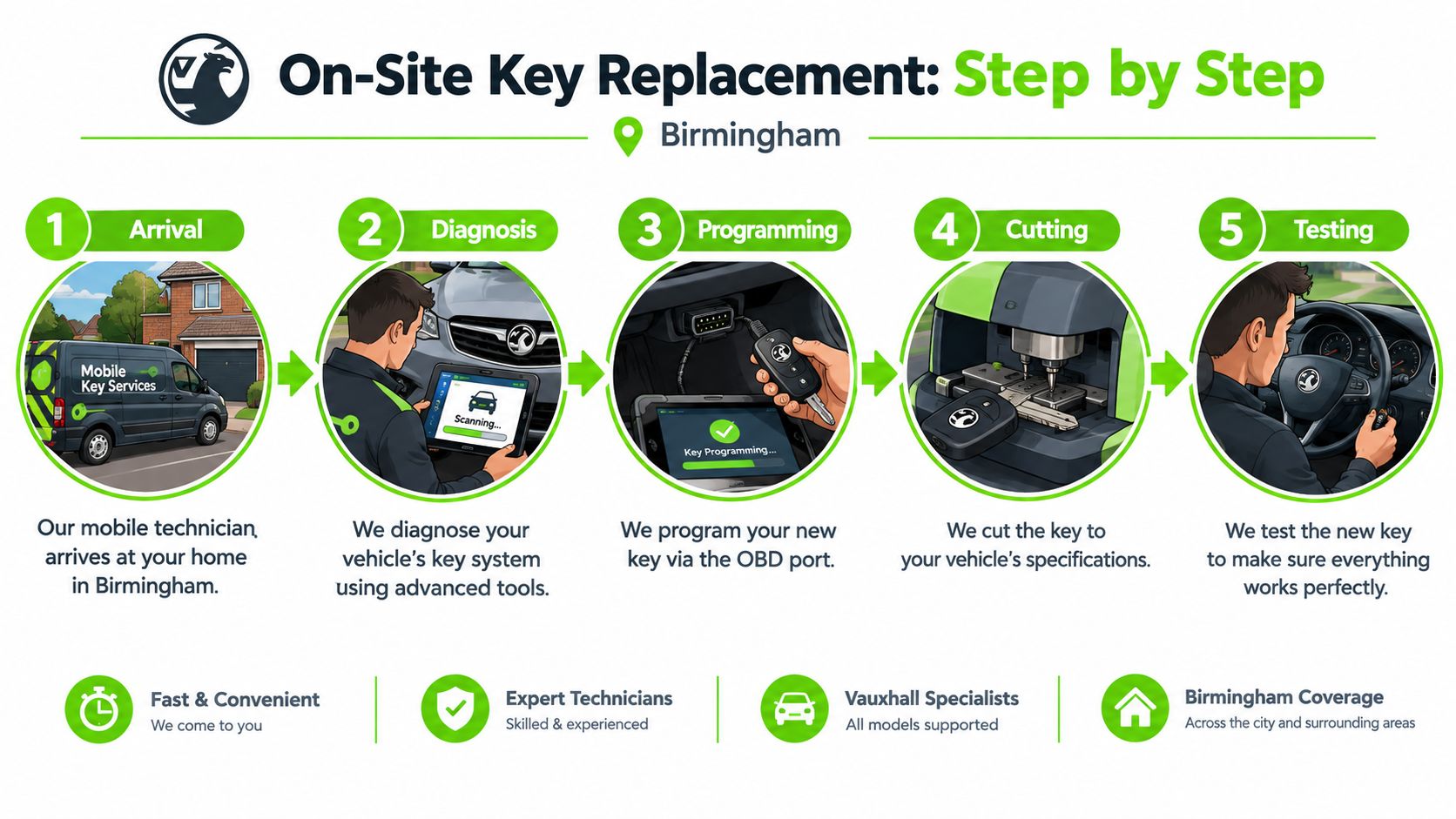
A typical call might be a Corsa outside a house in Birmingham or an Astra parked at a workplace in Coventry. The technician first confirms the registration and documents, then checks the key you have, the dashboard warnings and whether the vehicle has a conventional ignition or push-button start.
The vehicle is opened using non-destructive methods where possible. If no working key is available, the technician may decode the lock or verify the blade profile from the vehicle. The new blade is then cut to match the lock, rather than relying on a generic blank that only appears compatible.
Programming the vehicle correctly
The diagnostic stage is where many cheap-looking solutions fail. The technician connects to the vehicle's diagnostic system, communicates with the BCM or relevant immobiliser architecture, and registers the transponder. On a suitable model, lost-key credentials can also be removed from the authorised list.
Stable vehicle voltage matters during this work. A weak battery or unstable power supply can interrupt communication and leave the vehicle with incomplete programming. A used key or control unit can create another problem if it remains security-locked to a different vehicle. Some ECU, BCM and immobiliser units are paired, so they aren't always plug-and-play.
Remote synchronisation follows transponder programming. The buttons must lock and release the car, but that test alone isn't enough. I've seen vehicles where the remote operated the central locking while the engine still refused to start because the immobiliser chip had never been registered.
The final acceptance test should include:
Starting the engine with the replacement key.
Locking and opening from every relevant button.
Cycling the ignition and completing a second start.
Checking that immobiliser warnings have cleared.
Confirming that a deleted key no longer starts the vehicle where the system supports deletion.
A working second key usually makes a spare-key job faster because the technician can use it as a reference. An all-keys-lost job requires deeper vehicle communication, security data and a more complete authorisation process. On-site Vauxhall key cutting should therefore be quoted according to the actual model and key condition, not just the badge on the bonnet.
Typical Turnaround Times and Costs in GBP
Drivers usually want two answers first: how long will the car be unavailable, and what will the replacement cost? The honest answer depends on the key type, model generation, whether a working key remains and whether the missing key needs deleting.
A basic transponder is normally the least complex option. A remote fob costs more because it combines the blade, transponder and remote electronics. A proximity key can require additional pairing and testing. The exact price must be confirmed from the registration, model year and key details.
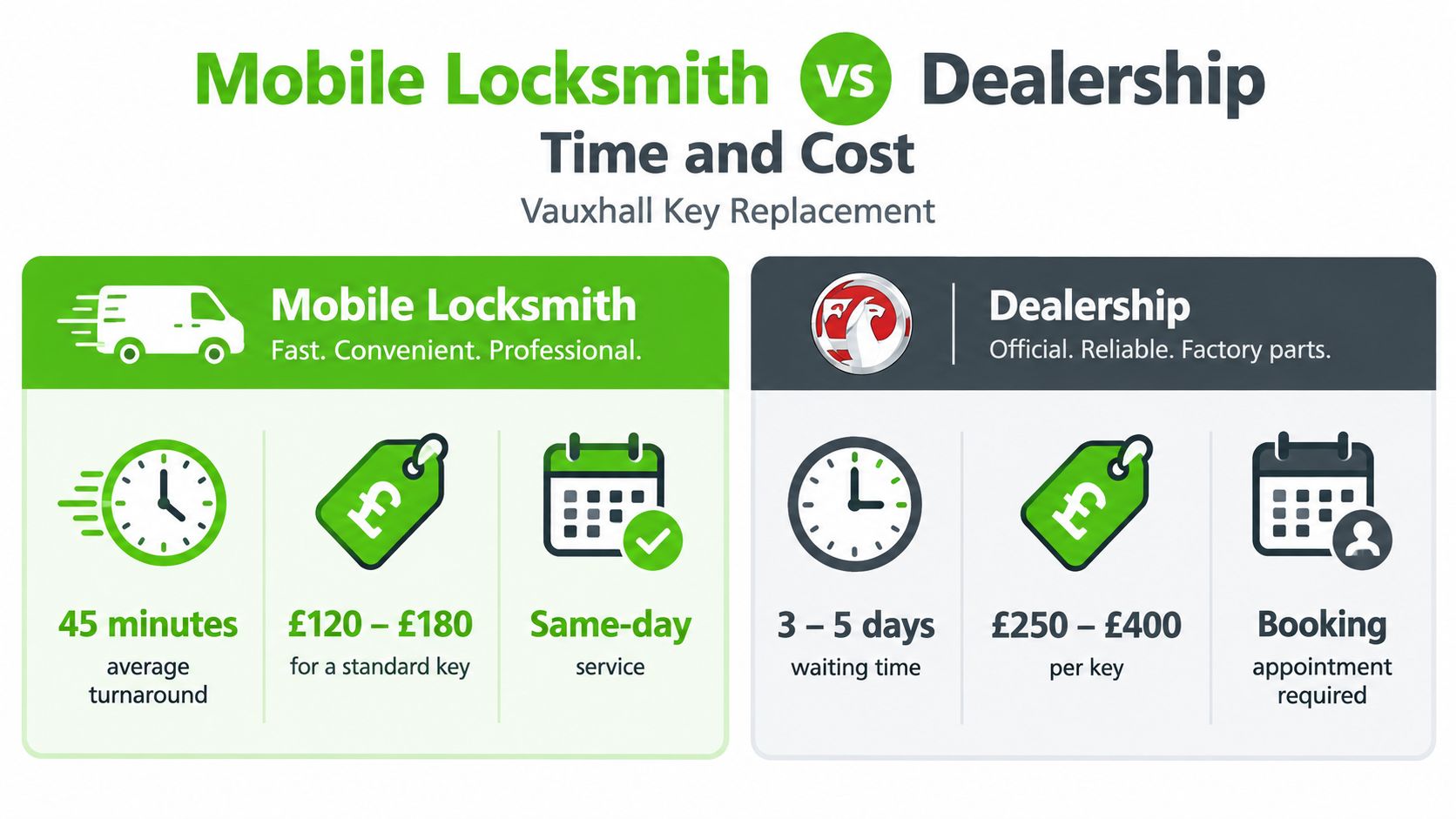
The supplied comparison graphic shows example figures of £120 to £180 for a standard mobile key and £250 to £400 per key through a dealership, with the graphic also presenting 45 minutes and 3 to 5 days as example turnaround and waiting figures. Treat those as illustrative comparison figures, not a universal quote, because Vauxhall systems vary significantly.
Where the money goes
A dealership may need to order the key, verify the vehicle through its retailer process and book the car into a workshop. If the car can't be driven, recovery or towing becomes part of the practical cost. An independent garage may cut a blade but lack the equipment for BCM-level or proximity programming.
A mobile auto locksmith carries cutting and diagnostic equipment to the vehicle. That removes the recovery step and can make same-day completion possible, although all-keys-lost work or a security fault may take longer than a straightforward spare.
Some mobile operators quote VAT-free prices, but check the written quote rather than assuming every provider uses the same tax status. Ask whether the figure includes the blank, cutting, programming, remote synchronisation, key deletion and post-job testing.
For wider cost context, you can compare cost of UK implementations, although that resource isn't a Vauxhall key tariff and shouldn't replace a vehicle-specific quotation. The security consequences of delay also matter. LV reported that vehicle-theft claims involving lost or stolen keys, keys left inside vehicles and related circumstances commonly involved average losses between £6,000 and £10,000. The published vehicle-theft information provides that context, but it doesn't predict the loss associated with any individual car.
Choosing a Mobile Locksmith Over the Dealership
A dealership remains a sensible choice for owners who want a manufacturer-supplied key and don't mind arranging an appointment. It can also be appropriate where the vehicle has a complex electronic fault that requires dealer-level support. The trade-off is less flexibility, possible waiting and the need to get the vehicle to the retailer.
A mobile locksmith is usually more practical when the Vauxhall is immobilised on a driveway, outside work or in a car park. The van brings the key blanks, cutting machine and diagnostic equipment to the vehicle. That avoids towing and lets the technician test the replacement in the same place where the problem occurred.
Look for two separate credentials. SERMI registration concerns secure access and handling of vehicle security-related information, while TASSA focuses on standards and best practice for aftermarket vehicle-security systems. TASSA identifies products including Autowatch Ghost II, Ghost Pro and Ghost Pro FD as approved products when installed by a TASSA-registered installer. TASSA's published information makes clear that recognition relates to the vehicle being fitted by a registered installer, not only to buying a product.
A Ghost-II immobiliser or an S5 tracker is an optional security upgrade, not part of ordinary key replacement. The replacement restores authorised access. An aftermarket immobiliser adds another starting barrier, so ask for separate pricing, certification and insurance requirements rather than treating the two services as interchangeable.
Before booking, ask for:
Registration evidence: Confirm the technician's SERMI and TASSA status where relevant.
Written scope: Check whether cutting, transponder programming, remote pairing and deletion are included.
Parts policy: Ask whether the key is genuine or aftermarket and what warranty applies.
Security outcome: Confirm whether the lost key can be removed from the vehicle's memory.
Testing: Ensure the engine start, remote buttons and warning lights will be checked before payment.
The same discipline applies when assessing any local trade service. Businesses researching marketing for trades from Kultiva should still judge a locksmith by verifiable credentials, clear documentation and the work included in the quote.
Troubleshooting and FAQs for Vauxhall Key Issues
The new key locks the doors but the engine won't start. What happened?The remote may have synchronised while the transponder didn't programme. Return to the technician for an immobiliser check rather than buying another battery.
The immobiliser warning remains on.Try the spare key if you have one. Vauxhall manuals advise seeking workshop assistance when the warning persists, because the fault may involve the immobiliser or vehicle system rather than the replacement key.
How can I tell whether the fob battery is flat?If the buttons stop working but the vehicle still starts, suspect the battery or remote circuit. If the car refuses to start and shows an immobiliser warning, the transponder or vehicle authorisation needs testing.
Will a breaker's-yard key work?Not necessarily. A used key may be security-locked to another car, and its blade, chip or remote frequency may be incompatible. Confirm compatibility before buying it.
What if the missing key may be stolen?Ask for key deletion where the Vauxhall system supports it. West Midlands Police recorded 13,822 motor-vehicle-related incidents in 2024, including 12,878 completed vehicle thefts, 275 attempted thefts and 669 unauthorised takings. These are local recorded incidents, not a prediction for your vehicle, but they show why a missing programmed key shouldn't be ignored. West Midlands Police publishes the breakdown here.
For Vauxhall key replacement, Top Motor Keys provides mobile cutting, programming, all-keys-lost assistance and immobiliser support across Tamworth, Lichfield, Sutton Coldfield, Cannock, Burton Upon Trent, Solihull, Coventry, Atherstone, Ashby-de-la-Zouch, Coleshill, Nuneaton, Walsall, Wolverhampton and Birmingham. Request a vehicle-specific quote through Top Motor Keys and have your registration, model year, remaining keys and Car Pass details ready.