
Volkswagen Polo Key Guide: Types, Replacement and Costs

You press the button on your Volkswagen Polo key and nothing happens. The car is sitting in a West Midlands car park, the spare is at home, and the day's plans have just changed. Before ordering the first replacement you find, it helps to know whether you need a cut blade, a remote repair, immobiliser programming, or all three.
That distinction matters because a Polo key performs separate jobs. The right diagnosis can avoid an incompatible key, an unnecessary dealer visit, or a replacement that opens the door but still won't start the engine.
The Sunday Morning Every Polo Owner Dreads
A Polo driver in a busy car park near Tamworth finds the key fob has stopped responding. The doors won't open from the buttons, and the driver assumes the whole key has failed. The metal blade still opens the door, but the engine refuses to start and an immobiliser warning appears on the dashboard.
That isn't one fault. It may involve three separate parts of the same Volkswagen Polo key:
The blade: physically turns the door lock and ignition where fitted.
The remote: transmits the secure and release command to the vehicle.
The transponder: exchanges a coded signal with the immobiliser so the engine can run.
A replacement must match the Polo's generation, model year and electronic system. An older car may need a blade and transponder, while a later version may use a folding remote or keyless entry and start. The key's appearance alone isn't always enough to identify the correct equipment.
This guide is written for drivers dealing with a lost key, a dead remote, a newly cut key that won't start the car, or the sensible question of whether to buy a spare before an emergency. It also covers the practical difference between a main dealer, an independent garage and a mobile auto locksmith.
Practical rule: Tell the locksmith whether the key turns the lock, whether the remote buttons respond and what warning appears when you try to start the Polo. Those details help determine which equipment needs to come to the vehicle.
The service territory includes Tamworth, Lichfield, Sutton Coldfield, Cannock, Burton upon Trent, Solihull, Coventry, Atherstone, Ashby de la Zouch, Coleshill, Nuneaton, Walsall, Wolverhampton and Birmingham. Coverage and response availability should always be confirmed for the exact address.
What a Volkswagen Polo Key Really Does
A Volkswagen Polo key does three separate jobs, and each one can fail on its own. The blade must be cut correctly so it turns the lock or ignition where that version uses one. The remote sends the locking and access command to the car. The transponder handles the immobiliser side, which is what allows the engine to keep running.
That split matters because the symptom usually points to the failed part. A key can turn perfectly and still not start the car. A remote can stop responding while the engine starts first time. Treating the key as one single product is how drivers end up buying the wrong replacement.
The blade works like any accurately cut mechanical key. If it turns stiffly, jams, or will not rotate fully, the problem is usually with the cut, the worn key, or the lock itself. That tells you nothing definite about the electronics.
The remote operates more like a garage-door clicker. Its battery powers the transmitter, and the car listens for the right signal. If the battery is flat or the remote has lost synchronisation, the Polo may still start normally while the buttons stop working.
The transponder is the security part hidden inside the key. Volkswagen explains that a perfect mechanical copy won't start the car unless it contains the correctly coded transponder, as set out in its vehicle security guidance.
Read the symptom, not just the key shape
If the door opens and the ignition turns but the engine will not stay running, the blade may be fine while the transponder is uncoded or not recognised. If the engine starts but the buttons do nothing, look first at the remote battery, the remote itself, or synchronisation.
A newly cut key often catches people out. The metal part can be right, yet the car still needs immobiliser coding before that key will start it.
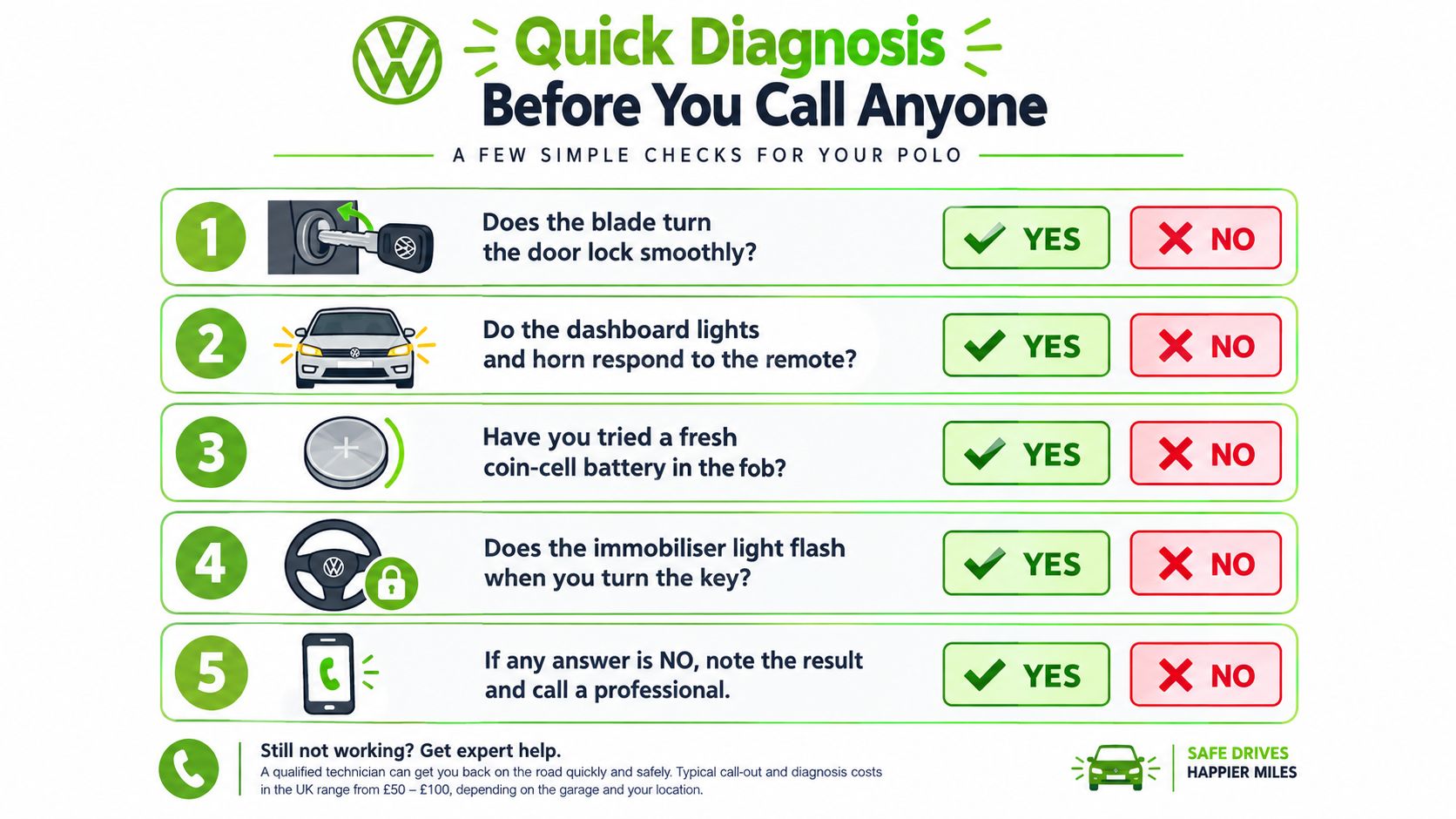
Before you call anyone, note whether the remote LED lights, whether the car reacts to the buttons, whether the blade turns smoothly, and whether the immobiliser lamp flashes or stays on. That description is what helps a locksmith bring the right kit to the driveway.
Identifying Your Polo Key Type
The Polo has a long UK history. It was introduced in May 1975, reached the UK market in early 1976, passed through six generations and exceeded 20 million vehicles sold worldwide by 2025, according to this Polo anniversary history.
That history explains why two Polos parked side by side can need completely different keys. Use the table as a starting point, then confirm the registration details and existing fob before ordering.
Generation / years | Key style | Remote function | Immobiliser |
|---|---|---|---|
Earlier generations | Fixed mechanical blade, often with a separate or integrated transponder | May be absent or basic, depending on specification | Earlier electronic immobiliser arrangements vary by model |
Middle generations | Folding blade with buttons and integrated transponder | Remote central locking | Coded transponder must match the vehicle |
Later and current versions | Folding remote or smart key, depending on trim | Remote locking, with keyless entry and start on equipped versions | More advanced immobiliser and proximity-key systems |
Find the clues on the car
Start with the registration document and model year. Then inspect the key itself. A fixed blade, a flip-out blade or a proximity fob gives a useful indication, but it doesn't replace vehicle-specific identification.
Look at the dashboard as well. A conventional ignition barrel suggests a different process from a keyless-start system, where the vehicle may require an emergency starting method if the fob battery is weak. The exact procedure depends on the vehicle's manual and equipment.
Used-car buyers in the West Midlands often inherit a Polo with only one working key. That makes checking the key type before purchase worthwhile. A missing spare isn't just an inconvenience. It can turn a simple duplicate into a more involved all-keys-lost job if the remaining key disappears.
Quick Diagnosis Before You Call Anyone
Run these checks beside the car before committing to a replacement. They separate a remote fault from a starting-authorisation fault.
Test the blade. Insert it into the driver's door and turn it gently. If it operates the lock, the mechanical part is probably usable. Don't force a stiff blade.
Check the remote response. Press a button and watch the fob LED, if fitted. Try the spare key if you have one. If the spare works, the vehicle receiver is less likely to be the problem.
Fit a fresh battery. A depleted fob battery can stop remote locking without proving that the immobiliser transponder has failed.
Try the key in the normal starting position. If the engine starts but the buttons don't work, remote synchronisation may be needed. Volkswagen Polo documentation identifies battery depletion and lost synchronisation as possible causes of remote-locking failure, with synchronisation completed within one minute of entering the car, as set out in this Polo guidance.
Watch the immobiliser warning. If the car shows an immobiliser warning and won't run, a cut blade alone won't solve it. The transponder needs to be identified and programmed.
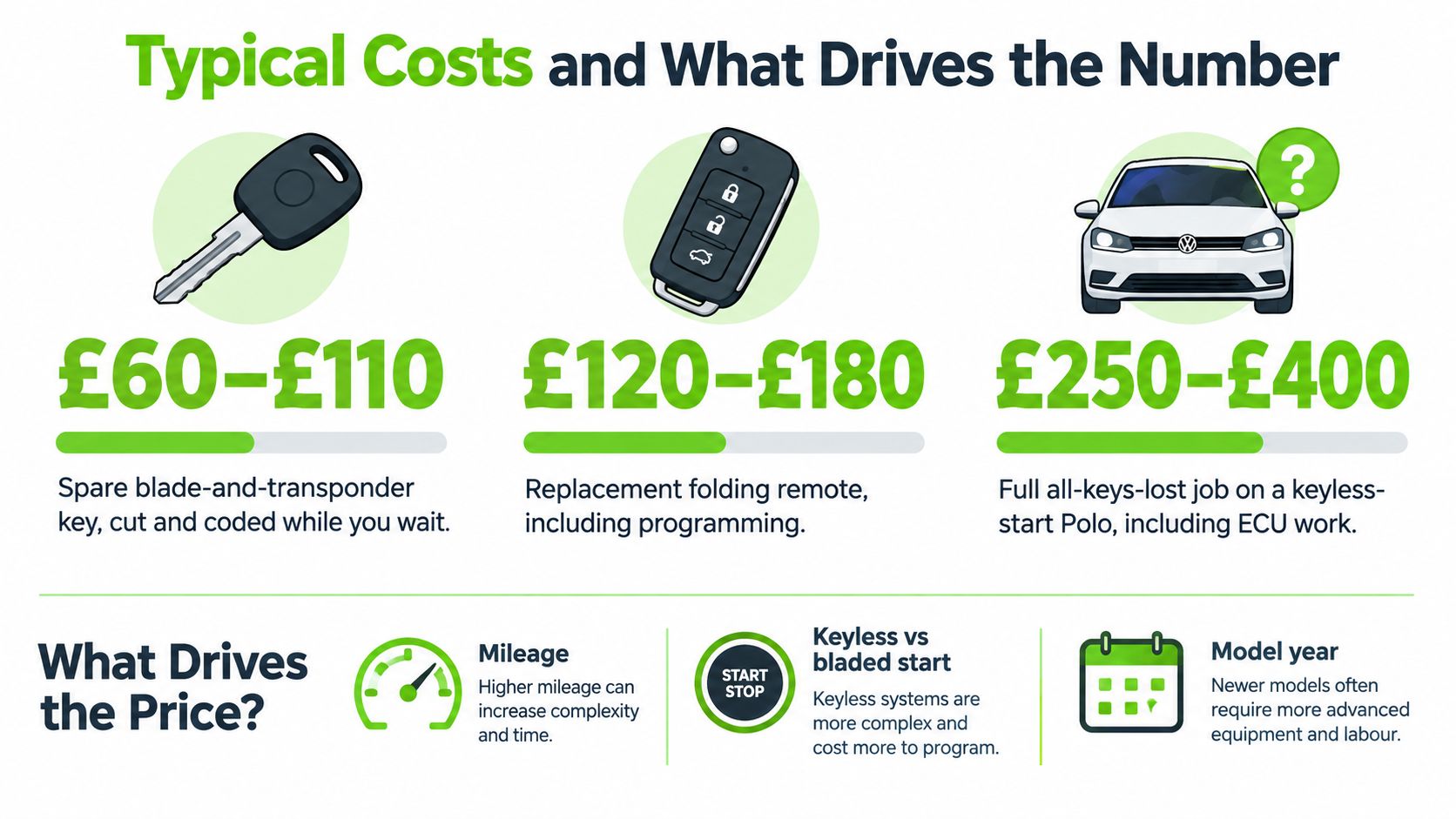
A key that starts the car but won't lock it remotely may need a battery or re-sync. A key that opens the door but triggers an immobiliser warning needs a different response. Have your registration details, location, model year and proof of ownership ready. This guide to proving car ownership explains why those checks matter.
Dealer Versus Mobile Locksmith
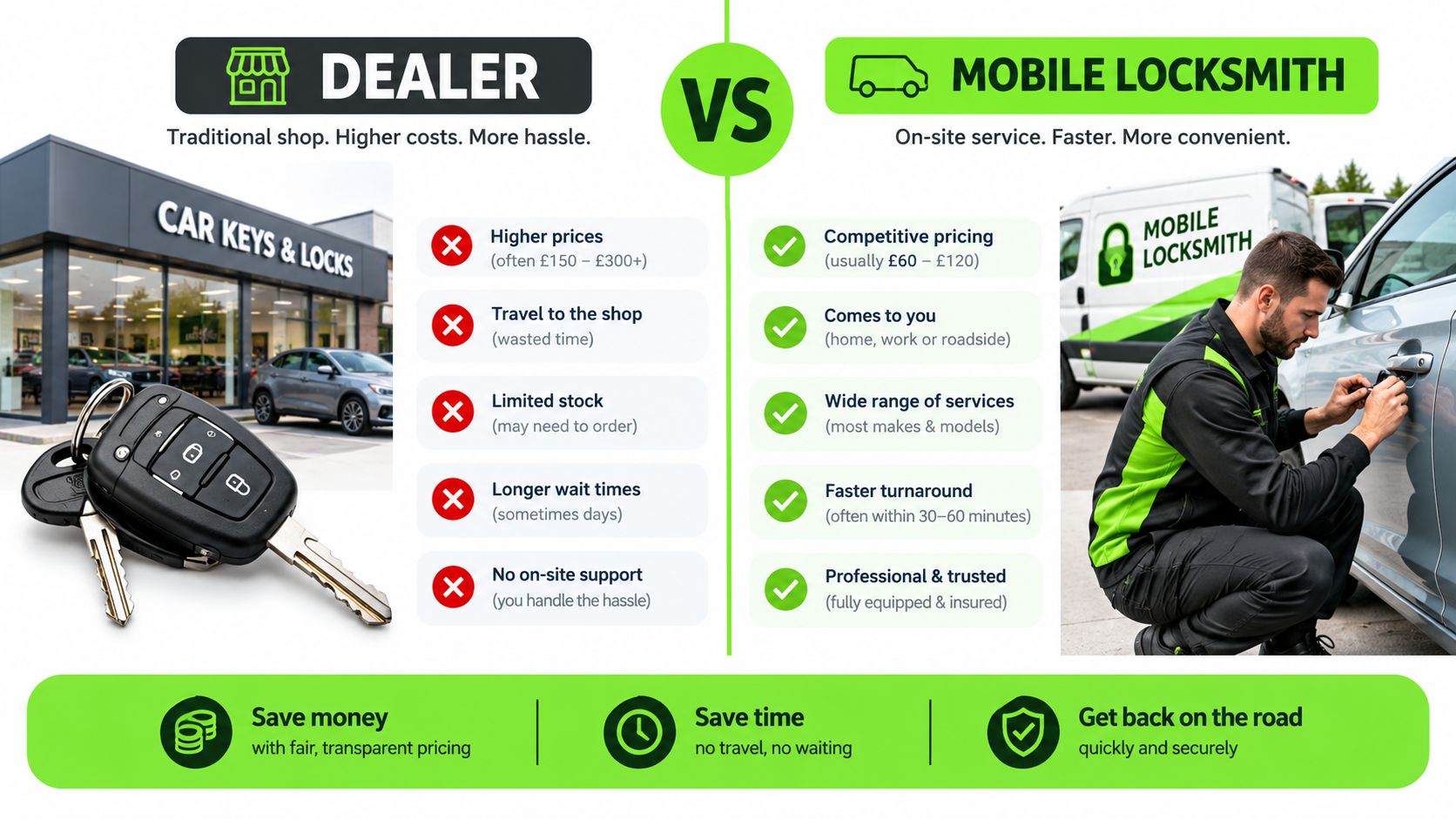
A main dealer is a sensible choice for some owners. A nearly new Polo, a warranty concern or a complex factory-specific issue may justify using the dealer network. The trade-off is that you normally take the vehicle or arrange recovery, wait for the booking and pay for the dealer's process.
An independent garage can be useful when the key issue is connected to wider electrical or mechanical work. It may not, however, have the equipment or security-information access needed for every immobiliser system.
A mobile auto locksmith is usually the practical option when the Polo is locked at home, outside work or in a car park. The technician can inspect the vehicle, cut a blade and carry out programming at the location, subject to the key system and available equipment.
What matters | Main dealer | Independent garage | Mobile auto locksmith |
|---|---|---|---|
Cost | Often higher due to dealer process and vehicle handling | Varies by equipment and experience | Quote usually reflects the exact key and on-site work |
Time | Appointment and possible vehicle transport | Depends on workshop availability | Can attend the stranded vehicle when available |
Ownership checks | Required | Required | Required |
Vehicle access | Usually you bring the car in | Usually workshop-based | Designed for roadside, home or workplace jobs |
Security information | Manufacturer route | Varies | Ask about security authorisation and equipment |
Ask about security access
SERMI controls access to security-related vehicle repair information. Approved independent operators can receive manufacturer-level access for work such as key programming, but the business and relevant employees must satisfy documentation, identity and security requirements, as explained by SERMI UK.
TASSA, the Tracking and Aftermarket Security System Association, covers a different area. It verifies aftermarket security products, services and installations. Its database records installations completed by an appropriately trained installer and allows them to be audited, as described by TASSA's information for consumers.
That distinction matters if you're considering a Ghost-II immobiliser or S5 tracker instead of replacing a Polo key. SERMI concerns controlled access to sensitive manufacturer information. TASSA concerns verified aftermarket security work.
For a broader Volkswagen replacement overview, see this Volkswagen key replacement guide.
Typical Costs and What Drives the Number
The supplied price guide for common Polo jobs is:
£60 to £110: spare blade-and-transponder key, cut and coded while you wait.
£120 to £180: replacement folding remote, including programming.
£250 to £600: full all-keys-lost job on a keyless-start Polo, including ECU work.
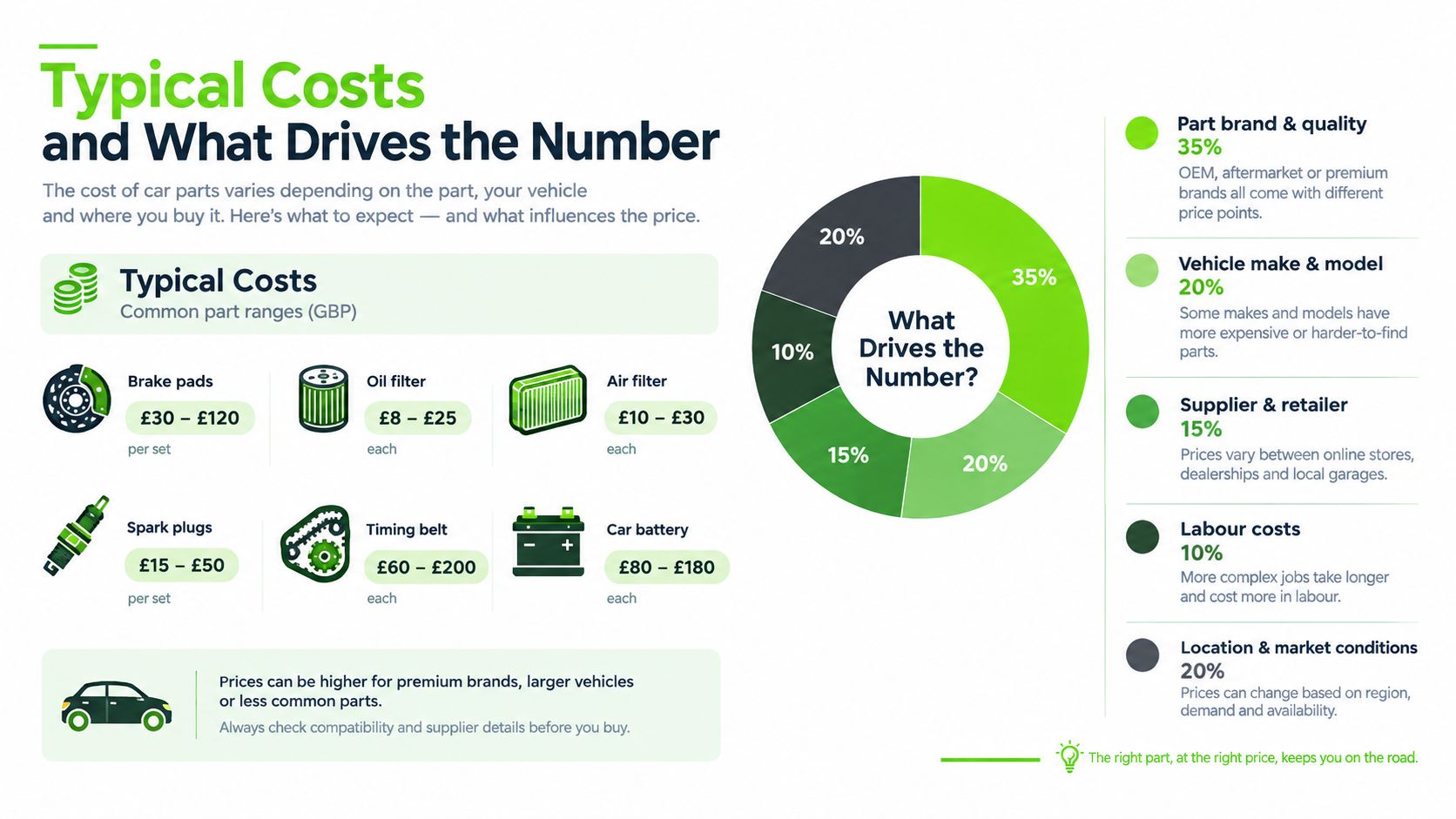
Treat those figures as useful price awareness rather than an automatic quote. The final amount depends on the key generation, whether the car starts with a blade or proximity fob, whether a working key remains, the required diagnostic procedure and the location of the vehicle.
The Polo's UK popularity supports a broad aftermarket. More than 45,000 new Polos were registered in the UK in 2010, when it ranked as the country's sixth-best-selling new car. In 2021, 30,634 new Polos were registered, placing it fifth, according to the model's UK sales history.
Older blade-and-transponder cars can be straightforward when a working key is available. Newer keyless models involve more security steps, particularly when every authorised key has disappeared. A low quote may exclude programming, travel, emergency attendance or key erasure, so ask what the price includes before agreeing to the work.
What Happens During an On-Site Replacement
A professional mobile replacement starts with identity and vehicle checks, not with a blank key. Have the registration document or other ownership evidence available, plus identification and the vehicle location. The chassis number may also be required when ordering a replacement or additional key.
The technician then confirms the Polo's model year, key style and immobiliser system. This prevents a common mistake, ordering a key that looks right but uses incompatible electronics.
The usual sequence
Vehicle identification: the registration and chassis details are checked against the car.
Key assessment: any remaining key is tested for blade operation, remote response and starting authorisation.
Blade cutting: a compatible blank is cut to match the vehicle's lock profile where required.
Transponder programming: diagnostic equipment communicates with the immobiliser so the new chip is authorised.
Remote synchronisation: the buttons are paired with the vehicle's locking system where applicable.
Lost-key management: if a key has disappeared, the technician can discuss removing it from the authorised-key memory where the system supports that procedure.
Final testing: the blade, remote and engine start are checked separately.
Volkswagen Polo documentation states that each new key contains a microchip encoded with the vehicle's immobiliser data and that replacement keys must be synchronised before use, as explained in this electronic immobiliser information.
A working spare often makes the job simpler than an all-keys-lost situation. Keyless-start vehicles can require additional diagnostic work, while older Polos may need fewer electronic steps. The process is not just key cutting. It is controlled vehicle authorisation. Further technical background is available in this guide to VW transponder key programming.
Choosing a Trusted Local Specialist
A credible provider should explain exactly what the quoted Volkswagen Polo key service includes. Ask whether the price covers the blade, remote, transponder programming, synchronisation, lost-key erasure and testing. Also ask what proof of ownership is required before work begins.
SERMI and TASSA answer different questions. SERMI relates to access to security-related manufacturer information. TASSA helps document aftermarket security installations by recording the trained installer and the fitted system in its database. Neither label replaces a clear quote or guarantees that every key job is suitable for every Polo.
Local wording needs the same care. The West Midlands statistical geography includes areas such as Tamworth and Coventry, and regional local-authority data identifies Nuneaton and Bedworth. A business should still confirm operational coverage for places including Lichfield, Sutton Coldfield, Cannock, Burton upon Trent, Solihull, Atherstone, Ashby de la Zouch, Coleshill, Walsall, Wolverhampton and Birmingham.
Top Motor Keys provides 24/7 mobile auto locksmith services, free no-obligation quotes, VAT-free pricing and more than twelve years of automotive experience. Its mobile service covers Volkswagen Polo key cutting, replacement, programming and immobiliser-related work, with advanced security options including Ghost-II immobilisers and S5 trackers.
If your Volkswagen Polo key opens the car but won't start it, or the remote has stopped responding, Top Motor Keys can assess the blade, remote and immobiliser separately. Request a free quote with your Polo's registration, location and key symptoms, and arrange mobile assistance at home, work or roadside.