
How Does Keyless Entry Work? A UK Driver's Guide

Ever wondered what's happening behind the scenes when you unlock your car with the press of a button? It’s not magic, but it’s clever. Think of it like a secret, invisible handshake between your key fob and your car.
Your key sends out a unique, secure code using a radio signal. If your car's receiver recognises that code, click—the doors unlock. It all happens in a flash.
Your Car's Invisible Handshake
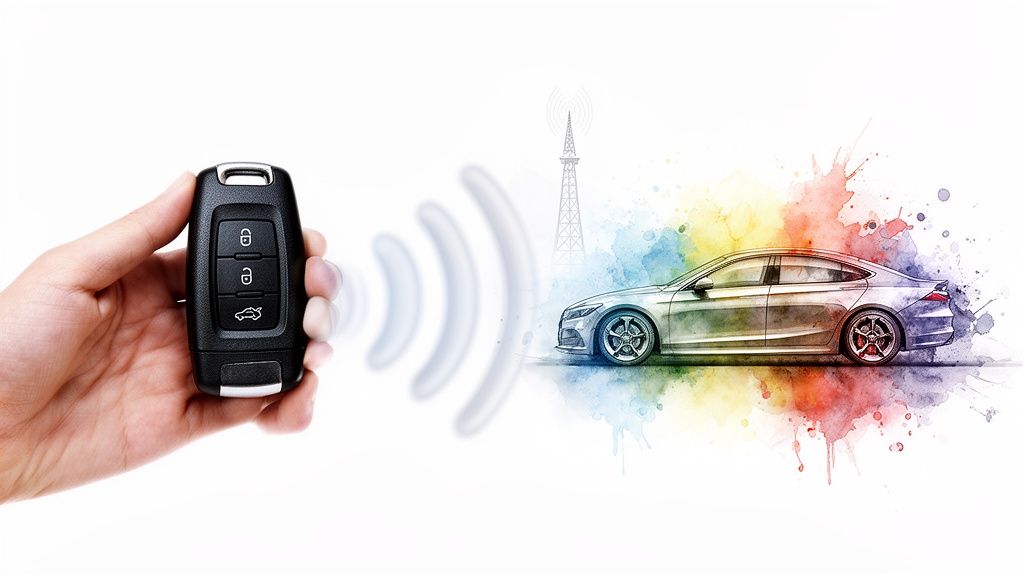
That seamless moment is all down to a brilliant bit of radio technology. Your key fob is essentially a tiny, personal radio station, broadcasting on a very specific frequency. Your car is the radio, always tuned in and listening for that one special broadcast.
When you press the unlock button, the fob zaps out a short burst of data – an encrypted digital code. This code is the secret password for that single moment. If the car’s on-board computer, the Body Control Module (BCM), gets the right password, it gives the nod and tells the locks to open.
The Two Main Flavours of Keyless Systems
While the basic idea is the same, you’ll generally find two types of keyless entry systems out on the roads of Birmingham, Sutton Coldfield, and Coventry:
Remote Keyless Entry (RKE): This is the classic system everyone knows. You have to physically press a button on the fob to lock, unlock, or pop the boot. It’s a direct command from you to your car. Simple and effective.
Passive Keyless Entry (PKE): This is the more modern, hands-free version. As long as the fob is somewhere on your person—pocket, handbag, you name it—the car senses it's close by. Just grab the door handle, and it unlocks itself. A real-life example is juggling shopping bags in a Lichfield car park; instead of fumbling for your keys, you just touch the handle and the boot opens.
Both of these systems rely on a tiny but vital component: the transponder chip. This little chip is the brain inside your key, holding the unique security data that stops just any old key from starting your engine.
If you want to get into the nitty-gritty of it, our practical guide to transponder car keys breaks down how they form the backbone of modern car security. This is the tech that’s keeping your car safe, whether it's parked up in Tamworth, Wolverhampton, or Walsall.
The Tech Behind the Magic: Rolling Codes and Immobilisers
To really get what’s happening when you use your keyless entry, we need to lift the bonnet on the tech that keeps your car secure. It’s not just a simple signal being zapped across the car park; it's a clever digital handshake between your key and your vehicle. The whole system is built on two core bits of kit: Radio Frequency (RF) and Radio-Frequency Identification (RFID).
Think of RF as the wireless messenger. When you press a button or get near your car, your fob sends out an RF signal carrying a special security code. RFID, on the other hand, is like the unique watermark on that message. It lets your car's receiver confirm the signal came from your specific key and not some dodgy fake.
The Ever-Changing Secret Password
The real hero in modern car security is something called rolling codes, also known as hopping codes. Imagine if your house key changed its pattern every single time you locked the door. That's pretty much what this system does for your car.
Each time you use your fob, it sends a brand-new, unpredictable code to the car. Your car's receiver is smart enough to know what code to expect next. Once that code is used, it’s instantly retired. It will never, ever work again.
This is what makes the system so tough to crack. It means even if a thief in a Cannock or Solihull car park managed to snatch the signal out of the air, it would be completely useless to them. Trying to reuse that captured code would be like trying to open a safe with last week's lottery numbers—it just won't work.
This constant change creates a nearly unbreakable chain of communication. It's the very reason thieves had to give up on simple signal-copying and start using more complex tricks like relay attacks.
The Final Gatekeeper: Your Car's Immobiliser
Even if a signal with the right rolling code gets through, there's one last bouncer at the door: the engine immobiliser. This is the ultimate guardian of your vehicle, and it has the final say on whether the engine is allowed to start.
Tucked away inside your key fob is a tiny transponder chip with its own permanent, unique ID. When you get in and try to start the car, the immobiliser sends out a little signal to "wake up" this chip. The chip then radios its secret ID back to the car.
If the immobiliser recognises the ID, it gives the engine control unit (ECU) the all-clear. But if the ID doesn't match—or if there's no ID at all—the engine stays dead. To get the full story on this critical bit of security, check out our detailed guide on how a car immobiliser works.
It's the combination of rolling codes and immobilisers that forms such a powerful defence against would-be thieves.
When Convenience Meets Crime: Understanding Relay Attacks
There’s no denying how brilliant passive keyless entry is. Just walk up to your car, pull the handle, and you're in. But this very convenience has, unfortunately, created a gaping hole for a new breed of car thief. This method, called a relay attack, has sadly become the number one way modern cars are stolen.
It turns a feature designed for ease into a massive security risk.
Picture this real-life scenario happening late at night, whether you're in Atherstone, Coleshill or Nuneaton. A thief lurks near the front of your house holding a small device – a relay amplifier. Inside, your key fob is sitting on the kitchen counter or hanging on a hook, constantly emitting its faint, low-frequency signal. The thief's box picks it up.
The amplifier instantly boosts that signal and sends it to a second box held by an accomplice standing right next to your car. This second device effectively becomes a clone of your key, broadcasting the now-amplified signal. Your car's system is completely duped. It thinks you are standing there with the genuine key. The doors unlock, the immobiliser switches off, and the accomplice can simply push the start button and drive off.
The whole thing is silent. It leaves no broken glass, no signs of forced entry, and can be over in less than 60 seconds.
The Alarming Rise of Signal Relaying
This isn't some high-tech heist from a spy film anymore. Relay attacks have fuelled a massive crime wave right here in the UK. Data from the Crime Survey for England and Wales is pretty shocking: between March 2023 and 2024, an incredible 58% of all car thefts were carried out using this method.
Thieves are using cheap, easy-to-buy devices, sometimes costing less than £100 online, to pull this off. What was once a minor issue, accounting for just 14% of thefts in 2019, has exploded into the go-to method for criminals. You can read more about these car theft statistics and see just how effectively this technology is being exploited.
The diagram below shows the security handshake that a relay attack is designed to hijack.
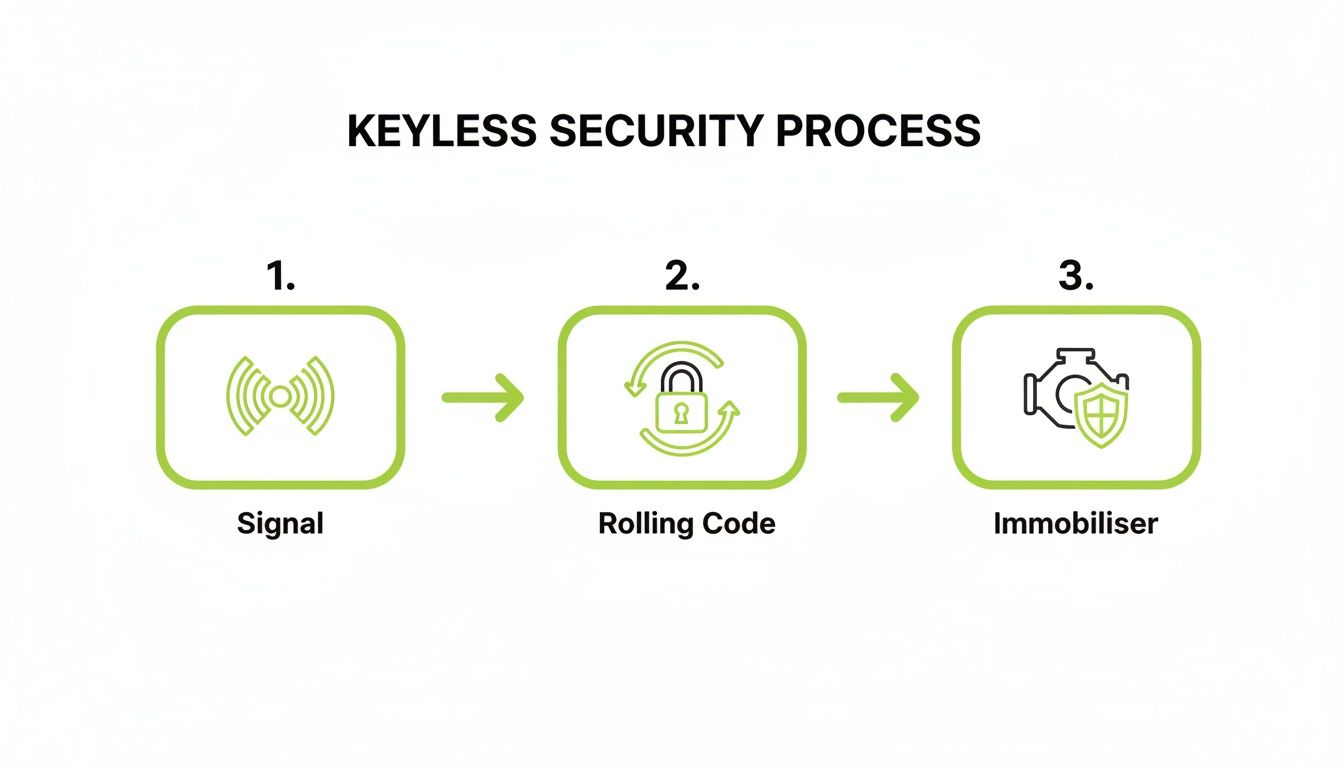
Normally, the signal, rolling code, and immobiliser work together to keep your car safe. A relay attack simply tricks the car into thinking the legitimate process has happened, when it’s anything but.
Fighting Back: How to Protect Your Keyless Car
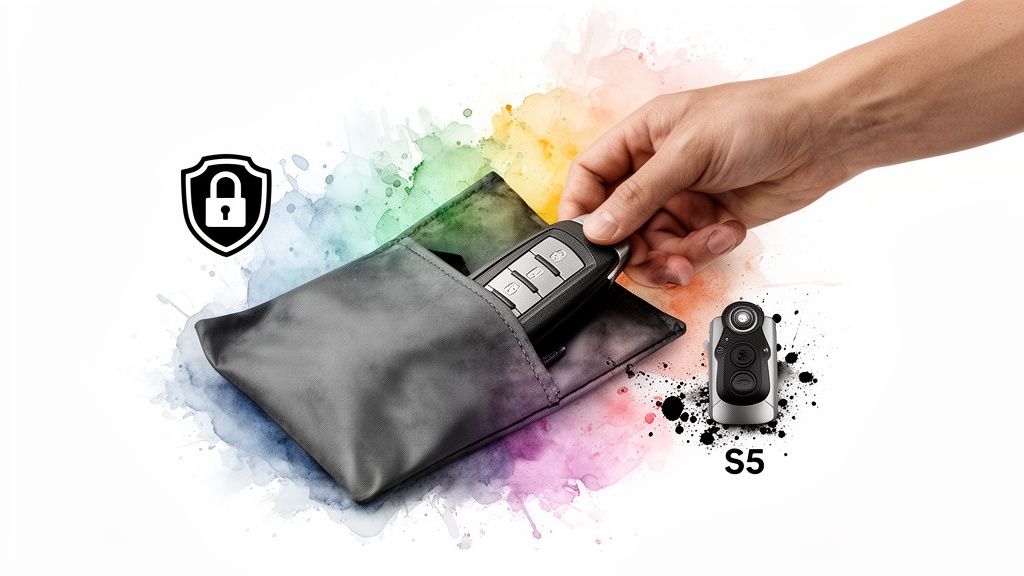
Once you understand how keyless entry works, you can start to see where the weak spots are. But here's the good news: you can absolutely fight back. Protecting your car is all about layering your security, from simple daily habits to professional solutions that will stop thieves dead in their tracks. It’s about making your car a much, much harder target.
The easiest and most effective first step is to block the signal at its source. When you’re at home in Lichfield or Burton upon Trent, don't just leave your keys on the hook by the front door. Pop them inside a signal-blocking Faraday pouch or box. This simple, metal-lined container acts like a shield, stopping your fob's signal from getting out and making it completely invisible to a relay attack.
For real peace of mind, however, you need to add a few more layers.
Professional-Grade Security Upgrades
To properly shut down the threat of a relay attack, you need something that works even if a thief does manage to boost your key's signal. This is where a Ghost-II Immobiliser is an absolute game-changer. It’s an invisible device we can install that adds a second, rock-solid layer of security.
Even if thieves get your car's doors open, the Ghost-II immobiliser stops the engine from ever starting until a unique PIN code is entered. This isn't a separate keypad; it's a sequence you choose, using your car’s existing buttons on the steering wheel or dash.
This brilliant bit of kit makes relay theft physically impossible. We had a customer in Solihull with a Range Rover who was targeted just recently. The thieves successfully relayed the key signal and got inside, but the Ghost immobiliser we’d fitted left them completely baffled. They couldn't get the engine to fire up and had no choice but to give up and run.
For the ultimate security setup, a lot of drivers also add an S5 Vehicle Tracker. If the worst-case scenario happens and your car is stolen (maybe by being physically lifted onto a truck), a tracker gives the police its real-time location for a quick recovery. While relay attacks are a specific problem for keyless cars, a smart approach also includes general strategies for preventing car break-ins. By mixing good habits with professional-grade tech, you turn your convenient keyless car into a secure fortress on wheels.
Keyless Entry Troubleshooting Guide
That keyless entry system is a bit of magic, isn't it? Right up until the moment it decides to stop working. When your car suddenly gives you the silent treatment, it’s almost always down to one of a handful of common culprits. Let’s walk through how to play detective and figure out if you've got a simple fix on your hands or if it's time to call in the experts.
Step 1: Check the Key Fob Battery
Nine times out of ten, the problem is a dead or dying battery in your key fob. It rarely just dies without a bit of a warning, though. You might notice you have to press the button a few times to get a response, or that you need to be standing practically on top of the car for it to work. If your dashboard flashes up a "Key Fob Battery Low" message, consider it a final warning. Most fobs are pretty easy to pop open with a small screwdriver or even a coin, and the CR2032 battery you'll likely find inside is cheap as chips to replace.
Step 2: Rule Out External Factors
Okay, so you've swapped in a fresh battery and... nothing. Before you get too frustrated, let's check a few other things.
Is the car battery dead? A flat car battery means there's no power to run the receiver that listens for your fob's signal. If the interior lights are dim or you just get a sad clicking sound when you try to start the engine, your car's battery is the real problem.
Radio signal chaos: Sometimes, it's not you, it's the location. Powerful radio signals from nearby transmitters or even certain types of dodgy LED lighting can jam your fob's signal. If your key works perfectly everywhere else but plays up in one specific spot – say, that multi-storey car park in Nuneaton or outside a certain shop in Coleshill – then you've found your culprit.
Step 3: Identify a Resynchronisation Issue
Another classic issue is when the key fob simply forgets its connection to the car. This can happen if you drop it one too many times, it gets a dunking, or sometimes just from a random electronic glitch. In simple terms, your key and car have become strangers, and their digital handshake is failing. The biggest clue here is that the little red light on the fob still flashes when you press a button, but the car does absolutely nothing. This is where a DIY fix is off the table. The key needs to be professionally resynchronised with your car's immobiliser system.
So, you've put in a new battery and you're not parked next to a radio mast, but the car still won't play ball. That's a textbook case for reprogramming. A mobile auto locksmith can come right to you, whether you're in Ashby de la Zouch or Walsall, and get it all sorted out then and there.
FAQ: Your Keyless Entry Questions Answered
Alright, let's wrap up by tackling some of the most common questions we hear from drivers across the Midlands.
Can a thief just grab my key's signal out of the air?
Not in the way you might think. A criminal can't just snatch the code and use it later. Your key uses ‘rolling codes’, which means every time you lock or unlock your car, the code changes. The old one becomes completely useless. However, they can capture your key's live signal and instantly relay it to your car using an amplifier. This is the classic relay attack that fools your car into thinking the key is right next to it.
What do I do if my key fob battery dies completely?
Don't panic! You're not stranded. Nearly every key fob has a secret physical key blade tucked away inside. Look for a tiny button or switch on the fob – that will release it, letting you open the door the old-fashioned way. For push-to-start models, there's a designated spot—often in the centre console or near the steering column—where you hold the dead fob. This allows the car to read the transponder chip directly, giving you the green light to start the engine.
Is it possible to switch off the keyless entry feature?
Yes, in most modern cars, you absolutely can. Many manufacturers let you disable the passive entry feature, either through the settings menu on your infotainment screen or with a specific combination of button presses on the fob itself. This is a fantastic security habit to get into, especially if you're parking up for the night or in a high-risk area. Your car's manual is the best place to find the exact method.
Will a Faraday pouch damage my key fob or drain its battery?
Not at all. A Faraday pouch won't have any impact on your key's battery life. It’s just a passive little bag that acts as a signal-blocking shield. Since the pouch stops the key from constantly communicating with the car, it might even help the battery last a tiny bit longer.
If your keyless entry system is playing up, or you’re ready to step up your security with something like a Ghost immobiliser, Top Motor Keys is here to help. We provide expert, on-the-spot solutions across Tamworth, Lichfield, Sutton Coldfield, Cannock, Burton Upon Trent, Solihull, Coventry, Atherstone, Ashby de la Zouch, Coleshill, Nuneaton, Walsall, Wolverhampton, and Birmingham. We save you a trip to the dealer. Get in touch with us for a fast, no-fuss fix: https://www.topmotorkeys.co.uk