
How to Open a Frozen Car Door Safely Without Causing Damage

When your car door is frozen shut, the first thing to figure out is what's actually frozen. Is it the lock, or is it the rubber seal around the door? If the lock is frozen, your best bet is a de-icer spray or carefully warming the key. If the seal is the problem, a firm push on the door or some lukewarm water can usually break the ice bond without causing any damage.
That Sinking Feeling of a Frozen Car Door
We’ve all been there. You’re running late on a frosty Sutton Coldfield morning, you pull the handle, and… nothing. It’s a classic UK winter problem that can throw your entire day into chaos. Before you start yanking on the handle, just take a breath. The issue is almost always a simple case of frozen rubber seals or an iced-up lock, not a broken car.
This guide will walk you through the safe, effective ways to get that door open without damaging your vehicle.
So, Why Does This Happen?
A car door usually freezes shut for one of two reasons: moisture gets trapped between the rubber weatherstripping and the metal door frame, or water finds its way into the lock mechanism itself.
This little bit of winter magic can happen from:
Rain followed by a sudden temperature drop overnight.
Melting snow that refreezes into a solid block of ice.
Even the condensation from a recent car wash can be the culprit.
For drivers all over the areas we cover, from Tamworth, Lichfield, and Sutton Coldfield to Cannock and Burton Upon Trent, this is a familiar frustration. The trick is to figure out whether you're dealing with a frozen seal or a frozen lock and use the right technique for the job.
A Word of Warning: Yanking on a frozen handle is one of the fastest ways to cause expensive damage. A broken handle or a torn rubber seal will cost you a lot more to fix than the few minutes it takes to safely de-ice the door.
A Quick Look at Safe Solutions
Before we dive into the specific methods, it helps to know your options. Different situations call for different approaches, and choosing the right one saves time and prevents a whole lot of headaches. Whether you're stuck in Solihull, Coventry, or Atherstone, having a plan is your best defence against a frozen-over morning.
Here's a quick rundown of the safe and effective techniques we'll cover.
Method | Best For | Risk Level | Time Required |
|---|---|---|---|
Pushing the Door | Frozen rubber seals | Low | 1-2 minutes |
Lukewarm Water | Frozen rubber seals or handles | Low-Medium | 2-5 minutes |
Lock De-Icer | Frozen key locks | Low | < 1 minute |
Warming the Key | Frozen key locks | Low-Medium | 2-3 minutes |
Hairdryer | All frozen components | Medium | 5-10 minutes |
These methods are your first line of defence, and one of them will usually do the trick. Now, let's get into the step-by-step details for each one.
Figuring Out Why Your Door Is Stuck
Alright, before you start blasting your car with de-icer or wrestling with the handle, take a breath. The first, most important step is a bit of detective work. You need to figure out what exactly is frozen. Is it the lock itself, or is the rubber seal around the doorframe the culprit?
Getting this right from the get-go saves you a world of hassle. I've seen countless drivers in Ashby de la Zouch waste time (and de-icer) on a perfectly fine lock when the real issue was the rubber seal, which was basically glued shut with a layer of ice. Knowing the problem lets you pick the right tool for the job and get on with your day.
The Lock vs. The Seal Test
So, how can you tell the difference? It's actually pretty simple. Just run through this quick two-part check.
Try the Key: Gently slide your key into the lock. If it won't go in at all, or if it goes in but refuses to turn, then you've got a frozen lock mechanism. Ice has formed inside the lock cylinder, jamming up the works.
Check the Handle: What if the key turns just fine and you hear that satisfying clunk of the door unlocking? Now try the handle. If it moves normally but the door itself feels welded to the car frame, that’s a classic case of a frozen rubber seal.
This distinction is everything. Trying to brute force a door with a frozen seal is a surefire way to tear the rubber, which can lead to annoying leaks and wind noise down the road. And forcing a key in a frozen lock? That’s a fast track to snapping it right off in there.
You wouldn't believe how many broken key extraction call-outs we get in places like Cannock and Burton Upon Trent that were totally avoidable. Taking just 30 seconds to properly diagnose the problem is the smartest thing you can do.
Think of it like this quick decision tree – it helps you figure out the first crucial move to make when you're stuck.
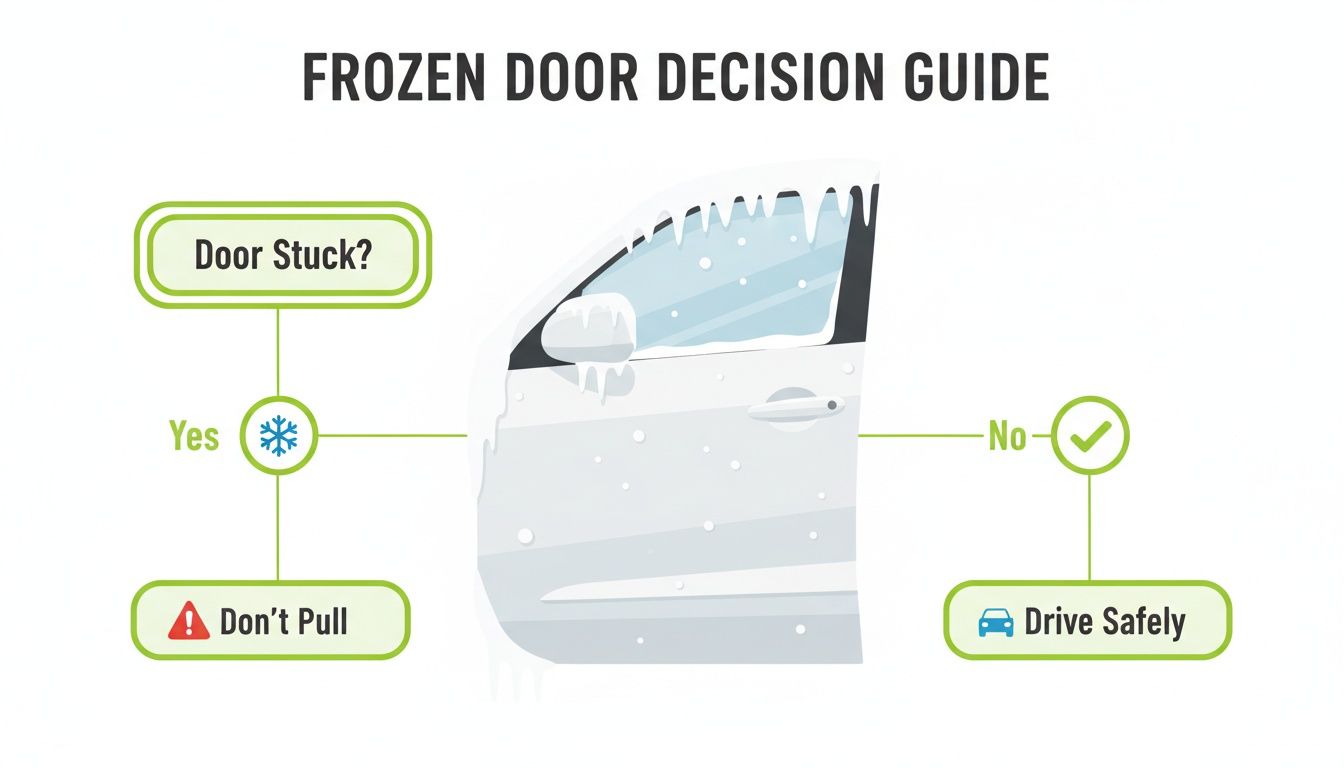
The main takeaway here? Your first instinct should never be to just yank harder. It's to pause and figure out what you're actually up against. Now that you know whether you're dealing with a stubborn lock or a frozen seal, you can move on to the right techniques to safely get it open.
So, The Rubber Seals Have Frozen Solid
If you’ve figured out it’s the rubber seals and not the lock, you’re dealing with the most common reason for a car door being frozen shut. It happens when a bit of moisture gets trapped between the rubber weatherstripping and the car’s metal frame, then the temperature plummets. It basically glues the door shut with a thin layer of ice.
The good news? Breaking that icy bond is usually pretty straightforward. You just need a bit of patience, not brute force.
Your first thought might be to give the handle a good, hard yank. Don’t do it. That’s the quickest way to tear the rubber seal, which will lead to frustrating wind noise, water leaks, and a bill you really don’t want. Instead, let’s start with the gentlest approach.
First, Try a Bit of Gentle Force
Start by using your body weight. Put the palm of your hand flat on the door, right around the edge, and just push firmly into the car a few times. Really lean into it. This simple pressure can be enough to crack that thin, brittle ice holding the seal, and pop, the door is free.
If a few solid shoves don't do the trick, try tapping around the door frame. Use the heel of your hand or a gloved fist and give it some light but firm taps all the way around the edge. The vibrations can travel through the metal and help shatter the ice without putting any strain on the handle or the seal itself.
Real-Life Example: Just last winter, we got a call from a customer in Nuneaton who was completely locked out. She’d been pulling on the handle so hard she was afraid it was going to break off in her hand. We told her over the phone to forget the handle and just push hard against the door itself. After three good shoves, she heard a loud crackle—the ice gave way and the door popped open. It was a simple, damage-free solution that got her on her way to work.
Using Lukewarm Water—The Right Way
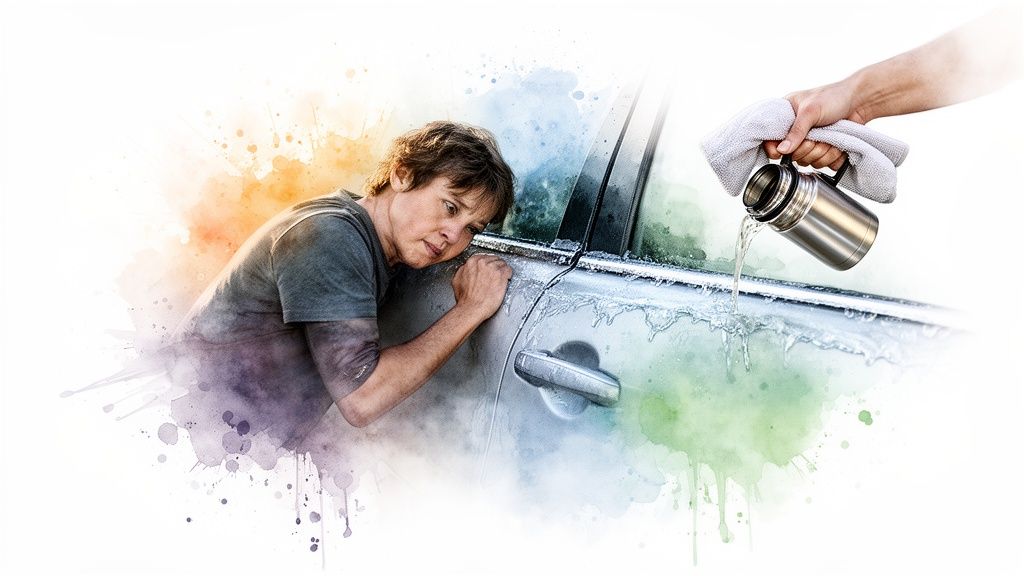
If pushing and tapping hasn't worked, it’s time to bring in some gentle warmth. This is where a lot of people go wrong, though. Never, ever use boiling or even hot water. That sudden, extreme temperature shock can easily crack your car windows or damage the paint. It's a costly mistake.
It’s shocking how many people don't realise the risk. Research actually found that a staggering one in five drivers in Greater London admit to using boiling water on their cars. If you're curious, you can read more about these de-icing statistics and see just how widespread these risky habits are.
Here’s the safe way to do it: grab a jug and fill it with lukewarm water. It should just feel slightly warm on your hand, nothing more.
Carefully pour the water along the top and sides of the door, letting it run down into the gap between the door and the frame.
Give it a minute or so to work its magic and melt the ice.
Now, try the handle again, gently. You might need to pour a second jug.
This next bit is crucial. As soon as you get the door open, you have to dry the whole area immediately. Grab a towel and thoroughly wipe down the rubber seal and the metal door frame. If you skip this, all that water you just poured will refreeze, potentially leaving you with an even worse problem. A quick wipe-down makes all the difference.
How to Deal with a Frozen Car Lock
So, you’re standing by your car, key in hand, but it won’t go into the lock. Or maybe it slides in but stubbornly refuses to turn. If that’s the case, you’ve found your culprit: the lock cylinder itself has frozen solid. This is a different beast to a frozen rubber seal and needs a more delicate touch. The goal here is to gently melt the ice inside the mechanism without causing any damage.
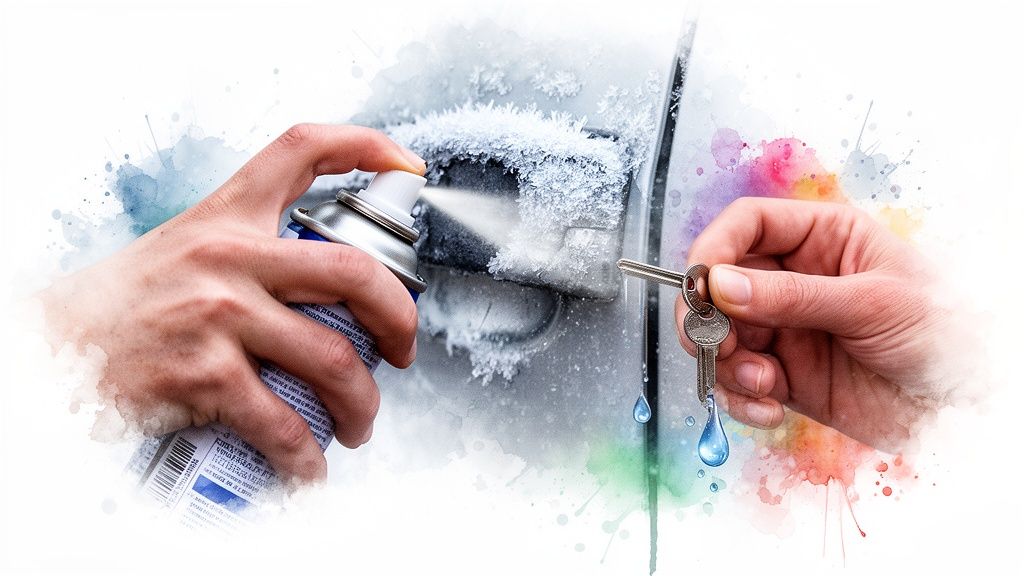
Without a doubt, the fastest and safest fix is a proper commercial lock de-icer. These sprays are made for this exact situation and usually come with a thin straw so you can get the fluid right where it needs to be – deep inside the keyhole. A quick blast is often enough to dissolve the ice in seconds, getting you back on the road in Atherstone or Ashby de la Zouch in no time.
DIY De-Icing Tricks That Actually Work
But what if you don't have a can of de-icer in your pocket? No worries. A couple of common household items can get you out of a jam.
Believe it or not, a bit of hand sanitiser works wonders. Its high alcohol content is great for melting ice. Just dab a small amount onto your key and gently work it into the lock. A little wiggle back and forth is all it should take to feel the mechanism loosen up.
Another old-school method is to carefully heat your car key's metal blade. Grab a lighter or a match and warm the metal for a few seconds. You want it warm to the touch, not red hot. The idea is to transfer just enough heat from the key to the lock to melt the stubborn ice inside.
Crucial Safety Tip: Be really careful with this one. If your key has a plastic fob or an electronic chip, only ever heat the metal blade. Getting the plastic bit too hot can melt the housing or, even worse, fry the delicate transponder chip inside. That turns a frozen lock into a much more expensive problem.
When to Be Extra Cautious
Whatever you do, don't resort to brute force. I’ve been called out to jobs in places like Walsall and Wolverhampton where someone has tried to force the key, only to hear that sickening snap as it breaks off in the lock. Now you’re not just locked out; you’ve got a broken key to deal with, which needs an expert to remove. Trying to force it can also wreck the delicate pins inside, meaning you'll need a whole new lock. If you do end up in that sticky situation, our guide on how to extract a broken key from a lock has some vital tips on what to do.
A few things you should absolutely avoid:
Never pour boiling water on a lock. The sudden temperature shock can cause damage, and it will just refreeze, possibly worse than before.
Avoid blowing into the lock. The moisture from your breath will just add more ice to the problem.
Don't try to pick the ice out with a screwdriver or pin. You’re almost guaranteed to damage the lock mechanism.
For anyone managing a fleet of vehicles in Cannock or Coventry, a smart move is to keep a few cans of de-icer at the depot. It's a tiny investment that can prevent major delays and expensive call-outs on those frosty winter mornings, keeping your drivers on schedule.
How to Stop Your Car Door from Freezing in the First Place
Let’s be honest, the best way to deal with a frozen car door is to make sure it never freezes shut. A bit of prep work in the autumn can save you a massive headache on a frosty morning. Taking a few simple steps now means drivers from Tamworth to Solihull can hop in their cars and get on their way, no drama involved.
So what's the enemy here? It's moisture. Water gets on the rubber seals, the temperature plummets, and bam—you're locked out. The goal is to create a barrier that tells water to get lost before it can turn to ice. It’s a five-minute job that genuinely works wonders.
A Bit of Pre-Winter TLC for Seals and Locks
Think of this as winter-proofing the bits of your car that let you in. A tiny investment in time and a couple of cheap products will keep everything working smoothly when the mercury drops.
Look After the Rubber Seals: Get yourself a can of silicone spray or a proper rubber conditioner. Don't spray it directly on the car! Spray a little onto a clean cloth and wipe a thin, even layer over all the rubber seals around your doors, boot, and even the windows. This creates a water-repellent surface, stopping ice from gluing the rubber to the metal frame.
Lubricate Your Locks: The old-school lock mechanism needs love too. A quick squirt of graphite-based lubricant directly into the keyhole is the way to go. It pushes out any moisture and stops the internal pins from seizing. It’s a much better choice than something like WD-40, which can actually attract dirt and gunk up the works over time.
Here’s a top tip: after a car wash or a heavy downpour, give your door seals a quick wipe with a dry cloth before you leave the car for the night. Getting rid of that surface moisture before it has a chance to freeze is a simple habit that makes a huge difference.
Smart Habits for Chilly Weather
It’s not all about products; changing a couple of small habits can also prevent a freeze-up. For example, we all love blasting the heater on a cold day. But that warm, moist air inside the car can condense on the seals and freeze after you park up.
A neat trick is to run the air conditioning for the last few minutes of your journey. It sounds counterintuitive, but the AC is a brilliant dehumidifier and will pull that excess moisture out of the cabin air.
For those of you with electric cars, winter throws a few extra curveballs your way, and it’s not just about the doors. Getting to grips with the proper operation of an electric vehicle in winter can offer a broader perspective on cold-weather care. Things like battery management and charging strategies are just as important as keeping your seals from freezing. It’s all part of making sure your entire car is ready for the cold snap.
When It's Time to Call in the Experts
Let's be honest, sometimes you’ve tried everything. You’ve used the lukewarm water trick, given the door a firm (but gentle) push, and even blasted it with de-icer, but it’s still frozen solid. Or, even worse, you hear that dreaded snap of a key breaking off in the lock.
This is the point where your DIY efforts can do more harm than good. Forcing a frozen handle is a surefire way to break the plastic mechanism inside, turning a simple problem into a costly repair job. And if your key fob is playing up because of the cold, poking around can easily create a much bigger electrical headache.
When you're properly stuck, the smartest and safest thing you can do is call for professional help.
Dodging Damage and Injury
This isn't just about protecting your car; it's about protecting yourself. Wrestling with a stubborn door while standing on an icy patch is just asking for a bad fall.
If you find yourself stranded in Lichfield, Sutton Coldfield, or Cannock, a mobile auto locksmith is your best option. We can get you back into your car safely and without causing any damage, often much quicker than you might think.
Calling a professional isn't giving up. It’s making a smart call to stop a small hassle from becoming a huge expense or, worse, a trip to A&E.
Our mobile service is built for exactly these kinds of situations. We’re out and about in areas from Burton Upon Trent and Solihull to Coventry and Atherstone, offering a fast, damage-free fix. Trust me, we’ve seen it all—from keys snapped clean off in Ashby de la Zouch to key fobs that have given up the ghost in Coleshill.
Instead of running the risk of damaging your vehicle, let us sort it out. If you're not sure who to trust in an emergency, have a look at our guide on finding reliable auto locksmith services near you for fast help for some practical advice. For anyone stuck around Birmingham, Nuneaton, Walsall, and Wolverhampton, our team is always ready to get you moving again, safely and quickly.
Troubleshooting Guide: What to Do If Nothing Works
You've tried the gentle push, the lukewarm water, and the de-icer, but the door won't budge. Before calling for help, run through this quick troubleshooting checklist.
My Door is Unlocked But Still Won't Open
Problem: The ice bond on the rubber seal is thicker than you thought.
Solution: Try another door. Can you get in through a passenger door or even the boot? Once inside, start the car and turn the heating on full blast. The warmth will eventually melt the ice from the inside out. This is often the safest method if you have a few minutes to spare.
My Key Turns, But the Handle Feels Loose or Spongy
Problem: The handle mechanism itself might be frozen, or worse, the cable connecting the handle to the latch could have snapped from being pulled too hard.
Solution: Do not pull any harder. This is a clear sign to stop. Try one of the other doors. If you can get inside, you might be able to open the frozen door from the interior handle. If that fails, it’s time to call a professional as the mechanism may be broken.
I've Tried Everything and I'm Still Locked Out
Problem: You could be dealing with a combination of a frozen seal and a frozen lock, or a more serious mechanical failure that has coincided with the cold weather.
Solution: At this point, further attempts risk causing damage. This is the moment to call an auto locksmith. A professional has the right tools and expertise to diagnose the issue and open the door without breaking handles, tearing seals, or damaging the lock.
Frequently Asked Questions (FAQ)
Every time the temperature plummets, our phones start ringing. Here are a few of the questions we get asked the most by drivers across the areas we serve, including Birmingham and Wolverhampton.
Can I use boiling water on my car door or windscreen?
Please don't. It’s a definite no-go. Pouring boiling water onto frozen glass or paintwork is a recipe for disaster. The sudden, extreme temperature shock can easily crack a windscreen, ruin your paint, and even warp the rubber seals around your doors. What starts as a simple problem can quickly turn into a very expensive repair bill (£££). If you must use water, make sure it’s only lukewarm and apply it carefully to the rubber seals—never directly onto the glass.
Why is my keyless entry not working in the cold?
Frustrating, isn't it? Extreme cold is the enemy of batteries, and the small one inside your key fob is particularly vulnerable. When the temperature drops, the battery's power can weaken to the point where its signal is too faint for your car to pick up. Try holding the fob right up against the door handle or the engine start button. Sometimes, that's enough to get it to work. If not, it’s probably time for a new battery. Don't forget, most key fobs have a hidden physical key tucked away inside them for exactly these situations. We cover this in more detail in our guide on how to unlock your car without keys.
Is it safe to use cooking oil spray on the rubber seals?
It's better to avoid it. While it might seem like a good idea, cooking oils can degrade rubber seals over time, making them brittle and less effective. Stick to a proper silicone spray or rubber conditioner, which is specifically designed to protect and lubricate the seals without causing long-term damage.
It's worth remembering that your car insurance probably won't cover damage caused by trying to de-ice your car with the wrong method. Using boiling water could be classed as negligence, leaving you to foot the bill. Stick to safe techniques or call in a professional.
If you're stuck and just want to get back into your car without causing any damage, Top Motor Keys offers a 24/7 mobile service across Tamworth, Lichfield, Sutton Coldfield, Cannock, Burton Upon Trent, Solihull, Coventry, Atherstone, Ashby de la Zouch, Coleshill, Nuneaton, Walsall, Wolverhampton, and Birmingham. Don't risk it—give us a call, and we'll have you safely on your way in no time. Find us at https://www.topmotorkeys.co.uk.